Showing posts with label Holy Matrimony. Show all posts

Could It Be That Jesus Had a Wife?

0 comments
While seminary life prevents me from being able to post as often as I used it, it also connects me with a whole world of thoughtful, orthodox Catholic thinkers in the form of professors, formators, and fellow seminarians. I wanted to take a moment to highlight one of them, a fellow barbate seminarian for Kansas City, Kansas: Deacon Nathan Haverland.  Below is the homily that he gave this past Sunday at St. Clement of Rome parish, here in St. Louis.  

Ordinary Time
27th Sunday - Year B
October 7, 2012

Deacon Nathan Haverland
Our readings this Sunday invite us to reflect on the topic of marriage. They are readings that are just as relevant today as they were when they were written. Not long ago Blessed John Paul II used them as the basis for 129 talks given over 5 years in what is called the “Theology of the Body.” There’s a great richness to the readings given to us today.

The Pharisees were out to trick Jesus and so they asked Him if divorce was permissible. By this point, you would think that the Pharisees should have expected that Jesus would not fall into their trap. But they didn’t, and Jesus gave them an answer they never expected. Jesus recognized the law written by Moses, but He invites the Pharisees to look at a law written much earlier: the law written in nature. Yes, the Mosaic Law allowed divorce, He said, but that was because of the hardness of man’s heart. There is law much older than the law of Moses that was not written out of the hardness of man’s heart.

 From the very beginning God had a plan for humanity, a plan that He wrote into the very depths of our human nature. Jesus says clearly, “From the beginning of creation, God made them male and female...the two shall become one flesh...what God has joined together, no human being must separate.” Jesus is the Word of God “through whom all things exist.” He is the Word of God that existed from the beginning. Jesus certainly then has authority on the matter of how things were from the beginning.

Jesus explained to the Pharisees that the indissoluble union of a man and woman was always a part of God’s plan. From the beginning, he wrote this plan in the depths of our physical and psychological nature. From the beginning, man has always pointed towards woman, and woman has always pointed towards man. If viewed alone, neither man nor woman make sense. But viewed together, they show that each is designed to be a gift of self to the other. They compliment each other perfectly. From the beginning, God had a plan to unite man and woman so intimately that they would become one flesh, a union that God has bestowed with the capacity of producing new life.

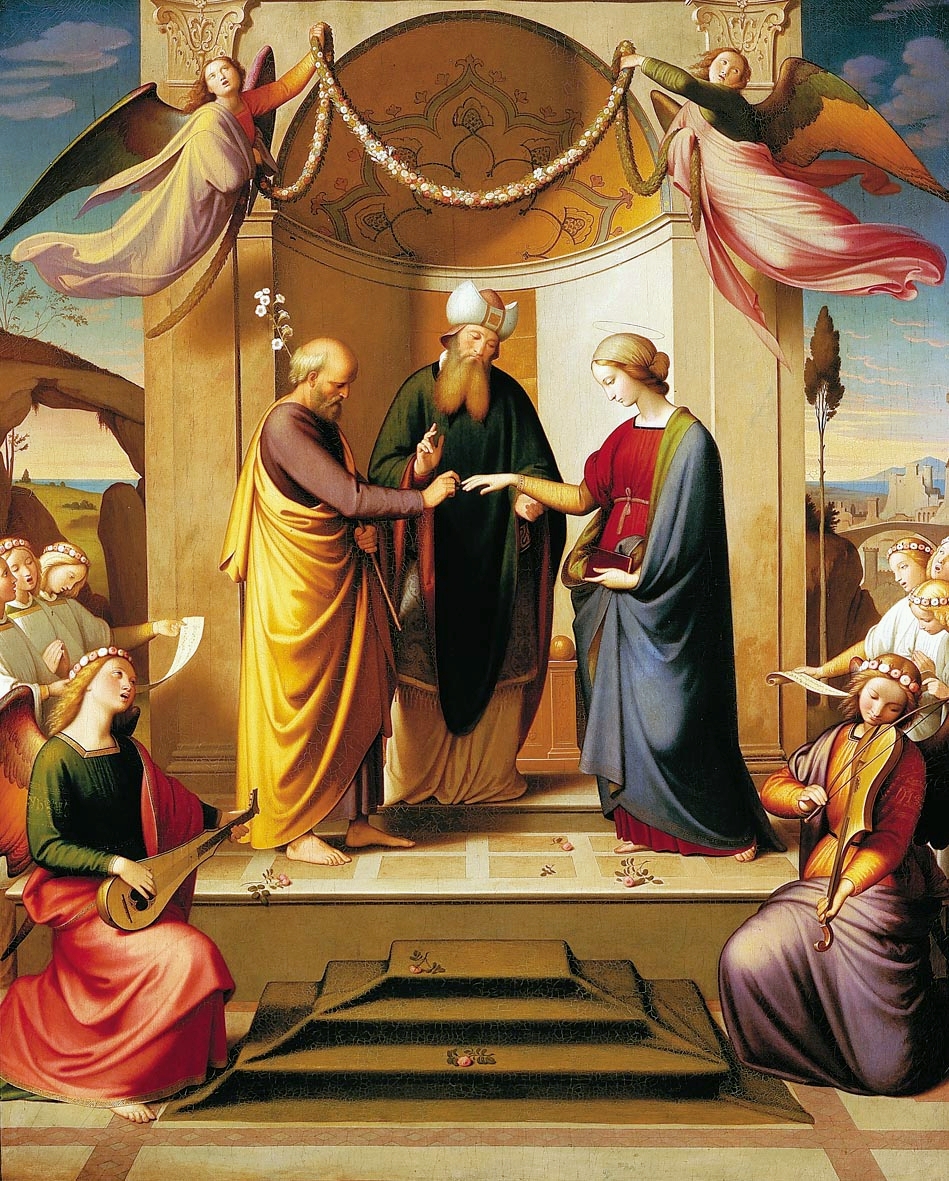
Johann Friedrich Overbeck, Marriage of the Virgin (1836)
Marriage has never been easy though. Moses saw this himself. The giving of one’s self to another for a few moments is one thing, but giving of one’s self to another over the course of a lifetime, that is a challenge. Selfishness can easily creep into marriage and slowly eat away at that union made by God. But, it is only in giving of ourselves that we will truly be happy. Selfishness can never bring about happiness.

Why did God write this in our human nature?

A few weeks ago Jesus made big news all around the world. This time, a small fragment from an unknown document, from an unrevealed source, from an uncertain time period, analyzed by a scholar with a questionable intention, just happened to have an incomplete sentence referring to someone named Jesus mentioning a wife. This caused quite a stir all over the world. Could it be that Jesus had a wife?

We don’t have to look any further than the New Testament to see that Jesus did indeed have a Bride. Jesus is the Bridegroom in the New Testament, and the Church is His Bride. Just as Eve was born from the side of Adam, the Church was born from the side of the New Adam, Jesus, on the Cross. Jesus does indeed have a Bride, and at each Mass He gives Himself body, blood, soul, and divinity to His Bride. This intimate union of God with man is what marriage has always foreshadowed. Here, at the altar, that union between God and man becomes realized. The two truly become one flesh.

This union of Christ with the Church has always brought about tremendous amounts of new life throughout the ages. We see this, for example, in the life of the saints. They are children of God who lived life to the fullest. This morning in Rome, our Holy Father proclaimed two new doctors of the Church: a german nun named St. Hildegard and a spanish priest named St. John of Avila. This is a title rarely given to a saint. Of all the saints that the Church has had over the past 2,000 years, the total number of doctors of the Church is now only up to 35.

This Thursday will mark the 50th anniversary of the opening of the Second Vatican Council and the 20th anniversary of the publication of the Catechism of the Catholic Church. The Holy Father will use that day to begin a “Year of Faith” in the Church in which he has called for “a summons to an authentic and renewed conversion to the Lord.” These new doctors of the Church and this “Year of Faith” will certainly be sources of new life coming from that union of Christ and the Church.

We give thanks this Sunday for the gift of marriage. And we pray that all marriages will come to image that selfless and unending love of Christ and the Church.

Saint Thérèse of Lisieux's Parents and Vocational Discernment

0 comments
Louis Martin, Thérèse's father
I've finally gotten around to reading St. Thérèse of Lisieux's autobiography, The Story of a Soul. It's a great read, but one of the things that fascinated me was actually from the introduction, which gave some background on Thérèse's family.

Thérèse's parents were holy, and wanted to give their entire lives to God.  When they were younger, each of them had pursued the religious life, going so far as to apply to particular orders. Thérèse's mother, Zélie Guérin, applied to the Sisters of Charity of St. Vincent de Paul, while Thérèse's father, Louis Martin, applied to the Augustinian Monastery of the Great St Bernard.  Both of them were rejected.

Zélie ended up becoming a lacemaker, while Louis became a watchmaker.  Externally, this would seem to be something of a failure -- making lace and watches seems to have little to do with bringing glory to God, particularly in comparison with being a monk or a nun.  Eventually, in 1858, Zélie and Louis met, fell in love, and three months later, married.  At first, the two did not consummate the marriage - they wanted a spiritual marriage, living as brother and sister in a non-sexual relationship.  After nine months, at the insistence of their confessor, the marriage was finally consummated.

In all, Louis and Zélie gave birth to nine children.  Three of them died in infancy, and a fourth at the age of five.  This left five children, all daughters: Marie, Pauline, Léonie, Céline, and the baby of the family, Thérèse.  Prior to Thérèse's fourth birthday, her mother, Zélie, died of breast cancer, leaving Louis to raise the four girls.  Each of them would go on to become nuns, and Thérèse, of course, went on to become the 33rd Doctor of the Church.

I think that the lives of Zélie and Louis help illustrate the mysterious way in which marriage and family are intertwined with celibacy and the religious life. The Catechism remarks on this in CCC 1620, which says:
St. Thérèse of Lisieux
Both the sacrament of Matrimony and virginity for the Kingdom of God come from the Lord himself. It is he who gives them meaning and grants them the grace which is indispensable for living them out in conformity with his will. (Cf. Mt 19:3-12.) Esteem of virginity for the sake of the kingdom (Cf. LG 42; PC 12; OT 10.) and the Christian understanding of marriage are inseparable, and they reinforce each other:

“Whoever denigrates marriage also diminishes the glory of virginity. Whoever praises it makes virginity more admirable and resplendent. What appears good only in comparison with evil would not be truly good. The most excellent good is something even better than what is admitted to be good.” (St. John Chrysostom, De virg. 10,1:PG 48,540; Cf. John Paul II, FC 16.)
Marriage is an amazing good, for the benefit of man, and for the glory of God. Celibacy for the sake of the Kingdom of God is an even superior good. But the greatest good is to do the will of God. For Louis and Zélie, this meant the married life.  And through marriage and family, they accomplished much more than they likely would have as a simple nun and monk: together, they gave the world one of the greatest Saints of all time.

In discussing vocations, it's helpful to speak of the primary vocation and secondary vocation.  The primary vocation is simple.  You're called to be a Saint.  Doesn't matter who you are, what your strengths or weaknesses are, or what your state of life is.  God designed you to know, love, and serve Him, and to enjoy eternity with Him.  That's what sanctity is.  The secondary vocation, whether you're called to be a priest, monk, nun, father, mother, or a single man or woman, flows out of the first: it's the way that you're called to live out your primary vocation.  Louis and Zélie didn't end up with the secondary vocations that either of them anticipated for themselves.  But by staying loyal to God throughout, they lived out inspiring and holy lives, and raised a saintly family.  The Church recognized this, not only in canonizing their daughter, and declaring her a Doctor of the Church, but in beatifying Louis and Zélie themselves.

John Paul II vs. Hugh Hefner: Take Two

0 comments

Christopher West, renowned speaker and author, found himself in a bit of a controversy in 2009 after an interview on ABC News about his understanding of Bl. John Paul II's "Theology of the Body." After a six month sabbatical, West returned to the public stage with a new format and tone. The result is FILL THESE HEARTS: God Sex and the Universal Longing. This new production is promoted as "an evening of beauty and reflection on John Paul II's Theology of the Body." I jumped on the opportunity to attend the October 29th presentation of FILL THESE HEARTS in Overland Park, Kansas. The night was co-sponsored by the Archdiocese of Kansas City in Kansas and filled the theater at a local community college.

As a parish priest that regularly works with youth, engaged couples, and married folks, I often use West's works on the "Theology of the Body" to foster a better appreciate of the nuptial meaning of the body and the deep longing for union with God that is part of the universal human experience. I'm still running off the fumes from the workshop West gives to seminarians at the Institute for Priestly Formation. I make sure each engaged couple I work with has two copies of the Good News about Sex and Marriage. The first of many books I have shared with our own Joe Heschmeyer was West's Theology of the Body for Beginners. I'm definitely a fan of his work. However, I'm even more of a fan of his humility. West is not afraid of looking at his own work with a critical eye. He has updated and revised a number of his books. After receiving criticism following the ABC News interview, West made a public statement in which he admitted some shortcomings to his approach. While maintaining that the interview misrepresented his approach and message in many ways, he stated, "I want to thank those of you who offered thoughtful critiques of my work and helpful suggestions on how to improve it. I have taken them to heart. Indeed, I have always weighed my critics' observations carefully and prayerfully. They have helped me refine my approach a great deal over the years and I remain very grateful for that."


In FILL THESE HEARTS, Christopher West presents the most current refinement of his approach. As is the case with any authentic reform rooted in real humility, the new approach is worth the purification process that preceded it. West and his team have gone all out to make the new presentation an experience that engages that ache each person has for nuptial union. Centered in a deep appreciation of beauty, the program features an adept use of music, visual art, dance, and film. Mike Mangione and The Union provide the live soundtrack for the evening that challenges the audience to go beyond being entertained and risk meditating. West blends the thoughts of Bl. John Paul II, Pope Benedict XVI, Bishop Fulton Sheen, and St. Teresa of Avila with his own experience and love of the "Theology of the Body." The result is an intense opportunity to take seriously the desire for union that is glimpsed on earth and fulfilled in Heaven. I was especially taken by how West presents Jesus and Mary as the New Adam and New Eve. I would sacrifice another evening just to experience that one meditation again. Considering the additional reflections on the Eucharist, the challenge of sharing the "Theology of the Body," celibacy for the sake of the Kingdom, and the beauty of marriage, FILL THESE HEARTS is a comprehensive but accessible experience. He even takes on the connection between Bl. John Paul II and Hugh Hefner that drew so much ire after his controversial interview. I'm glad he did. I'm also glad his humility is for real. FILL THESE HEARTS is the fruit of that humility and it is very good fruit. It's definitely worth attending. If it's not scheduled to come to a nearby location, it's even worth finding out what it would take to become part of the tour. To ensure that the experience isn't wasted, each person in attendance also receives a high quality 30 page program that contains the complete outline and "notes" for the entire evening, song lyrics and art. Overall, FILL THESE HEARTS accomplishes Christopher West's goals of adopting a new tone and sharing the brilliance of the "Theology of the Body" in a compelling way.

Mormons at Your Door: Evangelizing the Missionaries

0 comments
Yesterday, I talked about some of the basics for what to expect when Mormon missionaries come to the door.  Today, I'm going to take some examples from a real life encounter with Mormon missionaries to show how you can use it as an opportunity to Evangelize them.

On Wednesday, my friends Cary and Meg had invited me to join them at dinner with a couple of Mormon (LDS) missionaries.  During dinner, we talked about their lives and about their mission. Afterwards, we move over to the couch, and got down to the nitty-gritty of the things which unite and divide us.  It really was a blessing to have two missionaries as open to listening as these two men were. I'm not sure if we helped at all, but I think the Holy Spirit was able to use us a bit . In any case, here are the basic arguments we raised; I'd love to hear feedback about how strong or weak you feel each one is.

I . The "Great Apostasy" and Apostolic Succession

Cary went right for this one, because he'd been reading about it, and was genuinely confused by the Mormon position. In a nutshell, here's the LDS position:
Mormonism teaches that not long after Jesus Christ's lifetime, internal rebellions within the early Christian community caused the primitive Christian Church, led by the Twelve Apostles to disappear and be replaced by many factions, each of which had pieces of the truth, but not a fullness. More importantly, this falling away (see 2 Thessalonians 2:3) resulted in a loss of authority, which Mormons call Priesthood. Without proper authority from God, man cannot perform the ordinances of the Church. [...] 
Many of the Apostles and righteous members of Christ’s Church were killed by the wicked, and the priesthood along with Christ’s Church were taken from the earth. Persecution of those who were called Christians began in about the first century by the Roman Empire. Revelation could no longer be received on behalf of the Church, because there was no one authorized by God to receive it, although individuals could and continued to receive inspiration in their personal lives. [...] 
The Restoration, a necessary event after an apostasy, came about through Joseph Smith. In the spring of 1829, while translating the Book of Mormon, Joseph Smith and Oliver Cowdery were visited by heavenly messengers who restored to them the Priesthood, the authority to act in God's name. In 1830, the Church of Christ, as the Mormon Church was originally called, was organized officially. The authority to act in God’s name was restored, as was true doctrine. Latter-day Saints believe there are again Apostles on the earth, and a Prophet who guides the Church of Christ through revelation and the power of the priesthood. 
So in about 95-105 A.D., the Church which Jesus promised wouldn't be overcome by the gates of Hades, death (Matthew 16:17-19), was overcome by the death of the last Apostle, St. John.  But then the Church was restored through Joseph Smith, and it hasn't been wiped out again.

The missionaries explained that the early Church died out because of the wickedness of the people. If Mormons thought Catholics were wicked God-hating apostates, this view would make sense. But that's not the view they take these days.  They tend to think that the early Catholics were God-fearing, but just didn't have the full truth.  In fact, they think that these early Christians (1) more or less recognized which Books were the word of God (the Old and New Testaments), and (2) preserved these Books carefully. The Mormon Joseph Smith Edition of the Bible is based off of the King James Version, which is based off of the early Christian manuscripts. The JSE makes a few minor tweaks, but it's very close to the KJV.

So we're left to believe that there were early Christians trying to follow God, and doing a pretty good job of it (preserving the Bible, going to the death for the faith, and all that), yet who God considered too wicked for the Church to remain with.  If they're too wicked to be trusted with the Church, how can we trust them with the Bible?   We raised a few major points in response to these Apostasy/Restoration claims:

  1. Why was Joseph Smith able to carry on the Church and Jesus wasn't?  Jesus personally founded the New Testament Church in Matthew 16:17-19, and calls it His Church.  Within the Mormon view, God's own Church died out faster than 8-track tapes.  Cary asked why this view didn't elevate Joseph Smith over Jesus.
  2. Doesn't this view leave Mormonism's status in serious question?  If the early Church unwittingly fell into a total Apostasy, who's to say that it hasn't happened again?
  3. The third pope was already in Rome by the death of St. John. Cary mentioned this, but I thought his point was great.  By the time the Apostle John dies, we know from Church history that Peter (who'd died about thirty years before) was succeeded by Popes Linus and Clements. If the papacy was a false Church, and if the rest of the bishops throughout Christendom were phonies, why didn't the Apostle John say anything to condemn them?
  4. Jesus praises the early Church. Not only do we see, from the Book of Acts, a Church which is on fire for Christ and rapidly growing, but even by the end of John's life, the Church is still pleasing God. Just read the praises bestowed in the Book of Revelation, perhaps the last-written Book of the Bible.  In Revelation 1, Jesus tells St. John to deliver specific messages to each of the seven area churches.  And He's got mostly good things to say to the churches in Ephesus, Smyrna, Pergamum, Thyatira, and Philadelphia. Sure, the Church, both locally and globally, had / has / will have problems, but Jesus is encouraging these Christians, not denouncing their wickedness.
This last point is important, I think, because it basically disproves the Mormon case for the Great Apostasy.  If, towards the close of the Apostle John's life, there are still worthy men following Christ, men who Jesus Christ Himself announces that He's pleased with, there are surely men to draw the next generation of Church leaders from.  The Mormon claim that these Christians were simply too wicked runs headlong into the praises bestowed by Jesus.

II. Abortion

One area where most Mormons are excellent is morality. The two missionaries we spoke to had no problem denouncing abortion as murder, and saying that even in the tough cases (rape, incest, etc.), there are better options. In fact, they pointed to the numerous social services which the LDS Church provided.   I said, "I thought your church permitted abortion in some circumstances?" and they denied it.  At this point, I read from the official LDS website:
Church leaders have said that some exceptional circumstances may justify an abortion, such as when pregnancy is the result of incest or rape, when the life or health of the mother is judged by competent medical authority to be in serious jeopardy, or when the fetus is known by competent medical authority to have severe defects that will not allow the baby to survive beyond birth. But even these circumstances do not automatically justify an abortion. Those who face such circumstances should consider abortion only after consulting with their local Church leaders and receiving a confirmation through earnest prayer.
So in fact, while most Mormons are very pro-life, the LDS Church is much less so.  Cary then asked, "Wait, so is murder sometimes okay?"  The two missionaries were clearly unaware that their church taught this, and seemed troubled by it.  One of them speculated that the local church leaders wouldn't permit an abortion, despite what it said, but I don't think he even convinced himself.

III. Disarming Their Best Weapons

Mormon missionaries are apparently trained to fall on a few stock answers: to "pray on it," or "I can feel in my heart it's true" or some similarly non-falsifiable claim. If they're not trained to do this, it's at least the common refrain I've heard from countless Mormons I've talked theology with.  So if you're going to move ahead with a discussion, it's important to take it out of the realm of the subjective and the non-falsifiable. Otherwise, as long as Mormonism "feels right," the person you're talking to will never move towards a fuller Christianity.

In other to move past these fall-backs, we talked about how the LDS think that non-Mormons still have some truth, and that the Holy Spirit still works through these other denominations or churches. They conceded that it wasn't as if all the Catholics and Protestants were acting in bad faith, or that Catholic and Protestants don't pray. So we talked about the phenomenon of a Catholic, a Baptist, and a Mormon each praying, and each walking away thinking that God's telling them different (contradictory) things. We were careful to note that yes, we should pray, and yes, God does communicate to us through prayer, but we explained that as Catholics, we saw prayer alone as fallible, since it's easy to mix up what God's telling us, and what we want God to be telling us.

IV. Polygamy and Contradictions

Most people's argument about Mormon's one-time fling with polygamy (what they refer to as "plural marriage") goes something like this: "You used to do polygamy. The Bible says polygamy is bad. You're wrong." That argument is weak.  After all, we see polygamy in the Old Testament, and much of it goes uncondemned by God (we talked about that in the comments here, by the way).  The Mormon answer is that just as the Jews are forbidden to eat pork, but not Christians, it's possible that plural marriage is right or wrong for specific people, given the particular culture and context.

So  here's the approach I took to the question, instead, with a Q&A with the senior of the two missionaries that went something like this:

  • Q: Can God contradict Himself? [I genuinely didn't know the Mormon answer to this, so this wasn't just a set-up].
  • A: No
  • Q: So I can see how God could theoretically say that plural marriage is right for David and not for Solomon, or vice versa, but can God says that plural marriage is both right for Solomon and wrong for Solomon?
  • A: No, that would be a contradiction.
I then read from the Book of Mormon, Jacob 2:24,
Behold, David and Solomon truly had many wives and concubines, which thing was abominable before me, saith the Lord.
We all agreed that sounded quite clearly like the Book of Mormon was saying that God was condemning David and Solomon's plural marriages as an abomination. Then I read from Doctrines & Covenants 132:38-39
David also received many wives and concubines, and also Solomon and Moses my servants, as also many others of my servants, from the beginning of creation until this time; and in nothing did they sin save in those things which they received not of me. 
David’s wives and concubines were given unto him of me, by the hand of Nathan, my servant, and others of the prophets who had the keys of this power; and in none of these things did he sin against me save in the case of Uriah and his wife; and, therefore he hath fallen from his exaltation, and received his portion; and he shall not inherit them out of the world, for I gave them unto another, saith the Lord.
Yup, this passage says that not only was David and Solomon's taking of plural wives not an abomination, it was not even a sin; and not only was it not a sin, these women were given to David by God. Bathsheba, the wife of Uriah, is the only exception.  At this point, the senior missionary protested that he wasn't a "Scriptorian," and realized it had gotten late and that they had to leave.

A Final Point: The Importance of Charity

While we had, as the above post shows, some obvious points of disagreement, the single most important thing to remember when dealing with Mormons (or anyone) is to do it lovingly.  Name-calling, just telling them they're a "cult," or "not Christian," or anything else, is unhelpful. It might make us feel superior, but if we're genuinely concerned for their spiritual well-being, do for them what you would want done for you.  Would you be convinced by someone simply blowing off your religion?   So be prepared to make a defense of orthodox Christianity, and of Catholicism particularly, but do so with "gentleness and reverence" (1 Peter 3:16).  I can just about guarantee you that the Mormons are so used to being treated poorly by the folks they're meeting door-to-door that a genuine Christian witness done in charity will be a drink of cold water. That doesn't mean you have to compromise the Truth -- quite the opposite. If you truly love someone, you'll want them to be on the right track towards God.

We were fortunate because while Cary and I were pointing out many of the areas on which we disagreed, Megan balanced us out by talking about some of the great things about Mormonism, as well as many of the things we have in common. Her presence meant that there wasn't any "ganging up," and I'm quite thankful she was there. It's important for someone to accentuate the positive for a couple reasons. One, if you come across as simply argumentative, they're going to leave. And two, your goal isn't to just disprove Mormonism. You don't want some poor missionary leaving an atheist.  Rather, it's to show how Catholicism is the fulfillment of those truths which Mormonism has.

That is, Mormons are great at recognizing the importance of Apostolic succession, of a central Church hierarchy, of a leadership guarded by the Holy Spirit, of speaking the Truth in love, and so on. Showing that Catholicism affirms all of these things, without suffering from the many flaws within Mormonism, makes the Church an obvious candidate to look to if a Mormon starts to wonder exactly how his Church can both condemn and condone the murder of unborn children, or claim that God both praises and detests David and Solomon's many wives.

You might find yourself in the position of trying to do both of these things at once: show how we're similar, and show how we're different (and right).  It's a hard balance to strike, and I can nearly guarantee you'll have a strong sense of l'esprit de l'escalier after you say good night.  Certainly, there are a number of things I wish had been said, or said differently.  God understands.  Finally, remember that "One sows and another reaps" (John 4:37).  It's easy to let pride lead you to think you can convert someone, from start to finish, in an hour.  You almost certainly can't. So just do your part, and let God do the rest.

Understanding Sex Through the Mystery of the Trinity

0 comments
One of my friends has been trying to explain the Theology of the Body to one of his friends, and asked for a good way to explain what Catholics mean when we say that sex should be "unitive and procreative."  What we mean is that:

  1. Unitive: Sex should draw the husband and wife together into a more perfect union with each other; that through it, "the two become one flesh" (Genesis 2:24), in a way fully knowable only to God.
  2. Procreative: Sex should call forth new life, or at least be open to it.  Authentic love isn't jealous, it's creative.
To understand sex, I think you need to understand the Trinity.  In the Trinity, God the Father loves God the Son, the Son is Beloved, and the manifestation of that Love is the Holy Spirit. Fr. Barron does a good job explaining that here. It's precisely because of that Love that God made the Universe and everything and everyone in it. So the Trinity is both a Unity and Creative. So the very same love that draws the Father and Son into an unbreakable Divine unity is the love that causes them to create the universe.

Our love should be like that. When a husband loves his wife, the two really do become one flesh, and that physical and spiritual intimacy should desire to produce new life.  This willingness, and even desire, to produce new life is a sign that this is something spiritually healthy, rather than simply hedonistic. 

So in marital sex, the two become one (Gen. 2:24), but the two also become three, when their love takes the form of an unborn child.  So sex is designed to be cause the two individuals to form into something better, something both three and one, a reflection of how the Trinity is both Three and One.  So each child brought into the world in this way is stamped with an image of the Trinity simply in his conception.

It's why we can speak of the Trinity as the first Family: each Member of the Trinity pours Himself out completely for the other Two.  Just read the Scriptures, and you'll see that instead of proclaiming their own greatness, each Person of the Trinity focuses on how great the other Two are:
  • The Father praises the Son in Matthew 3:17 and Matthew 17:5, and is the One who testifies about Him (John 5:31-32);
  • The Son does the will of the Father (John 5:19-20), while refusing to testify on His own behalf (John 5:31-32);
  • The Father pours out the Holy Spirit upon the Son, while the Son then pours out the Spirit upon us (Acts 2:33).
  • Perhaps the highest complement that Jesus can pay is paid to the Holy Spirit: "It is for your good that I am going away. Unless I go away, the Counselor will not come to you"  (John 16:7);
  • The Holy Spirit is sent by the Father, in the name of the Son, and teaches us about the Son, Jesus (John 15:26), and it's only through the Holy Spirit that we can say that Jesus is Lord (1 Corinthians 12:3);
  • The Spirit offers the Sacrifice of the Son on Calvary to the Father as atonement for our sins (Hebrews 9:14);
  • The Holy Spirit leads us to the Father (Galatians 4:6; Ephesians 2:18).
Just look at Jesus praising the Father while filled with joy through the Holy Spirit (Luke 10:21), and you have a perfect image of Love.  The Father is sending forth His Holy Spirit, the Holy Spirit is filling Jesus with love, and Jesus is pouring out praise for His Father. Jesus immediately praises their Trinitarian Unity (Luke 10:22).

This is one of the reasons that contraception is wrong.  Using contraception to attempt to stop the procreative aspects of love while taking the other aspects is a perversion.  We're trying to control and contain love: allow the two to become one without allowing them to become three.  It just doesn't work -- couples who contracept are at a much higher risk of divorce than couples who don't.  Instead of pouring yourself out completely for your spouse, you're holding something back.  

If a man sat down to a meal, chewed up his food, sucking out all the flavor, and then spit everything out, we'd view that an unhealthy and abnormal approach to food.  It's not a coincidence that food tastes good: the very reason food is pleasurable to eat is because our bodies need it to live.  The pleasures of eating are a subtle way we're lead into doing what we should be (eating).  To extract the pleasure without satisfying the body's need for caloric intake would render the pleasures of food meaningless.

We'd recognize God's plan (make food enjoyable, so people eat, so they don't starve), and decide to actively thwart it.  Likewise, the reason sex is pleasurable is because we're called to be fruitful and multiply (Gen. 1:22) and to be drawn into marital union -- the pleasures are a way of encouraging that. We can know this by the very design of sex, or by looking to the animal world. There, scientists tell us that animals don't enjoy sex, but do it simply out of a reproductive instinct.  So sex is, by its very core, intended towards reproduction. That it's also unitive and pleasurable for most spouses simply points to additional graces God bestows upon mankind.  To thwart the core reproductive reality of sex, to chew it up and spit it out, is an offense against both authentic sexuality and against God's design.

Instead, couples should model their love off of the Trinity. Pour yourself out for your spouse, draw into perfect union with him/her, and be open to the manifestation of that love in the form of children.

Don't be Shocked: Marriage Redefined

0 comments
I still remember when I heard a clear defense for "same sex marriage" for the first time in college. The reasoning went along the lines of: "the only difference between same sex marriage and what is currently allowed is that some people think the sexual behavior of two men or two women is icky." It struck me then and it still hits me now. Is that right? In too many ways, unfortunately, yes.

Jennifer Fulwiler presents this challenge to those who would defend traditional marriage: We need to start engaging in dialogue with our fellow defenders of “traditional marriage” on what that term even means. I totally agree. We need to be honest about where we are at and how we got here.

One of my best friends has a very sharp and astute critique of the current state of marriage. He notes that we shouldn't be shocked by where we are at right now. We allowed ourselves to get to this point. We've allowed the definition of what marriage is to be so skewed that we can't feign surprise when the very definition of marriage as being between only one man and one woman is challenged. In this context, the "we" I am referring to is all Christians. If we want any chance to re-frame the debate and restore the dignity of marriage on a grand scale, we have to first look to the redefining of marriage we've allowed in practice.

Basically, here's the current definition we're now working with based on the behavior of too many Christians:
  • There is room for selfishness: Selfless love is at the heart of marriage. Unconditional love means just that: willing the good of the other no matter what. It's the love that doesn't count the cost. We didn't come up with this type of love. It's how God loves us and marriage is meant to be a clear icon of God's love for us. The problem: we have redefined marriage as a way to make me happy. We expect marriage to fulfill all of our selfish desires. We even say silly things like "you complete me." We make love conditional: I'll love you as long as you love me. That is not selfless. That is not unconditional. That is not how God loves us. We love as long as we still feel loved all too often. Marriage is formed more by the ego than by the Cross. We are made to give ourselves away in love. Currently, we settle for much less.
  • Being faithful only starts at "I do": When we talk about being faithful regarding marriage, we most often only start the discussion from the wedding on. If that's our perspective, we've really missed the point. The gift of faithful love involves giving a heart that does not belong to anyone else. A major crisis today is the casual regard for the gift of the heart (especially as expressed in sexual relations). Marriage might be viewed as the last time a heart is given away, but it's rare that it's viewed as the only time. No where is this more clear than in our appreciation of chastity. Unchaste behavior is not just breaking a rule or a rejection of the love of God, it is an act of cheating on a spouse...even if someone doesn't even know what the spouse looks like yet. That which is meant for the good of marriage is shared outside of it. Promiscuity isn't just permissible, it's pandemic. Being faithful in the ways of the heart must be approached from a lifelong perspective or "being faithful" risks being meaningless.
  • It's really a personal decision: While there are parts of our relationship with God that are personal, the decision to get married isn't one them. Marriage is a communal act. It is not just ordered to the good of the couple, but the good of children and ultimately the society. Everything other people might know that precedes and follows the "I do" of a couple in marriage is a public commentary on marriage itself. Marriage is not a private institution and the effects of marriage are not restricted to the particular married couple (especially when children are involved). However, we have been working under the assumption that each marriage exists in a vacuum.
  • Intentional sterility is a responsibility: When did "responsible parenthood" get tied to a fear of children? Real responsible parents view marriage as a relationship of freedom that anticipates and embraces new life. Looking at the behavior of most couples today, condolences instead of congratulations are in order when a child is conceived. The choice to make the conjugal act sterile in most marriages is staggering. We've gone from sterility being a curse to it being a blessing. The "contraceptive mindset" has become a duty instead of a detriment.
  • One and done? Maybe in the movies: Like marriage being faithful, marriage being for life is seen as something more poetic than pragmatic. Most couples don't enter marriage aware of an expiration date. Most couples really do want to be married for life. However, most couples will also concede that there may be a point when marriage should be temporary. We seem to forget that once our definition of marriage ceases to include permanence, we cease to understand marriage.
If we have redefined marriage in such ways, how else are we to respond when challenged to broaden marriage to embrace sodomy? Sodomy really is just "icky" if we are willing to define marriage on our terms instead of God's terms in other ways. At the end of the day, we have no one to begin the blame game with besides ourselves. Christians give the greatest scandal to marriage right now. If marriage can be selfish, open, personal, intentionally sterile, and temporary, then why should sodomy-based marriage garner such fresh outrage? Taking the next step of discussing the complimentary nature of the sexes and "limiting" marriage to just one man and one woman is near impossible if the other essential aspects of marriage are treated as optional.

Here's the hope: Jesus is married. He has a beautiful bride, the Church. If we want to promote the dignity of Christian marriage, we must first look to how Jesus loves us. His love is faithful (He has only one bride), forever (it's an everlasting covenant), total (Jesus holds back nothing), free (He doesn't love because he has to, but because he wills it), and fruitful (it gives birth to new life in the Spirit). If we embrace Christ's definition of marriage, we really will prepare many more souls for celebrating the everlasting wedding feast of Heaven. Until we are unified in our understanding of marriage as Christians, we have no right to be shocked when marriage is redefined in other ways. Only when we have a clear understanding of Christian marriage can we hope to effectively shape public opinion regarding marriage as an institution.

Jesus, the Apostles and the LDS

0 comments
Murdock Wallis, LDS lawyer extraordinaire, took issue with my previous post arguing that the Apostles are more trustworthy than Muhammad or Joseph Smith:
Joe, You say that Mormonism made Joseph a prophet and that Islam made Muhammad a prophet, with all the fame and glory that such a role entails, and so they had reason to lie and, thus, are less credible than Paul. Obviously, Joseph was not competing with or in contradiction to Paul, However, Christianity made Jesus Christ a god and the son of God, which necessarily involves fame and glory infinitely greater than that of a prophet. Therefore, by your logic, Jesus Christ is infinitely less credible than Joseph or Mohammad.


Oh yes. You mentioned women as well. Well, some people think that Jesus was married.


William E. Phipps, Was Jesus Married? The Distortion of Sexuality in the Christian Tradition (1986)(Phipps is a non-LDS professor of religion and philosophy.)


Ogden Kraut, Jesus Was Married (2003)(Kraut is LDS.)


http://www.jesusdynasty.com/blog/2007/05/01/was-jesus-married/ (non-LDS)


http://www.lightplanet.com/mormons/basic/christ/jesus_married.html (LDS)


Although some 19th Century leaders of The Church of Jesus Christ of Latter-day Saints expressed the opinion that Jesus was married, the Church has no position, one way or the other, as to whether Jesus was married, and members of the Church are free to make up their own minds:
http://en.fairmormon.org/Jesus_Christ/Was_Jesus_married


Similarly, while some 19th Century leaders of the Church expressed the opinion that Jesus had more than one wife, the Church has no position on that either, and members of the Church are free to make up their own minds about that as well:
http://en.fairmormon.org/Jesus_Christ/Was_Jesus_married/Was_Jesus_a_polygamist


For those people, such as myself, who believe that Jesus was married and, in particular, for those, such as myself, who believe that Jesus had multiple wives, your argument that Joseph and Muhammad had the attention of women, would be vastly stronger if applied to Jesus Christ.

Murdock,

First of all, great to hear from you again. I feel like it's been forever! Diving right into the substance of your comment, let me divide it up a little.

(1) Jesus had a motive to lie: 

Right, I think that this is true. The famous trilemma, "Lord, Liar, Lunatic" presupposes that some folks might claim to be God because they're crazy or evil egomaniacs. One need look no further than folks like Charles Manson or David Koresh to see that this is true.

So we don't simply believe Christ was God because He said He was. In fact, in Acts 5, we hear the Pharisee Gamaliel comparing Jesus to two prior false prophets: Theudas, and Judas the Galilean. Both started messianic movements, and both were later proven to be false. There are extra-Biblical references to a popular messianic figure from the same time referred to as "the Egyptian."

What distinguishes Jesus Christ from all of these impostors is that He proves He is who He claims to be. He does this through:
  • seemingly inspired teachings, 
  • a strong command of Scriptures and prophesy, 
  • the ability to make prophesies which later came true (like the destruction of Jerusalem), 
  • countless miracles, observed by the masses, including raising Lazarus from the dead,
  • willingly laying down His life for this Truth (in stark contrast from J. Smith, Jesus doesn't resist arrest or try and fight His way out of it, and rebukes Peter for trying to do so in Mt. 26:52),
  • and most importantly, by coming back from the dead. The reason the Resurrection is central to our faith is that it proves Jesus was telling the Truth. It's a Divine seal of approval upon this person who stood in the place of God. This is certainly the way the Resurrection is depicted in Romans 1:4.
Finally, the test that Gamaliel proposes is whether the Church dies out or not: “For if this endeavor or this activity is of human origin, it will destroy itself. But if it comes from God, you will not be able to destroy them; you may even find yourselves fighting against God.” (Acts 5:38-39). Catholicism meets this test. We can show, through Apostolic succession, that this is the same Church founded by the Apostles. The LDS church cannot meet this test, since your own teachings are that there was a global apostasy, and that the Church was destroyed, just like the cults of Theudas and Judas the Galilean. So if a movement is of God, it doesn't get wiped out, and doesn't need a "Prophet of the Restoration."

(2) Evidence for Jesus being married: 

Short answer, there is none. Some folks look at the fact that Jesus was loving towards women, and assume it must have been sexual. Others look at the fact He was loving towards men (like letting John rest his head upon Him at the Last Supper, John 13:25) and assume it must have been homosexual. Both of these are bizarre conclusions that suppose that men can't have non-sexual relationships. If you've got a specific piece of evidence you find compelling, I'll address it. In addition to no evidence suggesting He was married, there is evidence He wasn't. I'll get to that in (4).

(3) Evidence against Jesus being a Polygamist: 

Obviously, everything in (2) applies here as well. And there's a total dearth of evidence. Even FAIR admits that the writings of Celsus that Jedediah M. Grant refers to seem not to exist. But there's a positive case against Christ's alleged polygamy: He taught that if you divorce your wife and marry another, you're committing adultery (Mark 10:11). The logic here is clearly that to attempt a second marriage when you're already married is adultery.

Even from an LDS perspective, I don't see a case for saying Christ was polygamist. D&C 132:4-6 declares plural marriage as a "new and everlasting" covenant, suggesting that under the previous Covenant, polygamy was not permitted. If plural marriage is "new" in 1843, Christ presumably wans't practicing it in A.D. 30, under the prior Covenant. Previously, LDS taught that polygamy was an abomination (Jacob 2:27-28).

Of course, there's also the contradiction between Jacob 2:24 (which condemns David and Solomon for being polygamists) and D&C 132:38-39 (which praises David and Solomon for being polygamists). But it seems (and I may be wrong here) that you'd have to concede that at least the early LDS writings condemn historical polygamy.

(4) Evidence for Jesus being a Celibate: 

First, there's the absolute silence in Scripture about any wife or children of Jesus (despite other references to His Mother, father, and brothers through the New Testament). That's a pretty large omission for all four of the biographies of His Life, the Gospels. Were the wives of Christ absent from the foot of the Cross?  Because they're never mentioned even there.

Second, there's the fact that Christ's public ministry wasn't a very stable life: He said Himself, “Foxes have dens and birds have nests, but the Son of Man has no place to lay his head” (Mt. 8:20). This just doesn't sound like the life of a married man.

But most importantly, in Matthew 19:11-12, Jesus says:
“Not everyone can accept this word, but only those to whom it has been given. For there are eunuchs who were born that way, and there are eunuchs who have been made eunuchs by others—and there are those who choose to live like eunuchs for the sake of the kingdom of heaven. The one who can accept this should accept it.”
Christ is clearly giving celibacy for the Kingdom of God as the highest ideal, an ideal attainable only by some. To suggest that He did not or could not meet this ideal Himself would be to suggest someone could be more perfect than Christ, and that He gave advice He couldn't live up to. For me, at least, this settles the case quite conclusively.

The same is true for St. Paul. He says plainly that “It is good for a man not to marry” (1 Corinthians 7:1), and again, “it is good for them to stay unmarried, as I am” (1 Cor. 7:8). Even his rules regulating marriage are given “as a concession, not a command” (1 Cor. 7:7). When Paul says in 1 Timothy 3:2 that a bishop should be husband of one wife, then, he’s not encouraging them to be married (this would be contradictory to his teaching in 1 Corinthians 7, and hypocritical, given that he was an unmarried Apostle). Instead, he’s setting the max at one, so that divorced and remarried men are barred.

Based on Mt. 19 and 1 Cor.7, we can say that either we can do some good which Christ wasn't capable of (by being celibate for the Kingdom), or else Christ was celibate.  Since no one is holier than Christ, we know which one it is.

(5) My original point: 

Anyone making the claims of Christ has something to gain or lose by it, for sure. It would be strange to simply say, “Well, He says He’s God, so He must be…” But the Apostles, who have apparently nothing to gain (and a lot to lose, including their heads) from their testimony, clearly teach that He is God, and did rise from the Grave.

 Had Christ personally written the New Testament about how He was the Son of God, and how He’d done all of these miracles, and there was little corroborating evidence, that’d be very problematic for Christians. Likewise, if the Apostles wrote odes to how great they were for being Apostles, that'd be sketchy. Nothing like that here. Instead, we have nothing in writing from Jesus Himself, and a lot from His eyewitnesses and companions. They say that they saw Him appear after He’d died. They died for this truth rather than renouncing it. I think we have every reason to believe them. We could express it this way:

  • (a) If the Apostles are telling the Truth, then Christ rose from the dead. 
  • (b) If Christ rose from the dead, then He wasn’t a liar or a lunatic; 
  • (c) If Christ is not a liar or a lunatic, then He is who He says He is: the Messiah, the Son of God, the Son of Man, the Prince of Peace, YHWH.

In that same Christ,

Joe

From Concubine to Spouse

0 comments
Joe posted earlier about Archbishop Sheehan's letter regarding pastoral care for cohabitating couples. It caught my attention as I've been engaged in a discussion over at American Papist about that very topic. I commend Archbishop Sheehan for providing such clarity to his people and clergy. It's not an easy topic to discuss. As a still new priest, I tell my couples preparing for marriage that I don't bring up cohabitation because I like to talk about it. I bring it up because I want them to be in the best position to receive all of the grace God wants to give them and I have to answer to God for my pastoral care. Our society is infatuated with cohabitation, but that can't keep us from presenting the truth with love. I don't assume I know why a couple is living together, but that doesn't stop me from calling them to more. When it comes to preparing well for the Sacrament of Holy Matrimony, cohabitation has no home. As I note over at American Papist:
The technical term is concubinage. While that might be what happens in certain cases where there are serious reasons the couple cannot separate and therefore opts to take the option to live as "brother and sister," it's still not ideal or encouraged. It's hard to turn a concubine into a spouse. Cohabitation is not effective marriage prep. It wastes the honeymoon period and keeps the couple from founding their commitment on solid ground. Decisions about communication, finances, intimacy, prayer, and managing friends and family are made without the backing of the grace of the Sacrament of Holy Matrimony. Couples living together before marriage need prayers and real guidance. They should prepare as if this will be their only engagement. They need to take on a perspective of what is going to endure for the next 60 years, not what will get them through the next six months. It's worth doing right since they will never have a time of focused preparation and formation for marriage again. It's worth not adding the burden of turning a "Den of Temptation" into a real Domestic Church. Hopefully they are not simply "settling" for their choice of spouse. No need to "settle" for inferior marriage prep either.
"Concubinage" might sound harsh, but here's how Merriam-Webster defines it:
1: cohabitation of persons not legally married
2: the state of being a concubine
And according to the Catechism of the Catholic Church paragraphs 2390 and 2391, concubinage is still sinful and an offense against the dignity of marriage. Canon lawyer Ed Peters notes that concubinage alone is enough reason to abstain from Holy Communion. So does Archbishop Sheehan in his instruction.

Between the discussions at American Papist and over at National Catholic Reporter in a couple articles (here and here), there seem to be some common objections to letting cohabitating couples know that they should refrain from receiving Holy Communion: cohabitation isn't that wrong, telling them to refrain from the Eucharist is not Christ-like, and they need the healing power of the Eucharist more than anyone.

My take:
  • Without having to get into the practical consequences of cohabitation (it leads to more divorce, etc.), making someone your concubine is serious business. It is an offense to marriage. It causes serious scandal. It willingly puts the other person and yourself in the near occasion of serious sin. It thwarts the progress of virtue necessary for a free, total, faithful, and fruitful lifetime commitment. Just because it might be commonly practiced does not change the fact that it is objectively evil. Christ calls us to follow him on the "narrow way" and cohabitation ain't it.
  • When did we stop being horrified by sin? I don't mean that we should run away yelling if we run into a couple cohabitating (though Padre Pio did that as a boy when anyone would use salty language), but if the person I am about to entrust my soul to to help get me to heaven encourages cohabitation I would consider it. Even if you don't buy that cohabitation is an evil in and of itself (which the Church holds that it is), just the risk of leading your future spouse into sin should be terrifying. Sin keeps me from knowing full divine intimacy with God. No temporal intimacy should risk getting in the way of that. We should be disgusted with anything that puts our fiance, or anyone, at risk of committing even venial sin. Playing fast and loose with temptation is reckless. As Blessed John Henry Newman noted:
The Catholic Church holds it better for the sun and moon to drop from heaven, for the earth to fail, and for all the many millions on it to die in extreme agony, as far as temporal affliction goes, than that one soul, I will not say, shall be lost, but should commit one single venial sin, should will one venial untruth, or should steal one poor farthing without excuse.
  • Jesus encountered the woman at the well with five husbands "where she was at" (Jn 4:5-42). He also was charitable enough to tell her that the man she was currently living with was not her husband. Some take this scene to show that Jesus turned a blind eye to her living situation. I don't get it. Why should we assume that Jesus somehow condoned a return to the woman's sinful relationship? This is the same Lord who told the woman caught in adultery to go and sin no more (Jn 8:11). It's the same teacher who pulled no punches when discussing irregular sexual relationships (Mt 5:31-32). He even seems to take any occasion of lust pretty seriously (Mt 5:27-30). If the man the woman at the well was living with was not her husband, it's hard to make the case that Jesus favored or condoned their continuing an illicit living arrangement.
  • If we really want to play "WWJD", we should also look to the saints. The life of a saint is the life of Christ at a particular time and place. Fortunately, we need look no further than St. Paul when it comes to what is required to receive Holy Communion. He did not invite everyone to eat at the table (especially if you weren't properly disposed). Paul is extremely clear in his First Letter to the Corinthians about the severity of reception (1 Cor 11:26-29). Besides, Joe covers it really well in his initial post.
  • I tried the following analogy out on a pregnant woman today and she liked it. I ran it by a priest and he of course tried to come up with a better analogy. I'll state it now because I think it's appropriate. Just as the birth control pill strips the womb's ability to house the miracle of conception, mortal sin strips the soul's ability to house the miracle of the Eucharist. Of course Jesus came for the sick and not the well. However, if we are in a state of mortal sin, the Eucharist is not the healing that we need. We need the Sacrament of Penance first to restore the ability to be filled with sanctifying grace back to the soul. If we instead go first to the Eucharist, we commit a sacrilege and make no room for Jesus under our roof. Christ wants to be invited into the wounds caused by the use of others first in Reconciliation in order to restore the conditions necessary for the miracle of the Eucharist to find a receptive home in a soul. Cohabitating couples are missing out on the freedom to be found in a firm resolution to abandon the House of Sin and Death in order to become a home for the Lord of Life.
  • Finally, cohabitation undercuts the formation of a couple for marriage in a serious way. I love marriage and that's why I dread the practice of cohabitation. Married couples get to show Christ to the world in a unique and beautiful way. They get to sanctify the home and society. Instead of preparing hearts to be selfless stewards of the grace of Holy Matrimony, cohabitation sets up an environment of compromise and temptation. Heroic virtue is not a prerequisite to get married, but that doesn't mean a couple should start with a foundation that makes developing virtue more difficult. Couples should take every opportunity to grow in dependence on God's grace. Cohabitation is devastating when it comes to effectively preparing for a grace-filled marriage. As St. Josemaria Escriva claims:
Christian couples should be aware that they are called to sanctity themselves and to sanctify others, that they are called to be apostles and that their first apostolate is in the home. They should understand that founding a family, educating their children, and exercising a Christian influence in society, are supernatural tasks. The effectiveness and the success of their life — their happiness — depends to a great extent on their awareness of their specific mission. - Conversations, 91

Archbishop Sheehan Takes a Strong Stance Against Cohabitation

0 comments
A few weeks ago, Archbishop Sheehan of Santa Fe released a letter entitled "Pastoral Care of Couples Who are Cohabitating," on the problem of couples living in sin outside of marriage (h/t Michael Morris).  It's really good:
Dear Brothers and Sisters in Christ, 
We are all painfully aware that there are many Catholics today who are living in cohabitation. The Church must make it clear to the faithful that these unions are not in accord with the Gospel, and to help Catholics who find themselves in these situations to do whatever they must do to make their lives pleasing to God. 
First of all, we ourselves must be firmly rooted in the Gospel teaching that, when it comes to sexual union, there are only two lifestyles acceptable to Jesus Christ for His disciples: a single life of chastity, or the union of man and woman in the Sacrament of Matrimony. There is no “third way” possible for a Christian. The Bible and the Church teaches that marriage is between one man and one woman and opposes same sex unions. 
We have three groups of people who are living contrary to the Gospel teaching on marriage: those who cohabit; those who have a merely civil union with no previous marriage; and those who have a civil union who were married before. These people are objectively living in a state of mortal sin and may not receive Holy Communion. They are in great spiritual danger. At the best - and this is, sadly, often the case - they are ignorant of God’s plan for man and woman. At the worst, they are contemptuous of God’s commandments and His sacraments. 
Of these three groups, the first two have no real excuse. They should marry in the Church or separate. Often their plea is that they “cannot afford a church wedding” i.e. the external trappings, or that “what difference does a piece of paper make?” - as if a sacramental covenant is nothing more than a piece of paper! Such statements show religious ignorance, or a lack of faith and awareness of the evil of sin. 
The third group, those who were married before and married again outside the Church, can seek a marriage annulment and have their marriage blest in the Church. Please remember that divorce still is no reason to refrain from Holy Communion as long as they have not entered into another marriage or sinful relationship. Many Catholics are confused on this point. 
Christ our Lord loves all these people and wishes to save them - not by ignoring their sin, or calling evil good, but by repentance and helping them to change their lives in accordance with His teaching. We, as His Church, must do the same. In accord with this, I would remind you of the following:
He then instructs that those cohabitating (1) cannot receive the Sacraments (excluding Confession, of course); (2) may not serve as Extraordinary Ministers of Holy Communion, both to avoid scandal, and because it's sacrilegious to administer the Eucharist while in mortal sin); and (3) are not permitted to be Godparents or Confirmation sponsors. For other parish ministries and organizations, it's up to the pastors discretion. Then he says:
Many of these sins are committed out of ignorance. I ask that our pastors preach on the gravity of sin and its evil consequences, the 6th and 9th Commandments of God, and the sacramental nature and meaning of Christian marriage. Our catechetical programs in our parishes - children, youth, and adult – must clearly and repeatedly teach these truths.

A Church wedding does not require some lavish spectacle and entertainment costing vast sums of money (Indeed, how often we have seen the most costly weddings end in divorce in but a few months or years!). While beauty and joy should surround a Christian wedding, we must remind everyone that it is a sacrament, not a show.
Amen! Double Amen! This gets rid of two excuses for cohabitating: (a) we didn't know better, and (b) weddings are super-expensive. Finally, he urges those individuals who need an annulment to seek one.

All of this is the medicine the Church badly needs. More bishops willing to take unpopular stands against the culture, to stand up and say in no uncertain terms: "That's wrong, so stop doing it."  In response to this, as Fr. Z notes, Heidi Schlumpf wrote a snarky response for the liberal National Catholic Reporter.  The title, "Sheehan's threats to cohabitating couples," says it all.

From my reading, I genuinely don't see any threats.  I mean, I see understand what Schlumpf is saying: the bishop is saying not to present yourself for the sacraments in a state of mortal sin.  This is nothing more or less than what the Church has always taught, from 1 Cor. 11:27-29 to Canons 915 and 916, and everywhere in between.

But being denied the sacraments while you're in a state of mortal sin isn't really a punishment, or a threat. Paul explains the rule in 1 Cor. 11:28 because "those who eat and drink without discerning the body of Christ eat and drink judgment on themselves" (1 Cor. 11:29). So it's not about Catholics saying, "We think we're better than you, person living in sin."  It's about Catholics saying, "we don't want you to be liable for the Body and Blood of the Lord in judgment." That's why Paul cautions that you can't receive in an "unworthy manner."

Think about it this way:  if someone has a deadly allergy to peanuts, it's not a punishment not to share your peanut-butter sandwich with them. It's simply a recognition that if they eat this, they're gonna really regret it.  The charitable Christian thing to do (outside of an emergency, where the person is dying of starvation) is to say, "Sorry, you can't have this, it'll hurt you."  That's not a threat.  If we care enough about the physical well-being of a person not to give them something they're deathly allergic to, why in the world wouldn't we do the same for their spiritual well-being?

Abp. Sheehan is mature enough to recognize this, but Schlumpf has some learning to do on this front.  Either she doesn't know or believe that receiving the sacraments unworthily sacrileges the Lord and provokes His Judgment, or she doesn't care enough about the folks living in sin to act upon it.  Either way, she's in hardly the position to write article judging Sheehan for doing what God called him to do.