Showing posts with label abortion. Show all posts

The Chicken-and-Egg Problem for Abortion

0 comments
A chick beginning to hatch
You’re likely familiar with the philosophical problem, “which came first, the chicken or the egg?” But I want to pose a different sort of chicken-or-egg question for those abortion supporters who claim things like “My Body, My Choice.”

In the case of non-mammals like chickens, fertilized eggs develop outside of the mother’s body, so we can actually watch embryonic development occur. It’s a fascinating process. The chick grows inside the egg until she’s old enough to hatch, and then she hatches herself, by pecking her way out of the egg.

It’s worth asking two questions.

First, was the chick inside the egg alive before she hatched? Of course. If her life began at birth, she couldn’t have pecked her way out of the shell. Dead chicks don’t peck. For that matter, if she wasn’t alive, she couldn’t grow inside her shell. Metabolism is one of the key markers for life, since dead things don’t metabolize. And of course, it’s absurd to suppose that a dead egg suddenly turned into a living chick.

Second, was the chick a distinct living being prior to hatching? This answer is equally obvious: the chick is a living being distinct from her mother. If the hen looked down at the egg, and said “My Body, My Choice!” she’d be objectively wrong. The chick is a different being, with her own tiny body, and with her own genetic code. She is, by every scientific standard, a distinct organism.

A chick emerging from her egg
Sure, she’s still reliant upon her mother to live. The hen could easily kill her chick, either actively (by crushing the egg), or passively (by simply refusing to care for the egg). But the fact that someone’s life is entrusted to you doesn’t make them part of your person.

Of course, there’s one important difference between chickens and humans in this regard: in the case of unborn babies, they grow in an egg inside the mother. That’s it: that’s the incidental characteristic of human development that the entire argument for abortion is based on. If human babies grew like chicks, or if they grew in test tubes, we wouldn’t hesitate for a second to recognize them for what they are: living human beings, distinct from their mothers.

Of course, the fact that they grow in eggs inside their moms, instead of growing in eggs outside of their moms is an accident of geography. “My Body, My Choice” is just bad science. You can’t seriously claim this without grossly misunderstanding human anatomy or reproduction. It’s someone else’s body, your child’s body, and if it’s “your choice” to destroy her body, it’s just because she’s too helpless to defend herself.

The Unborn Child is a Child. Literally.

0 comments
When pro-lifers refer to the unborn child as a child, we get accused of playing games with language. The opposite is true, as Ramesh Ponnuru pointed out (fairly) recently. Originally the word “child” referred only to unborn children.

From the Online Etymology Dictionary:

child (n.) Look up child at Dictionary.com
Old English cild "fetus, infant, unborn or newly born person," from Proto-Germanic *kiltham (cf. Gothic kilþei "womb," inkilþo "pregnant;" Danish kuld "children of the same marriage;" Old Swedish kulder "litter;" Old English cildhama "womb," lit. "child-home"); no certain cognates outside Germanic. "App[arently] originally always used in relation to the mother as the 'fruit of the womb'" [Buck]. Also in late Old English, "a youth of gentle birth" (archaic, usually written childe). In 16c.-17c. especially "girl child."

The wider sense "young person before the onset of puberty" developed in late Old English. Phrase with child "pregnant" (late 12c.) retains the original sense. The sense extension from "infant" to "child" also is found in French enfant, Latin infans. Meaning "one's own child; offspring of parents" is from late 12c. (the Old English word was bearn; see bairn). Figurative use from late 14c. Most Indo-European languages use the same word for "a child" and "one's child," though there are exceptions (e.g. Latin liberi/pueri). 
The side playing games with language is the side trying to dehumanize unborn children, by replacing ordinary English with intentionally-obtuse technocratic jargon. As George Orwell wrote in his 1946 essay Politics and the English Language, “The inflated style itself is a kind of euphemism. A mass of Latin words falls upon the facts like soft snow, blurring the outline and covering up all the details. The great enemy of clear language is insincerity.” Words like “fetus” have been coopted to avoid calling unborn children “children.” [Of course, even “fetus” refers to the living-but-unborn offspring of an animal (e.g., a chick, while still in her egg). But that's a topic for another day.]

Ten Great Quotes from Pope Francis

0 comments
Pope Francis is a gifted orator, and an effective evangelist, proclaiming the Gospel from the world’s largest pulpit. In the short time that he’s been pope, he’s had a lot to say. Today, I want to highly ten quotations from Pope Francis that you might have missed. These are taken from ten different occasions, on a wide range of subjects related to the faith:

On the importance of Easter:
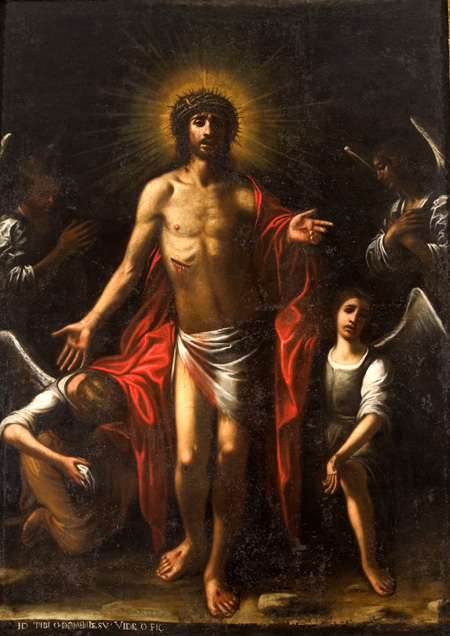
Workshop of Mario Minniti, The Five Signs (16th c.)
What was a simple act, done surely out of love – going to the tomb – has now turned into an event, a truly life-changing event. Nothing remains as it was before, not only in the lives of those women, but also in our own lives and in the history of mankind. Jesus is not dead, he has risen, he is alive! He does not simply return to life; rather, he is life itself, because he is the Son of God, the living God (cf. Num 14:21-28; Deut 5:26; Josh 3:10). Jesus no longer belongs to the past, but lives in the present and is projected towards the future; Jesus is the everlasting “today” of God. This is how the newness of God appears to the women, the disciples and all of us: as victory over sin, evil and death, over everything that crushes life and makes it seem less human. 
And this is a message meant for me and for you dear sister, for you dear brother. How often does Love have to tell us: Why do you look for the living among the dead? Our daily problems and worries can wrap us up in ourselves, in sadness and bitterness... and that is where death is. That is not the place to look for the One who is alive! Let the risen Jesus enter your life, welcome him as a friend, with trust: he is life! If up till now you have kept him at a distance, step forward. He will receive you with open arms. If you have been indifferent, take a risk: you won’t be disappointed. If following him seems difficult, don’t be afraid, trust him, be confident that he is close to you, he is with you and he will give you the peace you are looking for and the strength to live as he would have you do. (Homily, Easter Vigil, March 30, 2013)
 On the need for small (and large) proclamations of the faith:
To be sure, the testimony of faith comes in very many forms, just as in a great fresco, there is a variety of colours and shades; yet they are all important, even those which do not stand out. In God’s great plan, every detail is important, even yours, even my humble little witness, even the hidden witness of those who live their faith with simplicity in everyday family relationships, work relationships, friendships. There are the saints of every day, the “hidden” saints, a sort of “middle class of holiness”, as a French author said, that “middle class of holiness” to which we can all belong. But in different parts of the world, there are also those who suffer, like Peter and the Apostles, on account of the Gospel; there are those who give their lives in order to remain faithful to Christ by means of a witness marked by the shedding of their blood. Let us all remember this: one cannot proclaim the Gospel of Jesus without the tangible witness of one’s life. (Homily, April 14, 2013)
On the true goal of economics and politics: 
[C]oncern for the fundamental material and spiritual welfare of every human person is the starting-point for every political and economic solution and the ultimate measure of its effectiveness and its ethical validity.

Moreover, the goal of economics and politics is to serve humanity, beginning with the poorest and most vulnerable wherever they may be, even in their mothers' wombs. Every economic and political theory or action must set about providing each inhabitant of the planet with the minimum wherewithal to live in dignity and freedom, with the possibility of supporting a family, educating children, praising God and developing one's own human potential. This is the main thing; in the absence of such a vision, all economic activity is meaningless.

In this sense, the various grave economic and political challenges facing today's world require a courageous change of attitude that will restore to the end (the human person) and to the means (economics and politics) their proper place. Money and other political and economic means must serve, not rule, bearing in mind that, in a seemingly paradoxical way, free and disinterested solidarity is the key to the smooth functioning of the global economy.” (Letter to H.E. Mr David Cameron, British Prime Minister, on the occasion of the G8 Meeting, June 15, 2013).
On war and peace:
This morning I celebrated Holy Mass with several soldiers and with the parents of some of those who died in the missions for peace, who seek to further reconciliation and peace in countries in which so much fraternal blood is spilled in wars that are always madness. ‘Everything is lost in war. Everything is gained with peace’. I ask for a prayer for the fallen, for the injured and for their relatives.” (Post-Angelus comments, June 2, 2013)
On the Parable of the Prodigal Son:
I am always struck when I reread the parable of the merciful Father; it impresses me because it always gives me great hope. Think of that younger son who was in the Father’s house, who was loved; and yet he wants his part of the inheritance; he goes off, spends everything, hits rock bottom, where he could not be more distant from the Father, yet when he is at his lowest, he misses the warmth of the Father’s house and he goes back. And the Father? Had he forgotten the son? No, never. He is there, he sees the son from afar, he was waiting for him every hour of every day, the son was always in his father’s heart, even though he had left him, even though he had squandered his whole inheritance, his freedom. The Father, with patience, love, hope and mercy, had never for a second stopped thinking about him, and as soon as he sees him still far off, he runs out to meet him and embraces him with tenderness, the tenderness of God, without a word of reproach: he has returned! And that is the joy of the Father. (Homily, Papal Mass for the Possession of the Chair of the Bishop of Rome, Divine Mercy Sunday, April 7, 2013)
On the role of women in proclaiming the Gospel:
Friedrich Overbeck, Easter Morning (1818)
But how was the truth of faith in Christ’s Resurrection passed down to us? There are two kinds of testimony in the New Testament: some are in the form of a profession of faith, that is, of concise formulas that indicate the centre of faith; while others are in the form of an account of the event of the Resurrection and of the facts connected with it. [....]

Another point: in the profession of faith in the New Testament only men are recorded as witnesses of the Resurrection, the Apostles, but not the women. This is because, according to the Judaic Law of that time, women and children could not bear a trustworthy, credible witness. Instead in the Gospels women play a fundamental lead role. Here we can grasp an element in favour of the historicity of the Resurrection: if it was an invented event, in the context of that time it would not have been linked with the evidence of women. Instead the Evangelists simply recounted what happened: women were the first witnesses. This implies that God does not choose in accordance with human criteria: the first witnesses of the birth of Jesus were shepherds, simple, humble people; the first witnesses of the Resurrection were women. And this is beautiful. This is part of the mission of women; of mothers, of women! Witnessing to their children, to their grandchildren, that Jesus is alive, is living, is risen. Mothers and women, carry on witnessing to this! It is the heart that counts for God, how open to him we are, whether we are like trusting children.

However this also makes us think about how women, in the Church and on the journey of faith, had and still have today a special role in opening the doors to the Lord, in following him and in communicating his Face, for the gaze of faith is always in need of the simple and profound gaze of love.

The Apostles and disciples find it harder to believe. The women, not so. Peter runs to the tomb but stops at the empty tomb; Thomas has to touch the wounds on Jesus’ body with his hands. On our way of faith it is also important to know and to feel that God loves us and not to be afraid to love him. Faith is professed with the lips and with the heart, with words and with love.
(General Audience, April 3, 2013)
On good and bad pastors: 
‘Do you love me?’; ‘Are you my friend?’

The One who scrutinizes hearts (cf. Rom 8:27), makes himself a beggar of love and questions us on the one truly essential issue, a premiss and condition for feeding his sheep, his lambs, his Church. May every ministry be based on this intimacy with the Lord; living from him is the measure of our ecclesial service which is expressed in the readiness to obey, to humble ourselves, as we heard in the Letter to the Philippians, and for the total gift of self (cf. 2:6-11).

Moreover, the consequence of loving the Lord is giving everything — truly everything, even our life — for him. This is what must distinguish our pastoral ministry; it is the litmus test that tells us how deeply we have embraced the gift received in responding to Jesus’ call, and how closely bound we are to the individuals and communities that have been entrusted to our care. We are not the expression of a structure or of an organizational need: even with the service of our authority we are called to be a sign of the presence and action of the Risen Lord; thus to build up the community in brotherly love.
Not that this should be taken for granted: even the greatest love, in fact, when it is not constantly nourished, weakens and fades away. [....] A lack of vigilance — as we know — makes the Pastor tepid; it makes him absentminded, forgetful and even impatient. It tantalizes him with the prospect of a career, the enticement of money and with compromises with a mundane spirit; it makes him lazy, turning him into an official, a state functionary concerned with himself, with organization and structures, rather than with the true good of the People of God. Then one runs the risk of denying the Lord as did the Apostle Peter, even if he formally presents him and speaks in his name; one obscures the holiness of the hierarchical Mother Church making her less fruitful. 
(Profession of Faith with the Bishops of the Italian Episcopal Conference, May 23, 2013).
On the quest for holiness: 
Carl Heinrich Bloch, Woman at the Well (19th c.)

Draw always from Christ, the inexhaustible wellspring; strengthen your faith by attending to your spiritual formation, to personal and communitarian prayer, and to the liturgy. [...] Advance with determination along the path of holiness; do not rest content with a mediocre Christian life, but let your affiliation serve as a stimulus, above all for you yourselves, to an ever greater love of Jesus Christ. (Homily, Holy Mass on the Occasion of the Day of Confraternities and of Popular Piety, May 5, 2013)
On staying close to Christ in times of trouble:
Remain steadfast in the journey of faith, with firm hope in the Lord. This is the secret of our journey! He gives us the courage to swim against the tide. Pay attention, my young friends: to go against the current; this is good for the heart, but we need courage to swim against the tide. Jesus gives us this courage! There are no difficulties, trials or misunderstandings to fear, provided we remain united to God as branches to the vine, provided we do not lose our friendship with him, provided we make ever more room for him in our lives. This is especially so whenever we feel poor, weak and sinful, because God grants strength to our weakness, riches to our poverty, conversion and forgiveness to our sinfulness. The Lord is so rich in mercy: every time, if we go to him, he forgives us. Let us trust in God’s work! With him we can do great things; he will give us the joy of being his disciples, his witnesses. Commit yourselves to great ideals, to the most important things. We Christians were not chosen by the Lord for little things; push onwards toward the highest principles. Stake your lives on noble ideals, my dear young people! (Homily, Holy Mass and Conferral of the Sacrament of Confirmation, April 28, 2013)
 On the institution of the priesthood:
It is true that God has made his entire holy people a royal priesthood in Christ. Nevertheless, our great Priest himself, Jesus Christ, chose certain disciples to carry out publicly in his name, and on behalf of mankind, a priestly office in the Church. For Christ was sent by the Father and he in turn sent the Apostles into the world, so that through them and their successors, the Bishops, he might continue to exercise his office of Teacher, Priest, and Shepherd. Indeed, priests are established co-workers of the Order of Bishops, with whom they are joined in the priestly office and with whom they are called to the service of the people of God. (Homily, Holy Mass on the Occasion of Priestly Ordinations in the Vatican Basilica, April 21, 2013)
Obviously, these ten passages are just scratching the surface. If you want more, feel free to check out his homilies, Angelus and Regina Caeli talks, papal audiences, and letters.

The Untold Story of the Ecumenism of the Trenches

0 comments
This week, in addition to being the 40th anniversary of Roe v. Wade and the 40th annual March for Life, is also the Week of Prayer for Christian Unity. It’s fitting that these two events should overlap, since the pro-life movement seems to have done more to draw together Catholics and Protestants, particularly Evangelicals, than any official ecumenical talks. It’s fittingly been dubbed “the ecumenism of the trenches,” and this cooperation has only increased in the face of the HHS Mandate, with Evangelical schools like Wheaton joining the fight for religious liberty.

AHA’s philosophy, in a nutshell.
That’s not to say that there haven’t been some trials and tribulations in that relationship. In fact, the latest bump in this relationship occurred recently, with a rather poor-timed feud between the Crescat (who is Catholic) and the pro-life group Abolish Human Abortion (who do really good work, but really don’t care for Catholics). At the heart of the dispute are two facts, as was explained in an open-letter written by one of their bloggers.  First, AHA believes that the only solution to the problem of abortion is the Gospel.  Second, they “do not affirm the same gospel as the Roman Catholic Church,” going so far as to call the Catholic Gospel “satanic.

There is a certain irony in all of this.  The blogger Rhology, the author of that open letter, is a Southern Baptist.  And the Southern Baptist Convention was vocal on the issue of abortion, even before Roe.  The only problem: they were on the wrong side.  This oft-overlooked history was pointed out recently by Dr. R. Albert Mohler, Jr., president of the Southern Baptist Theological Seminary, in a fascinating article for the Washington Post :
Two years before Roe, the Southern Baptist Convention passed a resolution calling for “legislation that will allow the possibility of abortion under such circumstances as rape, incest, clear evidence of fetal abnormality, and carefully ascertained evidence of the likelihood of damage to the emotional, mental, and physical health of the mother.”

That resolution reveals two very important aspects of this story. First, that the language of “the emotional, mental, and physical life of the mother” was already in use and, second, that the convention called for the legalization of what would become abortion on demand. After Roe, the language about emotional and mental health would be used to allow virtually any abortion for any reason.

Did Southern Baptists have any idea what they were doing? The leadership of the denomination’s ethics agency was then pro-abortion, but the convention itself passed the resolution. Clearly, no pro-life consensus then prevailed among Southern Baptists.
And when the Southern Baptists, along with much of the Evangelical world, looked ready to simply go with the flow on abortion (as they had with contraception), who was it who saved the day?  The Catholic Church:
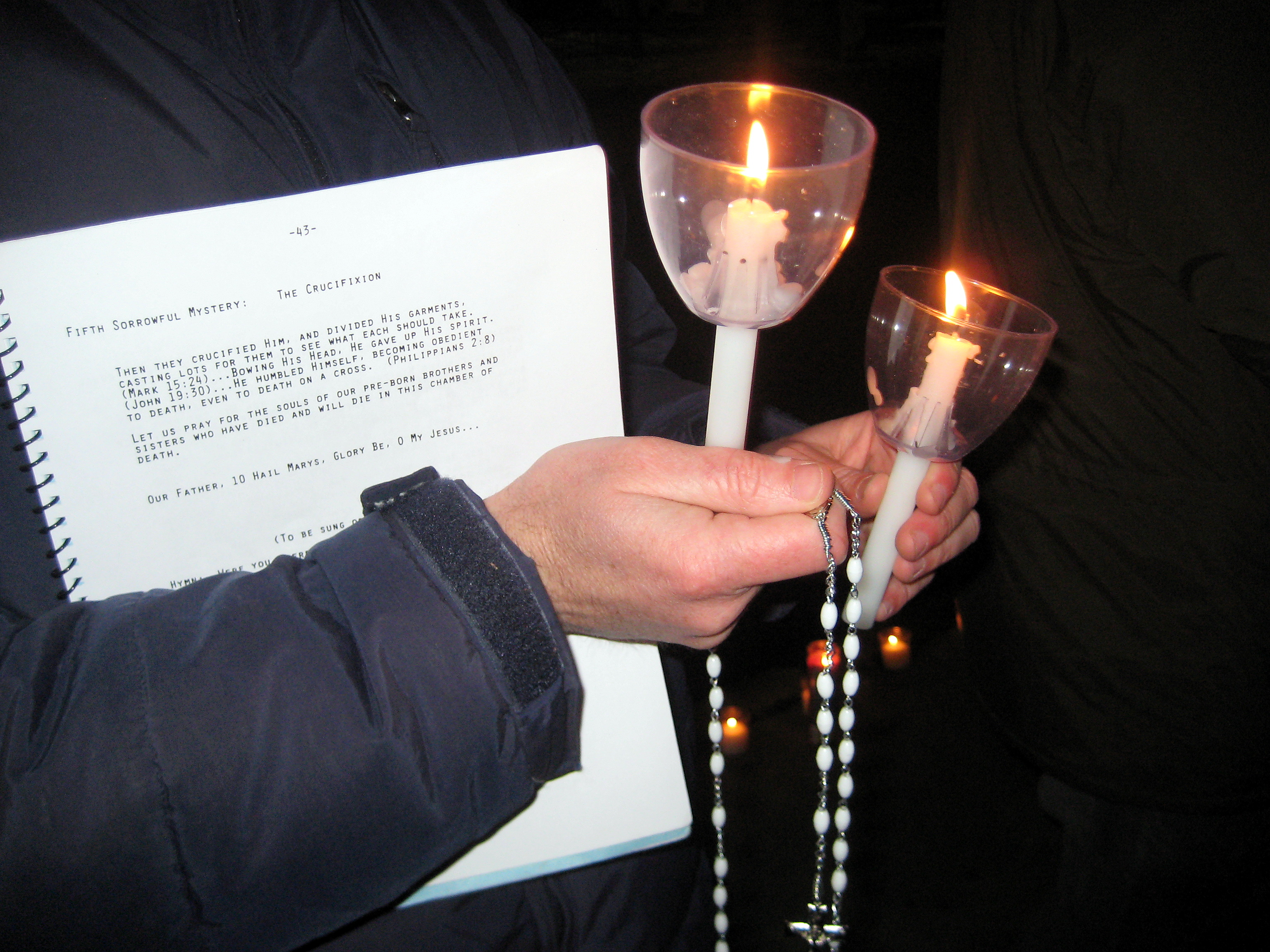
From a 2009 Pro-Life Vigil
While most evangelicals were either on the wrong side of the issue or politically disengaged, Roman Catholic leaders were on the front lines opposing abortion as a fundamental assault on human dignity. By the late 1960s, the Roman Catholic Church was fighting demands for the legalization of abortion nationally and state by state - opposition that preceded the 1968 papal encyclical Humanae Vitae.

By the time Roe was handed down, Catholic leaders had developed sophisticated arguments and growing organizations to fight for the pro-life cause. In 1967, six years before Roe, Catholics had led in the creation of the National Right to Life Committee. The Catholic tradition, drawn largely from the natural law, became the foundational intellectual contribution to the development of a united front against abortion. Nevertheless, for evangelicals to join the movement in a decisive way, arguments drawn directly from Scripture had to be formed and then preached from the pulpits of evangelical churches.

Those arguments captured the conscience of the evangelical movement and produced a seismic shift within the movement and within the political life of the nation. From the 1980 U. S. presidential election until the present, the pro-life movement has been populated, funded, and directed, for the most part, by evangelical and Roman Catholic leaders. Beyond that, the emergence of crisis pregnancy centers and support systems for women considering abortion have come from the work of millions of pro-life Roman Catholics and evangelicals at the grassroots.
There are a lot of ways of reacting to this news. We could view it in a triumphalistic way, in which the Catholic Church (or at least, the Magsterium) stood strong even while Evangelicalism blinked. Or we could view it as a silver lining in Evangelicalism’s ability to change core beliefs over the span of a few years or decades. Evangelical believers are even more pro-life than their (nominally) Catholic brethren these days.

But perhaps the most edifying reaction is to remember that we’re strongest when we work together. The story of pro-life Evangelicalism can’t be told without reference to the cooperation and support of their Catholic brothers and sisters. That’s a legacy to continue, not to lightly throw away.

Science v. Religion on When Life Begins

0 comments
One of the looming questions in the abortion debate relates to when human life begins.  From a scientific perspective, this question has been solved for centuries, thanks in part to the work of a seventeenth-century Italian scientist by the name of Francesco Redi.  And it’s left the opponents of the scientific view appealing lamely to outdated religious definitions.

I. Francesco Redi and the Theory of Spontaneous Generation

In 1688, Redi debunked a then-popular theory, namely, spontaneous generation, that claimed that dead things could spontaneously give rise to new life. This view dates back at least to Aristotle, who mistakenly taught (and by the way, this is where it’s about to get a little gross) that certain insects spontaneously originated “from putrefying earth or vegetable matter,” while “others are spontaneously generated in the inside of animals out of the secretions of their several organs.

An illustration from Francesco Redi’s 1688 work
debunking spontaneous generation. (h/t Scientus)
It was based on a simple mistake: if you leave meat out, it’ll eventually start rotting, and you’ll see maggots and flies crawling around on it, and the dead meat seems to be turning into these living creatures.  Of course, what was really happening was that maggots and flies were eating the rotting meat, and then laying tiny eggs, which eventually hatched.  But people generally didn’t know that, until Francesco Redi used a simple experiment to disprove spontaneous generation:
Francesco took eight jars, placed meat in all the jars, but covered four of the jars with muslin. Maggots developed in the open jars but did not develop in the muslin-covered jars.
In other words, dead things (like rotting meat) don’t suddenly become baby flies. So no matter who or what we’re talking about, from maggots to men, a simple principle is at play: living things come directly from other living things. Dead things don’t suddenly spring to life.

For some reason, in the abortion debate, this is still a revolutionary idea.  The scientific position, shared by pro-lifers, is simple: the father’s (living) sperm and the mother’s (living) egg form a (living) offspring when the two fuse (a moment in time known as conception or fertilization).  This living offspring is both alive and is distinct from each parent.  As Evangelium Vitae puts it:
[F]rom the time that the ovum is fertilized, a life is begun which is neither that of the father nor the mother; it is rather the life of a new human being with his own growth. It would never be made human if it were not human already.
Simple, scientific stuff.  Two living beings create a third living being.  The “pro-choice” side of the debate can’t acknowledge this without admitting that the “choice” in question is the killing of a living human being (albeit a tiny one), and yet they can’t deny it, either. To deny it would be to say that, at some point in the pregnancy cycle, a non-living embryo simply springs to life: the very sort of absurd spontaneous generation that Redi’s opponents believed in.

So what does the pro-abortion side do? Ignores the science, and obfuscates instead. Let me show you what I mean.

II. Using Religious Dogmatism Against Science

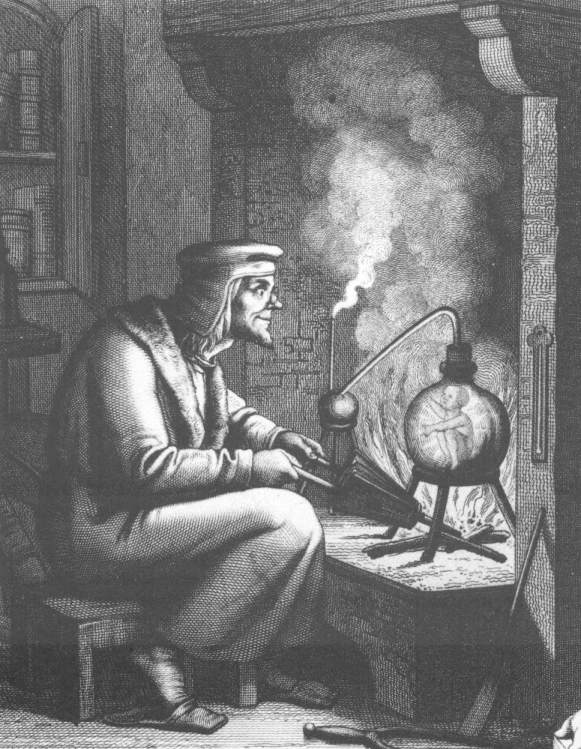
19th century engraving of
Faustus and the Homunculus
The online website My Family Doctor routinely hosts debates on a variety of issues including, “When Does Life Begin? Medical Experts Debate Abortion Issue.”  They began the article thusly:
In every political season, abortion emerges as one of the most hotly debated topics. It draws in everybody—from the religious to the political. But what about the scientists?
In fact, My Family Doctor seems to have had trouble finding actual scientists willing to claim that life begins after conception (for precisely the reason outlined above). The only doctors, scientists, and scientific organizations mentioned in the piece either agree that life begins at conception, or avoided answering the question.  This is part of a broader pro-choice strategy of simply ignoring the science and hoping that it’ll go away:
“Pro-choice docs would say that it is not their business to determine for a patient when life begins,” says Diana Philip, interim executive director of the National Coalition of Abortion Providers and its sister organization, the Abortion Conversation Project. “Ultimately each patient determines the value and definition of life and that definition lies within her own mind and heart.”
See? Who cares about the science, when “each person” can make up their own “definition of life” within their own heart?  Maybe Francesco Redi’s opponents could have employed a similar tactic, printing bumper stickers like “Don’t believe in spontaneous generation? Don’t leave rotting meat out.”

The reason the pro-abortion side is reduced to holding their ears until science goes away is that science is really clearly on the pro-life side.  As Donna J. Harrison, M.D., of the American Association of Pro Life Obstetricians and Gynecologists put it, “any biologist in the world can tell you that a mammal’s life begins when the sperm from the father unites with the egg from the mother.

Harrison’s debate opponent wasn’t actually a doctor or a scientist at all (despite the article’s introduction), but a professor from the University of Puget Sound’s Department of Religion, Dr. Suzanne Holland. Following the pro-choice strategy described above, Holland ignores science almost completely, and refuses to actually say when life begins.  She gives four possible answers.  First, the position that she falsely ascribes to the Catholic Church:
The Twins Georg and Regula Rahn, Zürich, 1752.
The genetic view (the position held by the Roman Catholic Church and many religious conservatives) holds that life begins with the acquisition of a novel genome; it is a kind of genetic determinism. 
As we saw above, the Catholic position is based on fertilization, not simply “genetic determinism” revolving around a “unique genome.” After all, identical twins have the same genome, but distinct epigenetics. If this really were the Catholic Church’s position, She’d have to deny that each twin was a unique individual.

Holland proceeds to lay out three alternative views, each holding to some view of spontaneous generation: that the non-living child simply springs to life.  The first alternative is the
Those who hold the embryologic view think life begins when the embryo undergoes gastrulation, and twinning is no longer possible; this occurs about 14 days into development. (Some mainline Protestant religions espouse a similar view.) 
This view requires holding that at some indistinct point in the second week of development, a non-living being becomes a living being by losing its ability to divide into two distinct individuals.  This is ironically anti-scientific, since this same process of cellular division and reproduction is used in other organisms to prove that they are alive, not dead.  Likewise, this view would “prove” that plants and microbes aren’t alive, since they reproduce asexually.
Proponents of the neurological view adhere to brainwave criteria; life begins when a distinct EEG pattern can be detected, about 24 to 27 weeks. (Some Protestant churches affirm this.) Interestingly, life is also thought to end when the EEG pattern is no longer present. 
This requires believing that a non-living creature somehow brought itself to life by ... generating its own brain.  Plus, several people who showed no EEG activity were declared “dead” before fully recovering, like Karen Arbogast or Zack Dunlap.  So maybe that’s not the best rubric to use, particularly standing alone?  Finally:
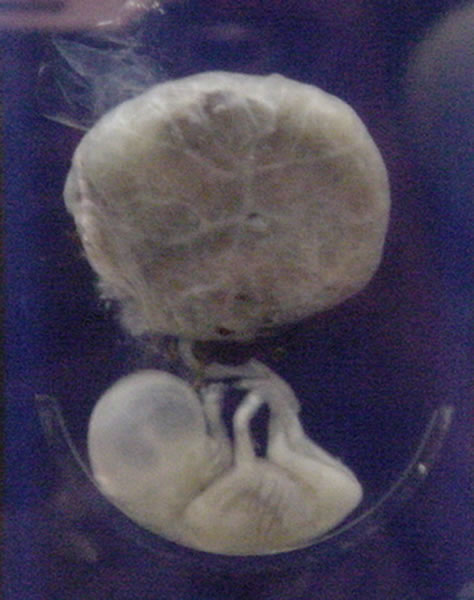
Unborn child, aged twenty-one weeks
Finally, one can say that life begins at or near birth, measured by fetal viability outside the mother’s body. (Judaism affirms something close to this position.) After all, somewhere between 50 and 60 percent of all embryos conceived miscarry.
This is the most absurd of the choices, since viability depends on the child and the culture. Roe defined viability at 24-28 weeks, but since then, plenty of children born in the two weeks before that have survived, due to technological improvements.  It makes absolutely no sense to say that a 23-week old fetus in America is alive, while a 23-week old fetus in Zimbabwe is dead.  And of course, even the prematurely-born children who died... died... which shows that they were previously alive.
    Each of these alternative views is also trying to claim that life begins at a certain point in embryonic or fetal development. This is self-evidentially absurd, since the unborn child must be alive in order to grow and develop in the first place!

    Holland doesn’t actually commit to any of these positions. To do so would open herself up for debate on the issue (and show the absurdity of each view). All she’s trying to do is muddy the waters, to make the issue of when life begins look unclear. It’s not.  And since she can’t marshal any science to support her claim, Holland is left claiming that some unspecified Protestant and Jewish groups support her.  But the question of when life begins is a scientific question, whatever else it may be. If some religious group comes along and defines it at your fourteenth birthday, that doesn’t invalidate the science. It invalidates the religious group.

    Of course, if it was the pro-life side using religious dogmas to deny objective science, we would be ridiculed in popular culture, and quite reasonably, for waging a “war on science.” But we’re quite comfortable with the science here.

    III.  When Life Begins Scientifically

    As I said above, the science on when life begins is perfectly clear.  The only scientific source Holland cites to is Dr. Scott Gilbert, author of an article entitled “Against Science and Scripture.”  In it, he makes the same argument that there are four possible places life could begin, and like Holland, relies on a combination of bad science and, mostly, bad Biblical exegesis.  But while Gilbert feigns confusion on when human life begins, he has no trouble knowing when life begins for every other mammals.  From his textbook on developmental biology:
    Newborn Golden Retriever puppies
    Traditional ways of classifying catalog animals according to their adult structure. But, as J. T. Bonner (1965) pointed out, this is a very artificial method, because what we consider an individual is usually just a brief slice of its life cycle. When we consider a dog, for instance, we usually picture an adult. But the dog is a “dog” from the moment of fertilization of a dog egg by a dog sperm. It remains a dog even as a senescent dying hound. Therefore, the dog is actually the entire life cycle of the animal, from fertilization through death. 
    [....]
    One of the major triumphs of descriptive embryology was the idea of a generalizable life cycle. Each animal, whether an earthworm, an eagle, or a beagle, passes through similar stages of development. The major stages of animal development are illustrated in Figure 2.1. The life of a new individual is initiated by the fusion of genetic material from the two gametes—the sperm and the egg. This fusion, called fertilization, stimulates the egg to begin development. The stages of development between fertilization and hatching are collectively called embryogenesis.
    So every new individual creature, whether an earthworm, a beagle, or a human being, is an individual from the moment of fertilization.  Whether we say “dog” or “puppy,”  “human” or “fetus” is purely semantics.  From fertilization through death, a dog remains a dog, and a human being remains a human being.

    That’s science.

    Catholic Voting and The Order of Truths

    0 comments
    A common mistake that Catholics make is assuming that every Catholic teaching carries equal weight, and that as the faithful, we are equally bound to follow everything that the pope or a bishop says. Related to this is the idea that a politician who goes against Church “teaching” on one issue, like supporting a particular social program, is equal to a politician who goes against another Church teaching, like the right of unborn children to live.

    For example, Commonweal’s Margaret O'Brien Steinfels’ described Paul Ryan like this: “sure, like the rest of us he is a Cafeteria Catholic.”  In other words , Rep. Ryan proposing a budget that some members of the USCCB criticized is like a Catholic supporting abortion in spite of the teachings of the Magisterium. William McGurn rightly took her to task for this false equivalency, on the pages of the Wall Street Journal, but it seems to me that one of the reasons that O'Brien Steinfels’ argument works is that most of the people talking about this are trying to score partisan points.

    So here, from a Catholic (rather than a partisan) perspective, is what the Church actually teaches about when it is, and isn’t, okay for a Catholic to disagree with a Church teaching.  Everything I’ll cite to is from a Church Council or pope, who I trust we can agree aren’t going around making Magisterial statements in the hope of winning U.S. presidential elections.

    I. Vatican II, John Paul II, Benedict XVI, and the Order of Truths 

    The notion of a hierarchy of truths was explicitly mentioned by the Second Vatican Council, in Unitatis Redintegratio:
    Moreover, in ecumenical dialogue, Catholic theologians standing fast by the teaching of the Church and investigating the divine mysteries with the separated brethren must proceed with love for the truth, with charity, and with humility. When comparing doctrines with one another, they should remember that in Catholic doctrine there exists a "hierarchy" of truths, since they vary in their relation to the fundamental Christian faith. Thus the way will be opened by which through fraternal rivalry all will be stirred to a deeper understanding and a clearer presentation of the unfathomable riches of Christ.
    Now, as the context suggests, this was targeted towards Catholic theologians dealing with non-Catholics in ecumenical dialogue.  And the point appears to be that a religious group that denies the Trinity is less Catholic than one that believes in the Trinity, but denies the authority of the Bishop of Rome.  Not all Catholic teachings are equally central.  Of course, this does not apply directly for Catholics: we must, by definition, believe in both the Trinity and the papacy.  But a similar order of truths exists for Catholics, as well.

    In 1998, Pope John Paul II referenced this when he added three paragraphs to the Profession of Faith made by those teaching the Catholic faith.  He explained that these additions were “intended to better distinguish the order of the truths to which the believer adheres.”  Accompanying this was a lengthier explanation of the changes from Cardinal Ratzinger, now Pope Benedict XVI.  It’s well worth the read.

    In it, Ratzinger explains that there are three distinct levels of Magisterial teaching, signified by each of the three paragraphs: (1) those truths which are divinely revealed, (2) those which are definitively proposed, and (3) those which belong to the authentic ordinary Magisterium.

    1. Divinely Revealed

    The highest of these three, of course, are those truths which are divinely revealed.  Ratzinger summarized what these beliefs were:

    To the truths of the first paragraph belong the articles of faith of the Creed, the various Christological dogmas and Marian dogmas; the doctrine of the institution of the sacraments by Christ and their efficacy with regard to grace; the doctrine of the real and substantial presence of Christ in the Eucharist and the sacrificial nature of the eucharistic celebration; the foundation of the Church by the will of Christ; the doctrine on the primacy and infallibility of the Roman Pontiff; the doctrine on the existence of original sin; the doctrine on the immortality of the spiritual soul and on the immediate recompense after death; the absence of error in the inspired sacred texts; the doctrine on the grave immorality of direct and voluntary killing of an innocent human being.
    Most of these are issues which are strictly theological: that is, politicians are rarely asked to deny their belief in the Trinity, or the sacraments, or original sin. But politicians and voters alike are asked to compromise on the last of these truth, about “the grave immorality of direct and voluntary killing of an innocent human being.


    Pace O'Brien Steinfels, a Catholic who supports abortion isn’t a “cafeteria Catholic.”  Rather, we rightly call that person a “heretic,” as Ratzinger explains:
    These doctrines require the assent of theological faith by all members of the faithful. Thus, whoever obstinately places them in doubt or denies them falls under the censure of heresy, as indicated by the respective canons of the Codes of Canon Law.
    These are the absolute core of the teachings of the Catholic Church.  You simply cannot deny them and remain “Catholic” in good standing.  Or put another way, there’s no such thing as “Catholics for Choice.” 

    2. Definitively Proposed

    The second tier of teachings are “those teachings belonging to the dogmatic or moral area, which are necessary for faithfully keeping and expounding the deposit of faith, even if they have not been proposed by the Magisterium of the Church as formally revealed.”  That definition is confusing, but Cdl. Ratzinger’s examples explain what is meant: he uses the examples of the validity of papal elections and councils, as well as the invalidity of Anglican orders (as explained  by Pope Leo XIII in the Apostolic Letter Apostolicae Curae).

    These three areas are all ones in which truths which we know are not Divinely revealed are still necessarily true. Put differently, Jesus didn’t say, “Benedict XVI is the pope,” “Vatican II is a valid Ecumencial Council,” and “Anglican orders are invalid,” but the truths that He revealed necessarily lead us to these conclusions. If Catholics denied the validity of Benedict’s papacy, just because Jesus didn’t tell us who the 265th pope would be, the Church would fall apart.  Also on this list are canonizations of Saints.  Since these individuals lived after the time of Christ, Jesus and Scripture are silent on the matter, but given what the Deposit of Faith reveals about what it takes to be a Saint, we can know infallibly that certain individuals are in Heaven.

    The difference between truths of the first and second tier are that we can say for certain that the truths of the first tier are Divinely revealed.  Given this, some of the truths in the second tier may belong in the first tier, once they are dogmatically defined.  This has already happened at least once, with papal infallibility: there was a dispute over whether papal infallibility was divinely-revealed, or simply the necessary consequence of Divine revelation: Vatican I settled that dispute.  Ratzinger notes that another doctrine appears to be going through the same transition:
    A similar process can be observed in the more recent teaching regarding the doctrine that priestly ordination is reserved only to men. The Supreme Pontiff, while not wishing to proceed to a dogmatic definition, intended to reaffirm that this doctrine is to be held definitively, since, founded on the written Word of God, constantly preserved and applied in the Tradition of the Church, it has been set forth infallibly by the ordinary and universal Magisterium. As the prior example illustrates, this does not foreclose the possibility that, in the future, the consciousness of the Church might progress to the point where this teaching could be defined as a doctrine to be believed as divinely revealed.
    In addition, Ratzinger raises another teaching, the prohibition against euthanasia, going through a similar process.  Unfortunately, this is a teaching increasingly relevant to the political realm, as at least one state already has legal “assisted suicide.”

    These truths, like those in the first tier, simply must be believed:
    With regard to the nature of the assent owed to the truths set forth by the Church as divinely revealed (those of the first paragraph) or to be held definitively (those of the second paragraph), it is important to emphasize that there is no difference with respect to the full and irrevocable character of the assent which is owed to these teachings. The difference concerns the supernatural virtue of faith: in the case of truths of the first paragraph, the assent is based directly on faith in the authority of the Word of God (doctrines de fide credenda); in the case of the truths of the second paragraph, the assent is based on faith in the Holy Spirit's assistance to the Magisterium and on the Catholic doctrine of the infallibility of the Magisterium (doctrines de fide tenenda).
    So both the first and second tier teachings require total assent: the only difference is whether we believe based upon the authority of the Word of God, or on the authority of the Holy Spirit’s guidance of the Magisterium. But since both the Second and Third Person of the Trinity are God, we need total faith on these issues.

    3. Authentic Ordinary Magisterium

    The third tier of teachings are those arising from the “Authentic Ordinary Magisterium.”  Basically, this is everything else worthy of being called Catholic teaching.  These teachings are not infallible.  Since this is a broad category, the teachings require different degrees of assent:
    As examples of doctrines belonging to the third paragraph, one can point in general to teachings set forth by the authentic ordinary Magisterium in a non-definitive way, which require degrees of adherence differentiated according to the mind and the will manifested; this is shown especially by the nature of the documents, by the frequent repetition of the same doctrine, or by the tenor of the verbal expression.
    In the document, Ratzinger does not given any examples of what these other areas are, but elsewhere, he does:
    Not all moral issues have the same moral weight as abortion and euthanasia. For example, if a Catholic were to be at odds with the Holy Father on the application of capital punishment or on the decision to wage war, he would not for that reason be considered unworthy to present himself to receive Holy Communion. While the Church exhorts civil authorities to seek peace, not war, and to exercise discretion and mercy in imposing punishment on criminals, it may still be permissible to take up arms to repel an aggressor or to have recourse to capital punishment. There may be a legitimate diversity of opinion even among Catholics about waging war and applying the death penalty, but not however with regard to abortion and euthanasia.
    I can’t make that any clearer than he already did. On some issues, like the death penalty and the justness of a specific war, we’re relatively free to disagree with one another, and even with the pope. But on other issues, there is one, and only one, legitimate Catholic opinion.

    II. The Implications for Catholic Voters

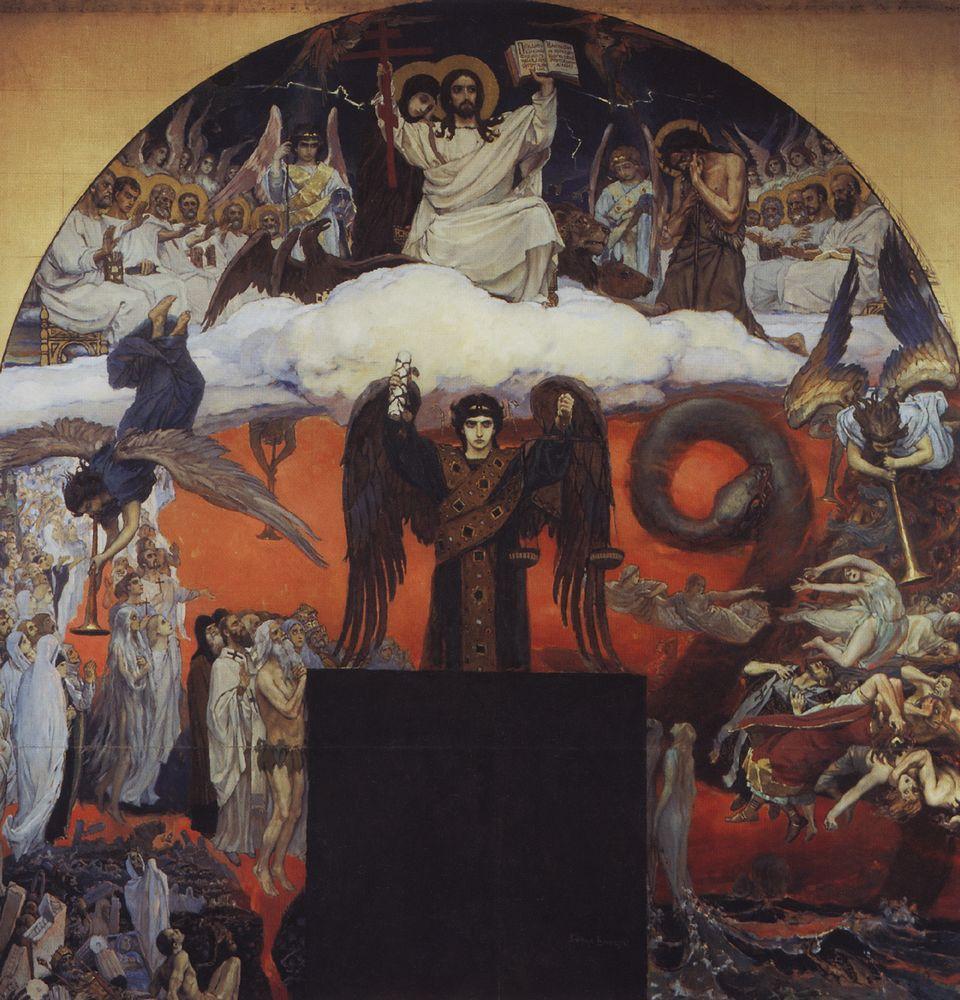
    Viktor Vasnetsov, Judgement Day (1896)
    The biggest risk facing Catholic voters isn’t that they’ll elect the wrong guy. It’s that they’ll ignore or compromise their faith when it’s politically expedient, effectively selling their souls for the sake of a political party.  It’s an odd irony in American culture, that politicians are lambasted as dishonest and slimy, and yet they’re the ones who Catholics seem to be tuning in to for moral guidance, rather than the Church.  It’s as if our nation damns the mass of politicians to Hell, and then willingly follows their lead.  It simply makes no sense, yet plenty of voters (of all political affiliations) do this.

    The two traps that Catholics often fall into when talking about politics is: (a) acting as if their own candidate is immaculate, or (b) acting as if all the candidates are equally bad, from a Catholic point of view. Neither of these are true. Every candidate is flawed, but some flaws (like support for abortion and euthanasia) are objectively worse, and simply indefensible.

    Having said all of that, I should emphasize that the points I raised here apply well outside of the realm of voting: if you’re a Catholic who argues against original sin, or for women’s ordination to the priesthood, or for euthanasia or abortion, you’re guilty of heresy, and need to repent.  My concern here is less with how you fare on Election Day, and more concerned with how you fare on Judgment Day.

    Debunking the “Pro-Choice” Euphemism

    0 comments
    To no great surprise, it turns out “pro-choice” just means the choice to abort your kid, not the choice to, say, have an incandescent light bulb or drink a large soda. This reality was highlighted by a recent Reason TV video in which Democratic delegates and supporters were interviewed about “choice” at the 2012 Democratic National Convention in Charlotte:


    In other words, most of the people claiming to be “pro-choice” are pledging fealty to a set of principles (about individual bodily autonomy and the like) that they don’t actually hold outside of the realm of abortion. It’s inaccurate to refer to this as “pro-choice,” and far more accurate to refer to it as “pro-abortion,” or (to use the AP style guide) being an “abortion rights supporter.”

    Perhaps this is semantics, but I think not. I would suggest that there are two reasons that this is important. First, because the use of euphemism tells us something about the reality of abortion. I’ve been reading D. Q. McInery’s book Being Logical, in which he says:
    The user shapes language, but language shapes the user as well. If we consistently use language that serves to distort reality, we can eventually come to believe our own twisted rhetoric. Such is the power of language. At first hearing, terms like “cultural revolution” and “reeducation” might sound quite harmless. Then one learns that they masked totalitarian brutality at its worst. 
    It is juvenile to use language simply to shock. But shocking language is preferable to evasive language, if it can disabuse people of hazy ideas and acquaint them with the truth.
    I think that this power of language was visible in the above video. The people being interviewed were not, as far as I can tell, trying to deceive the interviewer. They almost certainly thought of themselves as “pro-choice,” of having a live-and-let-live attitude towards what other people do with their bodies. They had, in other words, been fooled by their own language.

    So the question that this video should raise (in my opinion) is: what sort of a thing is “intentional abortion” that it has to be referred to by its supporters in overly-technical or euphemistic language? This linguistic practice alone should be sending up all sorts of red flags to listeners. And yes, the exact same point can be made about those who advocate for torture under euphemisms like “enhanced interrogation.” If you’re re-defining what a term means, or refusing to use the ordinary term for the act in question, chances are good that you’re advocating for something pernicious.

    The second reason is the obvious hypocrisy. Supporters of legalized abortion use a set of essentially-libertarian arguments that they reject in almost every other context. It really is hypocrisy at its rankest.  There are essentially three principled ways out:

    1. Stop supporting abortion, and take the positive principles of liberalism (like a belief that we’re all in this together, and a concern for the weakest among us), and apply those to the unborn; 
    2. Stop supporting liberalism, and become libertarians across the board, or 
    3. Find some non-hypocritical defense for abortion. 


    As a pro-life Catholic, I’d advocate (1), while I suspect that the producers of the Reason TV video would advocate (2), and principled abortion supporters would advocate (3). But I think all three groups should concede that the standard positions being used to defend abortion now are embarrassingly contradictory.  The Reason video just demonstrated this reality in a particularly effective way.


    ---

    P.S.  So what’s the answer to the response that pro-lifers are also equally guilty of intellectual inconsistency, and are really pro-fetus, not pro-life? Even if it were correct, this argument is guilty of the tu quoque fallacy. That is, it doesn’t actually make it okay to use disingenuous arguments, just because you think your opponents use them, and that mentality is a race to the bottom.

    But even as a tu quoque, it fails. Pro-lifers really do hold to a consistent set of intellectual principles. As a “lowest common denominator” principle, I’d point to the principle that innocent human life should never be intentionally taken. Given any public policy issue, if it involves the intentional taking of innocent human life (whether we’re talking about abortion, infanticide, euthanasia, targeting civilians in war, or some other form of murder), the views of pro-lifers can be determined from applying this principle.

    But this principle doesn’t dictate (although it may inform) how pro-lifers feel about issues like the minimum wage, universal health care, or the size of government. I agree that it would be better if all pro-lifers also had a high view of the dignity of, say, workers or immigrants. But that’s a separate issue, related to “quality of life” rather than the basic issue of life and death.  Someone could, therefore, take an absolutely libertarian, no-government-assistance view of the role of government, and still acknowledge an intrinsic right to life, and the duty of the government to protect that basic right.  But even here, pro-lifers are probably a lot more self-giving than you imagine.

    A Catholic Reply to “How to Suck At Your Religion”

    0 comments
    An anti-religious (and specifically, anti-Catholic) webcomic is making the rounds on the Internet right now. It’s part of a webcomic called The Oatmeal, and is called “How to suck at your religion.” I have to warn anyone clicking that link that it’s really offensive: profane, lewd, and blasphemous, all at once. Honestly, if you don’t have some reason to read it, just go ahead and skip it (and this whole post).  Whatever your religious views, this webcomic simply doesn’t enrich the discourse, or advance the debate in any positive or meaningful way.

    You would think that something this over-the-top would cause even non-religious people to balk at posting it on their Facebook feeds as indicative of their own views. Apparently not. I’ve already gotten two e-mails from people who had friends share it, and who wanted to know how to respond.

    There is a temptation to say, “It’s a webcomic, don’t take it so seriously!”  But the truth is, while it’s supposed to be funny, it’s also supposed to make a serious point. In my view, it fails on both counts, but I’m really only concerned about the latter.  Nearly every panel raises a different argument against certain types of religion, with most of the vitriol saved for Catholicism. Each of these arguments collapse on closer inspection, and it’s clear that the sheer quantity of arguments cannot overcome the dearth of quality of any given argument.

    So here are my thoughts, by panel:

    1. The first panel depicts a Catholic priest (with a Roman collar) confidently damning all those who don't belong to the Church. This is just a lazy straw man. While She's canonized thousands of Saints, the Church has never declared anyone in Hell. On a related note, one of the obnoxious things about atheist attacks on Christianity is that they act as if Catholicism and Evangelicalism / Fundamentalism are basically the same thing.  On of the things that Dr. Mark Gray said, in the article I linked to last week, was that: “It’s interesting that so much of the rhetoric of New Atheism seems to really be directed at Evangelical Christians—those specifically who take the Bible literally word for word. Many New Atheists seem to think anyone who is religious holds similar beliefs. Yet, this cannot be equated with the mainstream Catholic point of view.”  If you’re going to argue against something, it helps to at least understand the thing you’re arguing against.

    2. This gets the Galileo affair completely wrong. A much-needed corrective here, or a thousand other places, for those who actually care enough about the facts to check them.

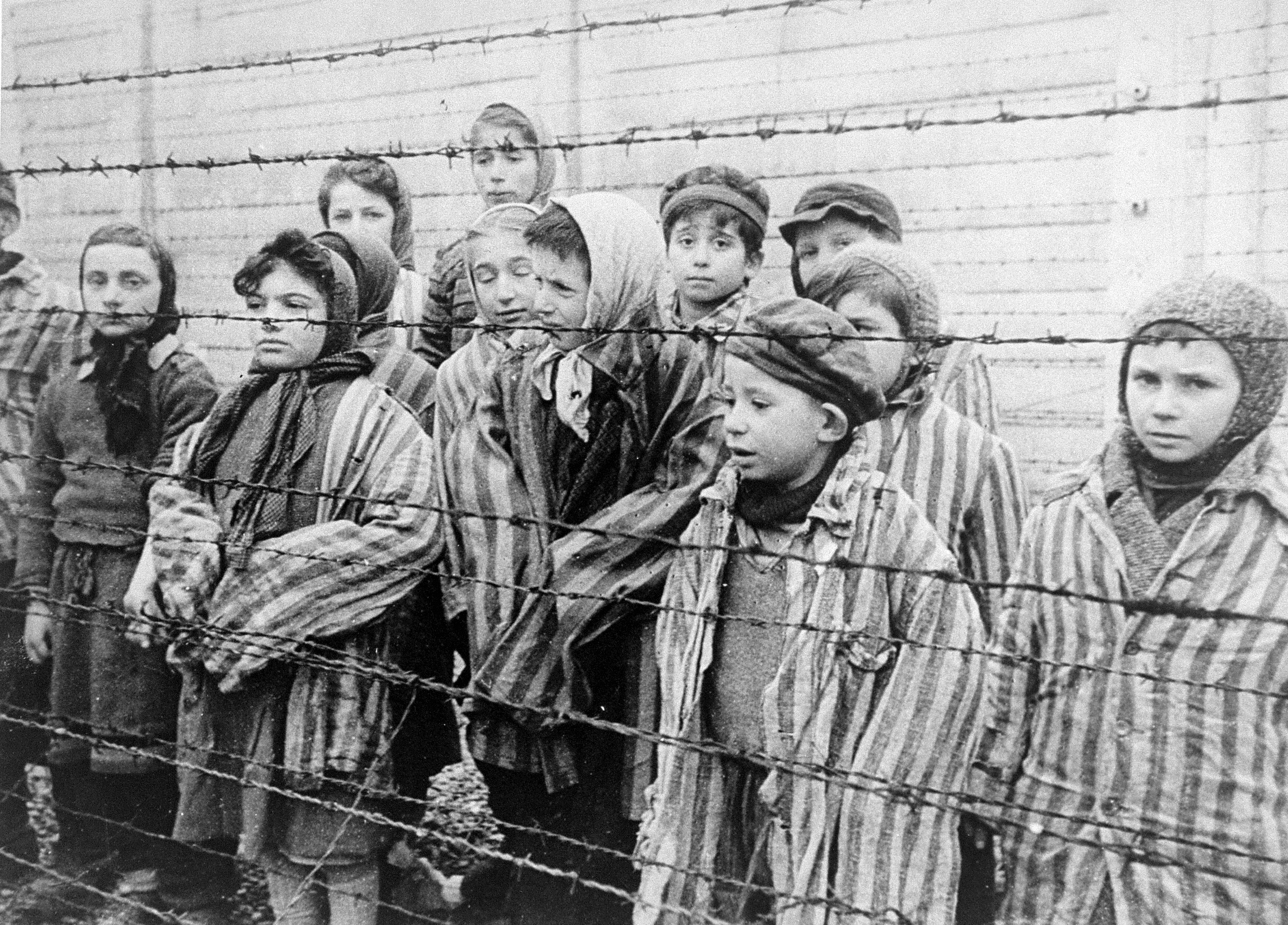
    3. Jewish twins kept alive at Auschwitz
      for the sake of human experimentation.
      Were those who opposed this barbarism “anti-science”?
      This also grossly misrepresents why Christians oppose embryonic stem cell research (and falsely accuses us of being against all stem cell research). But I suppose the author has to misrepresent the Christian view, because otherwise, it makes a lot of sense. If human life begins at conception (which, scientifically, it does.... and is the only reason embryonic stem cell research is even possible), we're talking about doing medical research that profits off of mass killing. This has been done before, and those who opposed it on moral grounds weren't "anti-science," and aren't today. The term you're looking for is pro-life.

    4. So... religion is fine, unless you actually believe in it? Should parents not pass their political, ethical or moral views on to their children as well? What parts of parenting would be left if parents were to avoid passing their views on to their kids? The irony here is that silence is itself a statement. Avoiding any mention of God to your kids sends as clear a message as talking about God: specifically, it tells your kids that God's existence is either untrue, unknown, or unimportant. Because if you knew Him to exist, surely you'd share that knowledge, right?

    5. This next section is probably the worst, because it's just an incoherent argument. A kid asks, “Dad, what happens to us after we die?” The author compares providing the Christian answer to this question with correcting your kid for having green as a favorite color. What??  That just isn’t a coherent argument.  In what world are those two ideas parallel, or even comparable?

      According to the webcomic, good parenting is to pretend to be agnostic, and say that “no one really knows for sure.” Of course, if the Resurrection is true, that claim is false. So to be a good parent, you apparently have to deny the Resurrection and embrace agnosticism, treating beliefs about the afterlife as mere matters of personal preference like having a favorite color. This is just… stupid. There’s just no other way of describing it. Imagine if we treated everything that way. “Dad, what’s 3 x 3?” “No one really knows for sure. What do YOU think 3 x 3 is?”

    6. Raphael, Adam and Eve (1511)
    7. The idea that a religion is bad if it gives you “weird anxieties about your sexuality” is naïve. What I mean is that sexuality is much more powerful and truly awesome than the author lets on. If sex is just no big deal, recreational fun, then adultery’s no problem, right?

      Of course not. Agnostics and atheists have “weird anxieties” about sexuality, too, precisely because sexuality is powerful, and can cause a heck of a lot of damage when treated carelessly and casually. Everything from broken hearts and broken homes to rampant STDs and AIDS to millions of unplanned pregnancies and abortions would seem to have made all of that really clear by now.

    8. Religion is bad if you believe enough to try to tell other people that it's true. Why, exactly? As a society, we freely try to convince each other of specific worldviews all the time, including really speculative ones, like political worldviews. Why is all of that positive, healthy democracy, while treating religion the same way is evil?

       The author specifically advocates that good religions are ones that make it hard to join. Again, why? If having the right relationship with God is the best thing, not only for me, but for anyone, then trying to prevent others from that right relationship would literally be about the worst thing that I could do.

    9. This just grossly misrepresents Christianity.  As I said before, if you’re going to argue against something, it helps to at least understand the thing you’re arguing against.  In Monday's post, I mentioned that one goal we should have in inter-religious dialogues and debates is to be able to describe the other person’s position in a way that they would recognize, and acknowledge as their own.

      Needless to say, that’s not what happens here. Instead, there’s mockery and sneering of a ridiculous distortion of Christianity: mocking beliefs, in other words, that no Christian actually holds.  Edward Feser has a great response to this sort of cheap shot, showing that this same asinine approach could be used to make science look stupid (provided that no one bothered to listen to scientists about what they actually believed).

    10. Do you need to read the Bible to know
      that killing him is immoral and unethical?
      I don't think anyone votes based solely on religious beliefs. I also don't think that being against abortion is a “religious belief.” The belief consists of three propositions: (a) human life begins at conception, (b) the intentional ending of innocent human life is murder, and (c) murder is bad. Which of these beliefs requires being a Christian?

    11. Invoking the Muhammad drawing controversy is just a reminder that the reason Christians are targeted for this mockery instead of Muslims is that smug atheists are afraid of Muslims. They bully us precisely because we're not the violent, intolerant psychos that they pretend we are. If there really were a “Christian Taliban,” folks like this would be too afraid to mock us, as they are with Muslims. So in this sense, all of this is a beautiful reminder that, for all our faults, there really is something to Christianity.

    12. In condemning killing for religion, the author conflates it with “hurt[ing], hinder[ing], or condemn[ing] in the name of your God,” right after a lengthy tirade condemning Christians. Not even a hint of irony.

    13. Good religion is apparently placebo religion, and it's okay only as long as we keep it to ourselves. The author then indulges the mandatory use of profanity to show us how calm and reasonable he is.
    In Scalia's dissent from Lee v. Weisman, he accused the majority of treating religion as “some purely personal avocation that can be indulged entirely in secret, like pornography, in the privacy of one's room. For most believers it is not that, and has never been.”  This really does capture two competing views of religion.

    Lucas Cranach the Elder,
    Head of Christ Crowned with Thorns (1510)
    One view, the view taken in the webcomic, is that religion consists of a set of ideas that we latch on to, not because they’re true, but because we happen to like them. Because our religious views aren’t objectively true, but just subjectively nice, they’re as personal (and insignificant) as our favorite color. It’s just a way of coping “with the fact that you are a bag of meat sitting on a rock in outer space and that someday you will die,” and that all existence is utterly meaningless. But someone who takes this view of religion can’t even be reasonably described as religious. After all, they’re essentially saying, “I know religion isn’t true, but I wish it was.”

    But the other view is that religion describes something, and Someone, utterly real… the very ground and sustenance of reality, in fact. What’s more, knowledge of this Truth is the most important knowledge we could possess – the only knowledge that makes an eternal difference, while all other knowledge fleets or fades. But beyond even this, a relationship with this God, our God, enriches our life here on earth, filling it meaning, not as some delusional placebo, but in the way that a story takes on new profundity when you can hear the author explain why he wrote it that way.  This is the only view of religion worth taking, since this is the only view of religion that treats it as true, rather than just a nice idea: that is, it’s the only one of the two views worthy to be called “religious.”

    Beneath all the smugness, profanity, blasphemy, and sneering hipster irony, the webcomic falters in the face of this: true, substantial, real religion. The comic can mischaracterize and distort, but in the face of actual Catholicism, it’s silent. It has no coherent or compelling answer in response to the Catholic claim. Snark simply has no retort to truth.


    Update: Marc Barnes (Bad Catholic) responds to the same webcomic, quite wittily.


    Update: Thanks to all who have commented so far.  I obviously can't respond to every one of you, but I've written a follow-up post responding to some of the general trends that I've seen.

    The New Eugenics: How Abortion Disempowers Mothers

    0 comments
    In his 2009 essay Her Choice, Her Problem, Prof. Richard Stith argues that, paradoxically, “the option of abortion actually makes sympathy and solidarity—and thus women’s empowerment—less likely.” As he explained:
    Anonymous, Pregnant Mary (detail) (1505)
    When birth was the result of passion and bad luck, some people could sympathize with a young woman who was going to need help with her baby, though the stigma of bastardry was genuine. If money or a larger place to live were going to be necessary for her to stay in school, a sense of solidarity would likely lead friends and family to offer assistance. The father would feel strong pressure as well, for he was as responsible as she for the child. He might offer to get a second job or otherwise shoulder some of the burdens of parenting.

    But once continuing a pregnancy to birth is the result neither of passion nor of luck but only of her deliberate choice, sympathy weakens. After all, the pregnant woman can avoid all her problems by choosing abortion. So if she decides to take those difficulties on, she must think she can handle them.

    Birth itself may be followed by blame rather than support. Since only the mother has the right to decide whether to let the child be born, the father may easily conclude that she bears sole responsibility for caring for the child. The baby is her fault.
    It was the French author Anatole France who once ironically quipped, “The law, in its majestic equality, forbids the rich as well as the poor to sleep under bridges, to beg in the streets, and to steal bread.”  Likewise, legalized abortion sounds like more “freedom” for women (or, at least, those who are already born).  But in reality, by taking away the entire safety net, from welfare to public compassion to a father willing to take responsibility for her pregnancy, abortion has greatly diminished freedom for middle- and lower-class women.

    And this danger of paternal and societal abandonment is particularly acute for mothers of disabled children:
    The mother is even worse off if, during pregnancy, tests show that the child will have a disability: Doctors often press for abortion, in order to be sure that she does not later blame and sue them for the costs of raising her child. Some have suggested that health-care plans should provide no postbirth coverage for a handicapped child whose mother refuses a paid abortion. If she does not abort, after all, she will be causally responsible for the costs and the alleged burdens that the child brings. Even her friends and neighbors may make her feel ashamed for not choosing to abort her child.
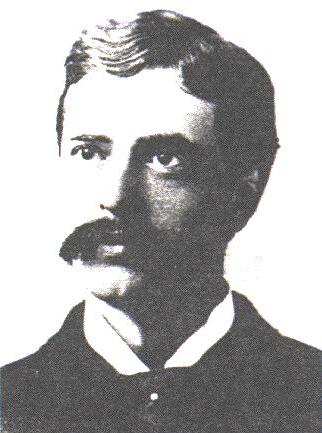
    Irving Fisher
    With this in mind, consider Ross Douthat's New York Times editorial on “Eugenics, Past and Future.” In it, he describes Irving Fisher, the late Yale economics professor who was an outspoken racist and advocate of eugenics.  As Yale Alumni Magazine recalls, Fisher's ideas included that birth control be “‘extended from the white race to the colored’ and to other ‘undesirable’ ethnic and economic groups, ideally under the control of a eugenics committee established to ‘breed out the unfit and breed in the fit.’

    Occasionally, we still see this disgusting impulse rear its ugly head, like the February 2012 Detroit News editorial that advocated putting contraception in Michigan's public drinking water to prevent children from being born to “immature parents,” families made up of mothers who are “poor women who can't afford  [children]” and fathers who are “sorry layabouts who spread their seed like dandelions.”  But Douthat rightly acknowledges that such state-run eugenics is no longer in vogue.  He is also right that it has been replaced with something equally dire, in the form of eugenic abortion:
    That scenario is all but unimaginable in today’s political climate. But given our society’s track record with prenatal testing for Down syndrome, we also have a pretty good idea of what individuals and couples will do with comprehensive information about their unborn child’s potential prospects. In 90 percent of cases, a positive test for Down syndrome leads to an abortion. It is hard to imagine that more expansive knowledge won’t lead to similar forms of prenatal selection on an ever-more-significant scale. 
    Is this sort of “liberal eugenics,” in which the agents of reproductive selection are parents rather than the state, entirely different from the eugenics of Fisher’s era, which forced sterilization on unwilling men and women?
    The user comments are eye-opening, showing both the depth to which the “liberal eugenics” impulse has taken root amongst Times readers, and also proving Stith's point about the manner in which legalized abortion takes the social net away from disadvantaged mothers, and the mothers of the disabled.  For example, the most recent user to post (whose comment has, as of this writing, been “liked” 78 times), wrote:
    I have no problem with someone choosing to have a severely disabled child, but I am adamantly opposed to society then being forced to pay for the care. Our choices in life have consequences, and when the economic consequences are externalized, as is commonly the case now, the individual choice then becomes a forced societal choice.
    Several other comments sound a similar tone.  Obviously, the women in question didn't intentionally conceive children that were severely disabled, so the “choosing” that the woman is to be punished for is her refusal to have an abortion.  There you have it.  Her choice, her problem.