Showing posts with label science. Show all posts

Just How Effective is Natural Family Planning, Anyway?

0 comments
One of the major arguments surrounding natural family planning is on its effectiveness. Critics of NFP claim isn’t all that effective at family planning. In part, this misconception is due to two things:
Charles Auguste Romain Lobbedez, Family Time (1876)
that, despite its name, it
  1. There are a wide variety of practices thrown together under the name “NFP.” If you threw every means of contraception together (from sterilization to withdrawal), you would end up with accurate-but-virtually-meaningless statistics. So it is with NFP: the “Standard Days” method is far less accurate than the sympothermal method. By far less accurate, I mean that even when used perfectly, it results in more than ten times the number of unplanned pregnancies (5% v. 0.4%). So when you hear a generic number about “NFP effectiveness,” realize that it might be including some fairly unreliable methods.

  2. Couples that practice NFP tend to want, or at least be open, to large families. In other words, the overlap between “couples who use NFP” and “couples who don’t think of children as diseases to be prevented” is substantial. So unsurprisingly, NFP-practicing couples tend to have large families. That looks like a bug, but is a feature (after all, many couples use NFP to have more children, not fewer).
Because of reason # 1, there are misleading (and imprecise) statistics on NFP effectiveness. Because of reason # 2, there’s a lot of anecdotal evidence leading people to think that NFP means large families, and therefore (the assumption goes), NFP mean lots of unplanned pregnancies.

So what are the real statistics?

Lets turn to two sources. First, “Contraceptive Failure in the United States” by James Trussell of the Office of Population Research at Princeton University. Trussell has a helpful chart (page 398 of this PDF) showing the unplanned pregnancy rate per year of a wide variety of family-planning methods, including all sorts of contraception and NFP.

From this chart, we see that sympto-thermal NFP, when used perfectly, was about as effective as the the Pill (0.4% and 0.3% unplanned pregnancy rate, respectively), and far more effective than either male (2%) or female (5%) condoms.

The only shortcoming to Trussell’s work is that it only lists the “perfect-use” percentages for each specific form of NFP. So while he tells us that typical use for the Pill involves 9% of women getting pregnant within a year, along with 18-21% of women relying on condoms, we don’t have a way to directly compare that with typical use symptothermal.

Fortunately, he cites to a large-scale study examining the topic. This study found that symptothermal NFP, when used perfectly, resulted in an annual 0.4% pregnancy rate. Overall, the typical-use rate was 1.8%. Even for women who had “unprotected” sex during their fertile period, the pregnancy rate was only 7.8% (since these couples tended to avoid the earliest, and most fertile, part of the woman’s fertile period). [Here is the study, and a very-readable summary of it.]

Comparing NFP to the major forms of contraception directly, here’s what we see:

“% of women experiencing an unintended pregnancy
within the first year of use”

“Typical Use”
“Perfect Use”
Combined pill and progestin-only pill
9%
0.3%
Female condoms
21%
5%
Male condoms
18%
2%
Withdrawal
22%
4%
Symptothermal NFP
1.8%
0.4%

Other studies appear to confirm similar effectiveness for the Creighton Method (1.2% perfect use; 2.0% typical use). The statistics paint a clear picture. When it comes to family planning, symptothermal NFP typically is far more reliable than condoms or the Pill.

So even apart from moral justifications, NFP produces the same results or better, without the risk of horrible side effects accompanying many forms of contraception. For example, many contraceptives carry the risk of preventing pregnancy for years after use: in short, they work too well at inhibiting fertility.

To take another case, the European Union has called for a $47 billion clean-up plan to purify the water system in the United Kingdom, after it was revealed that ethinyl estradiol (the primary ingredient used in birth control pills) was leading to intersex fish, and collapsing fish populations. So these drugs are unhealthy and unsafe for a fish to ingest, yet our culture has convinced women to poison their bodies with them. As a result, everyone who drinks the water is at risk. Given that these pills aren’t substantially better at preventing pregnancies than NFP (in theory or in practice), this is all the more tragic.

The Other Implications of NFP Effectiveness

Ary Scheffer,
Faust and Marguerite in the Garden (1846)
So NFP advocates are right: natural family planning really does work at family planning. But that only accentuates the need for NFP not to turn into the “Catholic-friendly contraception” that its critics claim.  Certainly, there’s nothing wrong with being responsibility about your sexuality. On the contrary, all human actions demand prudence, and a life-changing action like sexual intercourse calls for far more prudence than preparing dinner or determining the shortest route to the bank.

There is no virtue in treating your sexuality in an animalistic way. As Pope Paul VI noted in paragraph 10 of Humanae Vitae: “With regard to man's innate drives and emotions, responsible parenthood means that man's reason and will must exert control over them.” And Pope Pius XI, back in 1930, acknowledged that this “virtuous continence” was permitted in matrimony, as long as both parties consent. So being responsible about your sexuality is virtuous, and even necessary.

But a virtue is the mean between two extremes: and just as you can be reckless about your sexuality, you can also be obsessively controlling. An over-reliance on NFP to space or prevent the creation of new life can close its practitioners off to life. Worse, it can be symptomatic of an unhealthy approach to life in general: a need for more control than is warranted.

In the discussion of why NFP is okay when contraception is not, in paragraph 16 of Humanae Vitae, Paul VI explained that it was to be used only for good reason:
If therefore there are well-grounded reasons for spacing births, arising from the physical or psychological condition of husband or wife, or from external circumstances, the Church teaches that married people may then take advantage of the natural cycles immanent in the reproductive system and engage in marital intercourse only during those times that are infertile, thus controlling birth in a way which does not in the least offend the moral principles which We have just explained.
NFP was never intended to be the normal or ideal way that Catholics engaged in the marital act. It’s not healthy, virtuous or wise to obsess over NFP, particularly when one has the resources to welcome another child.

My concern is that NFP seems to be presented as the normal or ideal way that Catholics should approach their sexuality. And without a doubt, it’s far better than contraception. Back in 1880, the Sacred Penintentiary confirmed that “a confessor may, with due caution, suggest this proposal [avoiding intercourse during fertile periods] to spouses if his other attempts to lead them away from the detestable crime of onanism [that is, the “withdrawal” method] have proved fruitless.” So if the choice is between contraception (which is sinful), and NFP (which isn’t), easy choice.

But if the choice is between NFP and simply being open to new life without trying to make a plan, the latter is even more ideal. NFP has never been the ideal way to approach human sexuality, and if you find that you’re over-reliant on it (particularly if you have the resources to welcome another child), it might be time to take a step out in faith, and trust God not to give you more than you can handle.

Update: The second section above is intended to refer to using NFP to prevent pregnancy. I’ve modified one of the sentences to eliminate ambiguity on this point.

The Chicken-and-Egg Problem for Abortion

0 comments
A chick beginning to hatch
You’re likely familiar with the philosophical problem, “which came first, the chicken or the egg?” But I want to pose a different sort of chicken-or-egg question for those abortion supporters who claim things like “My Body, My Choice.”

In the case of non-mammals like chickens, fertilized eggs develop outside of the mother’s body, so we can actually watch embryonic development occur. It’s a fascinating process. The chick grows inside the egg until she’s old enough to hatch, and then she hatches herself, by pecking her way out of the egg.

It’s worth asking two questions.

First, was the chick inside the egg alive before she hatched? Of course. If her life began at birth, she couldn’t have pecked her way out of the shell. Dead chicks don’t peck. For that matter, if she wasn’t alive, she couldn’t grow inside her shell. Metabolism is one of the key markers for life, since dead things don’t metabolize. And of course, it’s absurd to suppose that a dead egg suddenly turned into a living chick.

Second, was the chick a distinct living being prior to hatching? This answer is equally obvious: the chick is a living being distinct from her mother. If the hen looked down at the egg, and said “My Body, My Choice!” she’d be objectively wrong. The chick is a different being, with her own tiny body, and with her own genetic code. She is, by every scientific standard, a distinct organism.

A chick emerging from her egg
Sure, she’s still reliant upon her mother to live. The hen could easily kill her chick, either actively (by crushing the egg), or passively (by simply refusing to care for the egg). But the fact that someone’s life is entrusted to you doesn’t make them part of your person.

Of course, there’s one important difference between chickens and humans in this regard: in the case of unborn babies, they grow in an egg inside the mother. That’s it: that’s the incidental characteristic of human development that the entire argument for abortion is based on. If human babies grew like chicks, or if they grew in test tubes, we wouldn’t hesitate for a second to recognize them for what they are: living human beings, distinct from their mothers.

Of course, the fact that they grow in eggs inside their moms, instead of growing in eggs outside of their moms is an accident of geography. “My Body, My Choice” is just bad science. You can’t seriously claim this without grossly misunderstanding human anatomy or reproduction. It’s someone else’s body, your child’s body, and if it’s “your choice” to destroy her body, it’s just because she’s too helpless to defend herself.

The Single Best Argument Against Philosophical Materialism?

0 comments
Robert Ritchie, commenting on Wednesday's post refuting philosophical materialism, raised another important line of argumentation: that we can see that philosophical materialism is false because of “the reliability of our cognitive functions.” Ritchie described the argument as “exceedingly powerful,” and “for my money, is the best single argument against materialism.” I’ll let you be the judge of that; it is, in any event, a very good argument. What follows is Ritchie’s explanation of the argument:
A Dilemma for Materialists
It is often difficult to get intelligent atheists to seriously consider arguments for the truth of Christianity. They will not listen, for example, to an argument for the resurrection because their worldview fundamentally excludes any event of that sort. In light of this, it seems to me that Christians need to attack this worldview--i.e. “materialism”--before they engage in other apologetical arguments.
Here’s a dilemma for materialists designed to do just that:

  1. Either subjective experience, in its capacity as subjective experience, is relevant in the explanation of behavior or it is not.
  2. If subjective experience is relevant in the explanation of behavior, then materialism is absurd (more than that, it is unambiguously false).
  3. If subjective experience is not relevant in the explanation of behavior, then materialism is absurd.
  4. Therefore, materialism is absurd.

    Premise (1): A Philosophical Axiom


Premise (1) is, as should be quite obvious, not controversial at all. It appeals, in philosophical jargon, to the “law of the excluded middle”, which holds that for any assertion X either X is true or not-X is true. One example of this axiom is that either Barack Obama is a horse or he is not a horse. There can be no “middle” position wherein he is somehow neither of those two possibilities. Premise (1) is simply another example of the same axiom where “subjective experience, in its capacity as subjective experience is relevant in the explanation of behavior” is used instead of “X” or “Barack Obama is a horse”. 

Premise (2): A Definitional Point

“Materialism” is a term used somewhat inconsistently by philosophers. However, materialists of every stripe are at least committed to the “causal closure of the physical domain.” For this reason, the truth of materialism and the explanatory relevance of subjective experience are mutually exclusive.

Perhaps most commonly, “materialism” is used interchangeably with “physicalism” as the view that everything including people consist of nothing by physical matter and that a person’s mental states just are (or at least are reducible to) physical states of their brains. But I am using the term in a broader sense to encompass the position known as “dual aspect theory” (or sometimes “property dualism” or “non-reductive materialism”) as well.

Dual aspect theorists are willing to admit that mental states are something distinct from physical states and that they are not reducible to physical states. This means, as the dual aspect theorist David Chalmers has put it, that our mental states are such that they could not be explained by anything we could reasonably apply the term “physics” to. Rather, on this theory there are as-of-yet undiscovered “psychophysical laws, specifying how [mental states] depend on physical properties.”

Importantly, however, both physicalism and dual aspect theory (and any other theory that could reasonably come under the term “materialism”) is committed to what may be called “The Causal Closure Thesis”: That there are no non-physical causes that operate on the physical level. This does not rule out the possibility—important to some theories of quantum mechanics—that some physical events are uncaused and random. But it does mean that even though the dual aspect theorist admits that non-physical mental states exist, he denies that they have any effect on the physical domain.

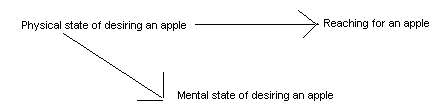
As Chalmers puts it, “the physical domain remains autonomous,” and “the view makes experience explanatorily irrelevant.” Rather, the true explanation of behavior may be diagramed as follows:


The sole explanation of the behavior in question (reaching for an apple) is the antecedent physical cause of that behavior. There may be an arrow from a physical state of affairs to the mental state of desiring an apple, but there could never be an arrow from that or any other mental state to a physical result. Stephen Hawking is a materialist and demonstrates his commitment to this position in his recent book The Grand Design:  

“Recent experiments in neuroscience support the view that it is our physical brain, following the known laws of science, that determines our actions, and not some agency that exists outside those laws… It is hard to imagine how free will can operate if our behaviour is determined by physical law, so it seems that we are no more than biological machines and that free will is just an illusion.”

Therefore, if materialism is true, then subjective experience, as Chalmers has put it, is “explanatorily irrelevant”; Premise (2), in other words, is sound.

Premise (3): Why Materialists Can’t Employ an Evolutionary Theory of Knowledge

It is tempting to jump to an overly simple objection to the materialist position at this point. Physics is governed by physical laws, not reason. As Victor Reppert has put it, when there is an avalanche the rocks do not move as they do because they think it would be a good idea to do so, but because they “blindly” obey non-rational physical laws. Why should we expect the atoms in our brain to behave any differently? Shouldn’t they too blindly follow non-rational physical laws? And, if so, why should we expect the result of such non-rational behavior would be rational and trustworthy? And, of course, the materialist must, to avoid absurdity, think his mental states are rational and trustworthy or else he could have no reason for believing materialism to be true in the first place.

C.S. Lewis used this as the basis for an argument for the existence of God in his book The Case for Christianity:

“Supposing there was no intelligence behind the universe, no creative mind. In that case, nobody designed my brain for the purpose of thinking. It is merely that when the atoms inside my skull happen, for physical or chemical reasons, to arrange themselves in a certain way, this gives me, as a by-product, the sensation I call thought. But, if so, how can I trust my own thinking to be true? It's like upsetting a milk jug and hoping that the way it splashes itself will give you a map of London. But if I can't trust my own thinking, of course I can't trust the arguments leading to Atheism, and therefore have no reason to be an Atheist, or anything else. Unless I believe in God, I cannot believe in thought: so I can never use thought to disbelieve in God."

But haven’t we  made that dangerous inference Richard Dawkins is always warning us about from the appearance of design to the existence of design? And, in this case, like so many others, shouldn’t we look to Darwinism to set us straight? William Hasker provides a nice summary of the position:

“The central idea of ‘Darwinist epistemology; is simply that an organism’s conscious states confer a benefit in the struggle to survive and reproduce. Such responses as discomfort in the presence of a chemical irritant, or the awareness of light or warmth or food, enhance the organism’s ability to respond in optimal fashion. For more complex animals there is the awareness of the presence of predator or of prey, and the ability to devise simple strategies so as to increase the chances of successful predation or of escape therefrom. As the organisms and their brains become more complex, we see the emergence of systems of beliefs and of strategies for acquiring beliefs, and the strategies that lead to the acquisition of true rather than false beliefs confer an adaptive advantage. Natural selection guarantees a high level of fitness, including cognitive fitness.”

But though this Darwinist sort of reasoning is quite convincing as an explanation of the apparent design of certain physical attributes of living things (such as the warm coat of arctic animals or the beaks of finches) it is unconvincing as an explanation of the reliability and rationality of mental states under a materialist worldview. This is because on such a worldview, as I noted above, subjective experience is utterly irrelevant as an explanation of one’s behavior. If this is true, then there is no survival advantage to proper thinking, meaning that evolution would be powerless to naturally select for proper thinking.

For example, if one person reacted to a vile of poison with the thought that poison is healthy and delicious and the physical state of running from the poison his thinking would be naturally selected over a person who reacted to the vile by thinking poison is poisonous and proceeded to take a sip. As Hasker puts it, on materialism “conscious experience is invisible to the forces of natural selection.” Or, in Chalmers’ colorful words “[t]he process of natural selection cannot distinguish between me and my zombie twin.”

In light of this, we can see that if subjective experience is not relevant in the explanation of behavior, then we have no reason for believing our thoughts to be true and, therefore, no reason for believing that subjective experience is not relevant in the explanation of behavior. Any position we might take under such conditions would be absurd, so Premise (3) is sound.

A Religious Conclusion

All right, materialism is absurd. So what?  Thomas Nagel notes that we shouldn’t jump to the conclusion that Christianity or even theism is true from such an argument. He calls the “overuse of evolutionary biology to explain everything about life, including everything about the human mind” “ludicrous.” And admits that “the capacity of the universe to generate organisms with minds capable of understanding the universe… has a quasi-religious ‘ring’ to it.”  But he concludes that “I think one can admit such an enrichment of the fundamental elements of the natural order without going over to anything that should count literally as religious belief. At no point does any of it imply the existence of a divine person.”

I think that Nagel is right about this. In fact, even C.S. Lewis provides further evidence for this position. Lewis converted from Atheism in reaction to the argument above (or something very near to it). But he did not immediately convert to Christianity. Instead, he sought refuge in the philosophy of absolute idealism.

But such philosophies have problems, which is why you see so few absolute idealists today. And, in any event, once materialism is given up, the door for Christian apologetics is thrown wide open. A reassessment of the argument for the resurrection, for example, is warranted.


Does the Immaterial Exist?

0 comments
One of the most common arguments from atheists is that matter is all that there is, and that the immaterial (God, angels, the human soul, etc.) simply doesn’t exist. This position is generally called “philosophical materialism,” although that term encompasses a number of distinct positions. In any case, here’s one of the clearest presentations of this argument:
When we speak of immaterial things, we are speaking of something that has no physical substance. Now, if you think about this, everything we know to exist has physical properties. Your arm, leg, mind, blood, teeth, tongue, and everything else are physical. They are in the form of your physical body. Your brain can’t work without physical/material processes of chemistry and electricity. Electricity can’t work without the physical electrons. A windmill can’t work without the physical air that passes across its blades. Everything we know to exist is physical. [….] 
So, if God is not material, what is God? If there is no answer for what God is, all we can say is God doesn’t exist, or he exists nowhere and is comprised of nothing, which I don’t see how that isn’t the same exact thing. It is rather interesting how the theist description of what there God is actually puts their God out of existence.
Or, a shorter version of essentially the same argument:
If we are talking about immaterial existence, then there is nothing to differentiate an entity or "thing" which exists from one which does not exist.

Often (including in the second link provided), these discussions descend into debates over speculative science: whether or not dark energy or photons have mass, etc. But I think that this materialist argument can be answered easily, using agreed-upon evidence. In other words, the fact that the universe is made up of something other than matter is self-evident, and should be admitted by anyone, upon close reflection. In addition to matter, we also see immaterial forms that can dictate the nature and behavior of the matter itself.

We can observe forms in nature, and cannot account for them in purely material ways. This is true even of forms that cannot exist apart from matter.  Consider the following examples, from most to least technical:
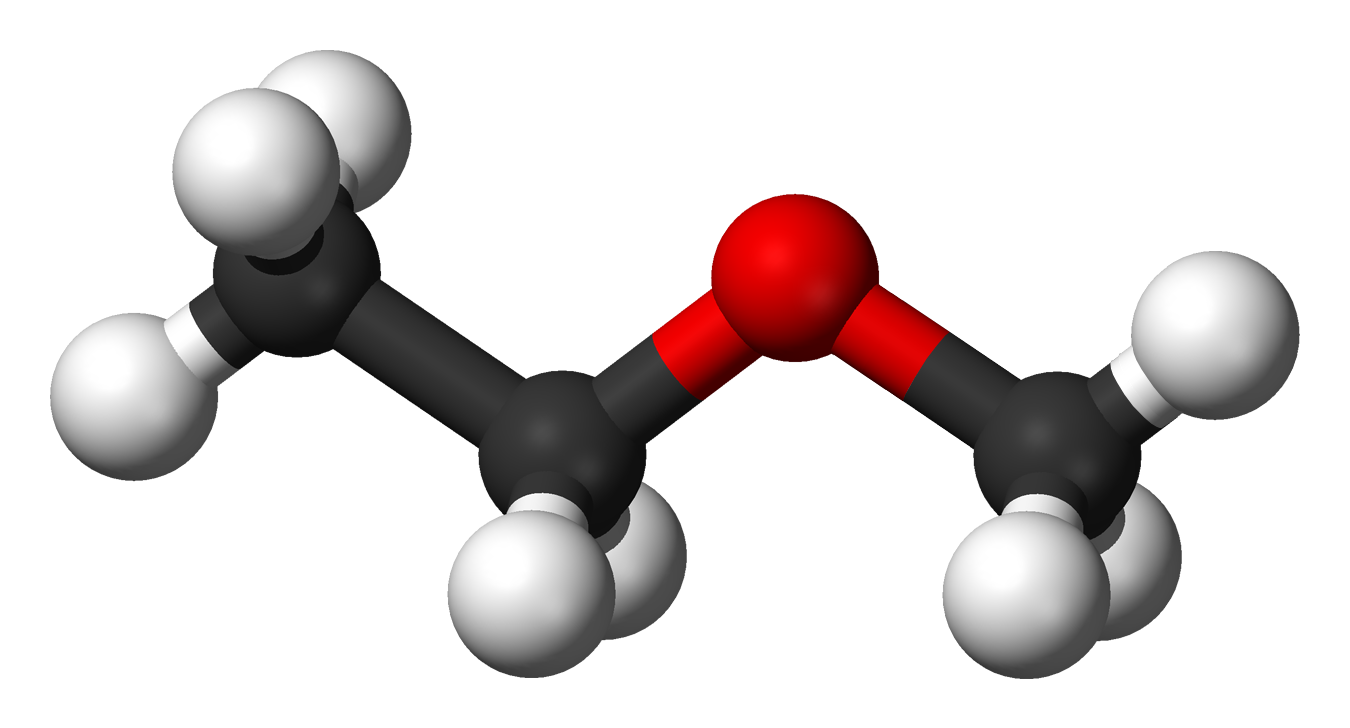
The molecular structure of isopropyl alcohol.
(Black = carbon, white = hydrogen, red = oxygen).
  1. Isomers: This is my favorite example. When two or more (different) compounds share the same molecular formula, you have isomers. For example, there are three different compounds with the molecular formula C3H8O: methoxyethane (a colorless gas that is extremely flammable and reactive); propanol (a liquid solvent used in the pharmaceutical industry); and isopropyl alcohol (rubbing alcohol).

    These are different substances, with different chemical properties. Yet these differences are not material. They’re formal. That is, each of the three substances is made up of the identical atoms: 3 carbon, 8 hydrogen, and one oxygen. It is the arrangement of those molecules that determines whether the substance will be methoxyethane, propanol, or rubbing alcohol. The same matter, in different forms, produces different substances.

  2. Phase Changes: A more obvious example of this would be the phase changes of water. Depending on its form (solid, liquid, or gaseous), it exhibits different properties, and is structured differently. Yet it maintains the same molecular and structural formula.

  3. Surfaces: The surface of a table is not the table itself. Surfaces are immaterial, and have no mass, and occupy no three-dimensional space. If you doubt this, try to imagine a surface that is 3 feet deep. Whatever you are visualizing is not a surface, but a substance with surfaces of its own. But we can still observe that surfaces exist.

  4. Shapes: Envision two different objects of equal mass, made of identical materials. The first is a wooden cube, and the second is a wooden sphere. The difference between the two objects wouldn’t be material, but formal.
In each of these cases, the form itself is immaterial. To test this, take your wooden objects, and remove the matter that they have in common (the wood). Likewise, take your isomers, and remove the matter that they have in common (the carbon, hydrogen, and oxygen). The result will be the same: you will be left with nothing. But does that mean that the different objects were, in fact, the same? Of course not. It means only that, in each of these cases, differences exist between the substances, but these differences cannot be isolated by removing the material common to each. That’s because these differences are immaterial, rather than material.

Those cases are obvious enough. A less obvious, but dramatically more important, example of a perceivable form is life itself. Consider what philosopher Peter Kreeft fittingly named the “Dead Cow Argument”: you come across two cows -- one that is alive, and one that has just died. What is the difference between these two cows? Craig Payne, quoting Kreeft, explains:
“There appears to be no material difference (e.g., in size or weight or color) between the two cows. Yet something is clearly missing. What is it?” The obvious answer is that the cow is “clearly missing” its life – its “soul” or anima, in other words, its animating principle or form, that which causes the cow to live and develop as a cow.
So the living and the dead cow, at this point, are still materially identical. Nevertheless, we can immediately observe that an immaterial difference exists, and a radically important one. As Kreeft notes, both cows have air in their lungs, but only one can breathe. This distinction is, as noted above, the “animating” principle of the matter: the form enabling a particular material substance to live. It is from this that we have the simplest understanding of what a soul is: the animating principle of a body.

Certainly, this is only the beginning of a discussion on the soul, not the end. We’re still left to determine what sort of a thing the immaterial soul is, whether a human soul is like a cow soul, and so on.  But this line of reasoning does dispel the absurd notion that the material is all that there is.

Science v. Religion on When Life Begins

0 comments
One of the looming questions in the abortion debate relates to when human life begins.  From a scientific perspective, this question has been solved for centuries, thanks in part to the work of a seventeenth-century Italian scientist by the name of Francesco Redi.  And it’s left the opponents of the scientific view appealing lamely to outdated religious definitions.

I. Francesco Redi and the Theory of Spontaneous Generation

In 1688, Redi debunked a then-popular theory, namely, spontaneous generation, that claimed that dead things could spontaneously give rise to new life. This view dates back at least to Aristotle, who mistakenly taught (and by the way, this is where it’s about to get a little gross) that certain insects spontaneously originated “from putrefying earth or vegetable matter,” while “others are spontaneously generated in the inside of animals out of the secretions of their several organs.

An illustration from Francesco Redi’s 1688 work
debunking spontaneous generation. (h/t Scientus)
It was based on a simple mistake: if you leave meat out, it’ll eventually start rotting, and you’ll see maggots and flies crawling around on it, and the dead meat seems to be turning into these living creatures.  Of course, what was really happening was that maggots and flies were eating the rotting meat, and then laying tiny eggs, which eventually hatched.  But people generally didn’t know that, until Francesco Redi used a simple experiment to disprove spontaneous generation:
Francesco took eight jars, placed meat in all the jars, but covered four of the jars with muslin. Maggots developed in the open jars but did not develop in the muslin-covered jars.
In other words, dead things (like rotting meat) don’t suddenly become baby flies. So no matter who or what we’re talking about, from maggots to men, a simple principle is at play: living things come directly from other living things. Dead things don’t suddenly spring to life.

For some reason, in the abortion debate, this is still a revolutionary idea.  The scientific position, shared by pro-lifers, is simple: the father’s (living) sperm and the mother’s (living) egg form a (living) offspring when the two fuse (a moment in time known as conception or fertilization).  This living offspring is both alive and is distinct from each parent.  As Evangelium Vitae puts it:
[F]rom the time that the ovum is fertilized, a life is begun which is neither that of the father nor the mother; it is rather the life of a new human being with his own growth. It would never be made human if it were not human already.
Simple, scientific stuff.  Two living beings create a third living being.  The “pro-choice” side of the debate can’t acknowledge this without admitting that the “choice” in question is the killing of a living human being (albeit a tiny one), and yet they can’t deny it, either. To deny it would be to say that, at some point in the pregnancy cycle, a non-living embryo simply springs to life: the very sort of absurd spontaneous generation that Redi’s opponents believed in.

So what does the pro-abortion side do? Ignores the science, and obfuscates instead. Let me show you what I mean.

II. Using Religious Dogmatism Against Science

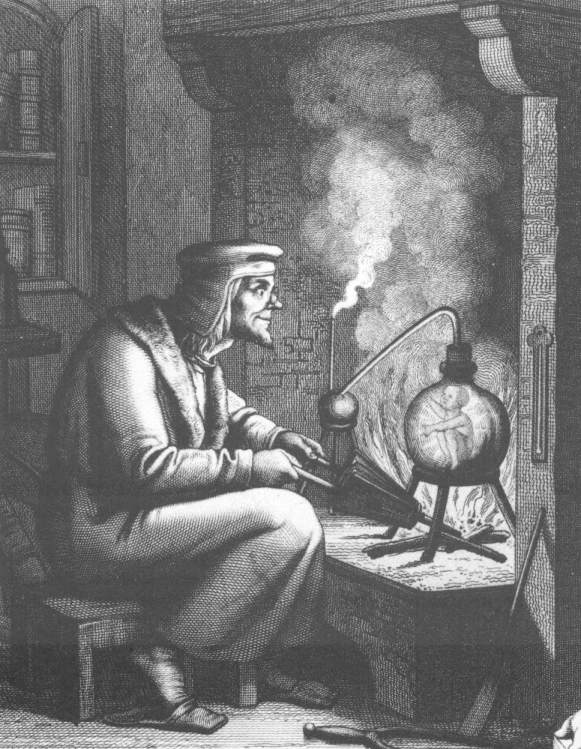
19th century engraving of
Faustus and the Homunculus
The online website My Family Doctor routinely hosts debates on a variety of issues including, “When Does Life Begin? Medical Experts Debate Abortion Issue.”  They began the article thusly:
In every political season, abortion emerges as one of the most hotly debated topics. It draws in everybody—from the religious to the political. But what about the scientists?
In fact, My Family Doctor seems to have had trouble finding actual scientists willing to claim that life begins after conception (for precisely the reason outlined above). The only doctors, scientists, and scientific organizations mentioned in the piece either agree that life begins at conception, or avoided answering the question.  This is part of a broader pro-choice strategy of simply ignoring the science and hoping that it’ll go away:
“Pro-choice docs would say that it is not their business to determine for a patient when life begins,” says Diana Philip, interim executive director of the National Coalition of Abortion Providers and its sister organization, the Abortion Conversation Project. “Ultimately each patient determines the value and definition of life and that definition lies within her own mind and heart.”
See? Who cares about the science, when “each person” can make up their own “definition of life” within their own heart?  Maybe Francesco Redi’s opponents could have employed a similar tactic, printing bumper stickers like “Don’t believe in spontaneous generation? Don’t leave rotting meat out.”

The reason the pro-abortion side is reduced to holding their ears until science goes away is that science is really clearly on the pro-life side.  As Donna J. Harrison, M.D., of the American Association of Pro Life Obstetricians and Gynecologists put it, “any biologist in the world can tell you that a mammal’s life begins when the sperm from the father unites with the egg from the mother.

Harrison’s debate opponent wasn’t actually a doctor or a scientist at all (despite the article’s introduction), but a professor from the University of Puget Sound’s Department of Religion, Dr. Suzanne Holland. Following the pro-choice strategy described above, Holland ignores science almost completely, and refuses to actually say when life begins.  She gives four possible answers.  First, the position that she falsely ascribes to the Catholic Church:
The Twins Georg and Regula Rahn, Zürich, 1752.
The genetic view (the position held by the Roman Catholic Church and many religious conservatives) holds that life begins with the acquisition of a novel genome; it is a kind of genetic determinism. 
As we saw above, the Catholic position is based on fertilization, not simply “genetic determinism” revolving around a “unique genome.” After all, identical twins have the same genome, but distinct epigenetics. If this really were the Catholic Church’s position, She’d have to deny that each twin was a unique individual.

Holland proceeds to lay out three alternative views, each holding to some view of spontaneous generation: that the non-living child simply springs to life.  The first alternative is the
Those who hold the embryologic view think life begins when the embryo undergoes gastrulation, and twinning is no longer possible; this occurs about 14 days into development. (Some mainline Protestant religions espouse a similar view.) 
This view requires holding that at some indistinct point in the second week of development, a non-living being becomes a living being by losing its ability to divide into two distinct individuals.  This is ironically anti-scientific, since this same process of cellular division and reproduction is used in other organisms to prove that they are alive, not dead.  Likewise, this view would “prove” that plants and microbes aren’t alive, since they reproduce asexually.
Proponents of the neurological view adhere to brainwave criteria; life begins when a distinct EEG pattern can be detected, about 24 to 27 weeks. (Some Protestant churches affirm this.) Interestingly, life is also thought to end when the EEG pattern is no longer present. 
This requires believing that a non-living creature somehow brought itself to life by ... generating its own brain.  Plus, several people who showed no EEG activity were declared “dead” before fully recovering, like Karen Arbogast or Zack Dunlap.  So maybe that’s not the best rubric to use, particularly standing alone?  Finally:
Unborn child, aged twenty-one weeks
Finally, one can say that life begins at or near birth, measured by fetal viability outside the mother’s body. (Judaism affirms something close to this position.) After all, somewhere between 50 and 60 percent of all embryos conceived miscarry.
This is the most absurd of the choices, since viability depends on the child and the culture. Roe defined viability at 24-28 weeks, but since then, plenty of children born in the two weeks before that have survived, due to technological improvements.  It makes absolutely no sense to say that a 23-week old fetus in America is alive, while a 23-week old fetus in Zimbabwe is dead.  And of course, even the prematurely-born children who died... died... which shows that they were previously alive.
    Each of these alternative views is also trying to claim that life begins at a certain point in embryonic or fetal development. This is self-evidentially absurd, since the unborn child must be alive in order to grow and develop in the first place!

    Holland doesn’t actually commit to any of these positions. To do so would open herself up for debate on the issue (and show the absurdity of each view). All she’s trying to do is muddy the waters, to make the issue of when life begins look unclear. It’s not.  And since she can’t marshal any science to support her claim, Holland is left claiming that some unspecified Protestant and Jewish groups support her.  But the question of when life begins is a scientific question, whatever else it may be. If some religious group comes along and defines it at your fourteenth birthday, that doesn’t invalidate the science. It invalidates the religious group.

    Of course, if it was the pro-life side using religious dogmas to deny objective science, we would be ridiculed in popular culture, and quite reasonably, for waging a “war on science.” But we’re quite comfortable with the science here.

    III.  When Life Begins Scientifically

    As I said above, the science on when life begins is perfectly clear.  The only scientific source Holland cites to is Dr. Scott Gilbert, author of an article entitled “Against Science and Scripture.”  In it, he makes the same argument that there are four possible places life could begin, and like Holland, relies on a combination of bad science and, mostly, bad Biblical exegesis.  But while Gilbert feigns confusion on when human life begins, he has no trouble knowing when life begins for every other mammals.  From his textbook on developmental biology:
    Newborn Golden Retriever puppies
    Traditional ways of classifying catalog animals according to their adult structure. But, as J. T. Bonner (1965) pointed out, this is a very artificial method, because what we consider an individual is usually just a brief slice of its life cycle. When we consider a dog, for instance, we usually picture an adult. But the dog is a “dog” from the moment of fertilization of a dog egg by a dog sperm. It remains a dog even as a senescent dying hound. Therefore, the dog is actually the entire life cycle of the animal, from fertilization through death. 
    [....]
    One of the major triumphs of descriptive embryology was the idea of a generalizable life cycle. Each animal, whether an earthworm, an eagle, or a beagle, passes through similar stages of development. The major stages of animal development are illustrated in Figure 2.1. The life of a new individual is initiated by the fusion of genetic material from the two gametes—the sperm and the egg. This fusion, called fertilization, stimulates the egg to begin development. The stages of development between fertilization and hatching are collectively called embryogenesis.
    So every new individual creature, whether an earthworm, a beagle, or a human being, is an individual from the moment of fertilization.  Whether we say “dog” or “puppy,”  “human” or “fetus” is purely semantics.  From fertilization through death, a dog remains a dog, and a human being remains a human being.

    That’s science.

    Misunderstanding God: Where Atheists Go Wrong in Opposing Christianity

    0 comments
    A post I wrote last week on Catholicism and atheism received over 200,000 views and (as of this writing) over 900 comments.  Most of these were negative, but they were helpful in showing the areas that many atheists go awry in their opposition to religion.  I’m hardly the first to notice that the same errors get made time and time again. Fr. Robert Barron, of the popular Catholicism and Word on Fire series, has labelled these errors the “YouTube heresies.”

    Four of the major errors that Fr. Barron identifies are: (1) a misunderstanding of what Christians mean by God – whether God is understood as the highest Being or as the ground of Being itself; (2) a belief that Biblical literalism is the most accurate way to understand the Bible; (3) a belief in scientism, “the reduction of knowledge to the scientific way of knowing,” with a concomitant belief that religion and science are antithetical; and (4) the belief that religion is invariably violent. All four of these views were prominently featured in the comments, but I want to focus specifically on two of them: scientism (and its accompanying errors), and the misunderstanding of what Christians mean by “God.”

    A. The Trouble With Scientism 

    Msgr. Georges Lemaître,
    father of Big Bang Cosmology 
    Most of the atheists who commented seem to have started from the same philosophical assumption: that you can only know what you can prove, and that all proof is scientific proof.  In this view, “real” things are things that science can prove, while “faith” refers to the obstinate, and inherently irrational, belief in those things that aren’t “real.”  Both of the underlying propositions (that all knowledge is provable, and that all proof is scientific) are false, and this grossly misunderstands what Christians mean by “faith.”  Fr. Barron explained it this way, in Church and New Media:
    The sciences - and their attendant technologies - have been so massively successful that people have come, understandably enough, to see the scientific way of knowing as the only epistemological path. 

    Time and again, my conversation partners on YouTube urge me to admit that the only valid form of truth is that which comes as a result of the scientific method: observing the world, gathering evidence, marshaling arguments, performing experiments, etc. I customarily respond that the scientific method is effective indeed when investigating empirical phenomena but that it is useless when it comes to questions of a more philosophical nature, such as the determination of the morally right and wrong, the assessment of something’s aesthetic value, or the settling of the question why there is something rather than nothing.

    More to it, I argue that to hold consistently to scientism involves one in an operational contradiction, for the claim that all knowledge is reducible to scientific knowledge is not itself a claim that can be justified scientifically! But this appeal to metaphysics and philosophy strikes most of my conversation partners as obscure at best, obfuscating at worst.
    Since the claim that all truth must be scientifically provable is not itself scientifically provable, it’s self-refuting (by the claim’s own standard, it renders itself false).  More than that, such a claim would require us to disregard most of what we know (since most of our knowledge is not derived from scientific inquiry).

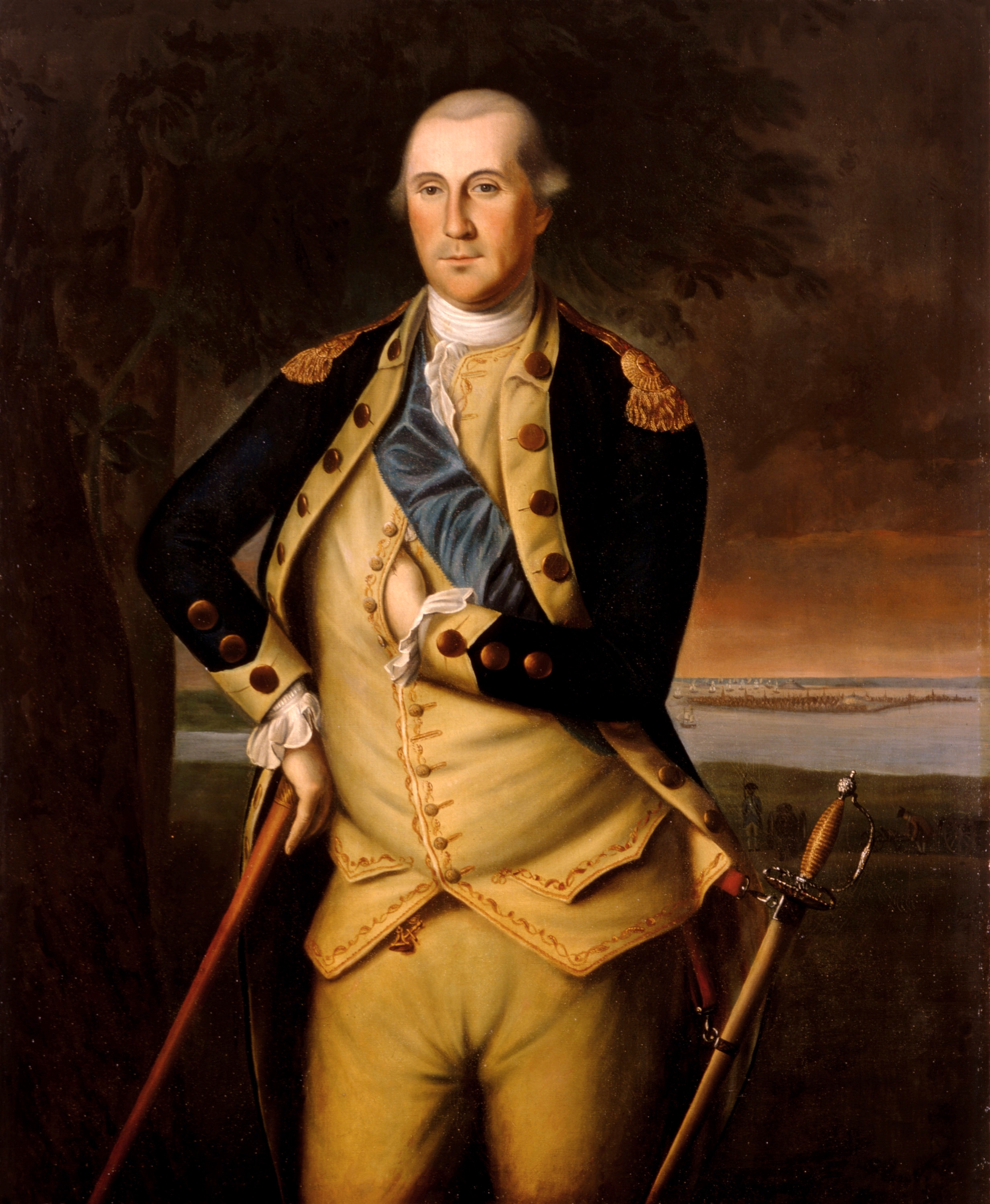
    Charles Willson Peale, George Washington (1776)
    For example, my own background is in history and law, neither of which confines itself to the methods used by the natural sciences. Lawyers, judges, and juries consider physical evidence where available, but also explicitly recognizes written and testimonial evidence as evidence as well.  Historians also look heavily to the written record, and base their findings off of what the eyewitnesses to history say.

    For example, “George Washington was the first president of the United States of America” is a factual claim, in a way that “George Washington was my favorite president of the United States of America” is not (since the latter is a subjective opinion). We can know that Washington was the first president, even though we cannot recreate his presidency in a lab experiment. Since it’s unrepeatable, the claim is not scientific, but it’s still true, and still a fact.

    In the original webcomic, Matthew Inman compared an individual’s religious belief to having a favorite color: that is, a subjective claim, and a matter of mere personal preference.  I stated in response that this view fundamentally misunderstands religion. We understand religion to be objectively true, as true as “3 x 3 = 9.”  This claim proved to be far more controversial than I anticipated. Apparently, several of the commenters assumed that since the Resurrection isn’t provable in the same manner than math is provable, it’s not equally true.

    In defending scientism, one of the commenters showed both the prevalence, and the intellectual weakness, of the methodology:
    “It's just a rational way of looking at things. If you have $100 in your pocket - take it out and show me - don't expect me to just blindly believe you have said $100 in your pocket because you read about it in a book or it came to you in a dream or some other no-win argument.”
    His own hypothetical shows the flaws in this approach. If a friend of yours has $100 in his pocket, this is true whether or not he proves it to you. Think about the old cliché about a tree falling in the forest: truth is true, whether or not it’s observable or testable (which, by the way, aren’t the same thing). And if you believed your friend when he told you that he had $100 in his pocket, this wouldn’t be simply “blind belief.” Rather, you’d be basing your belief off of evidence: namely, his testimony -- and he should know.  So it’s not as if you randomly came to this conclusion without reason or evidence (or on the basis of a dream, etc.): instead, you opted to believe the testimony of a witness.  In fact, it would be completely rational to believe your friend in this situation, unless you had some good reason not like (your friend is a notorious liar, etc.).

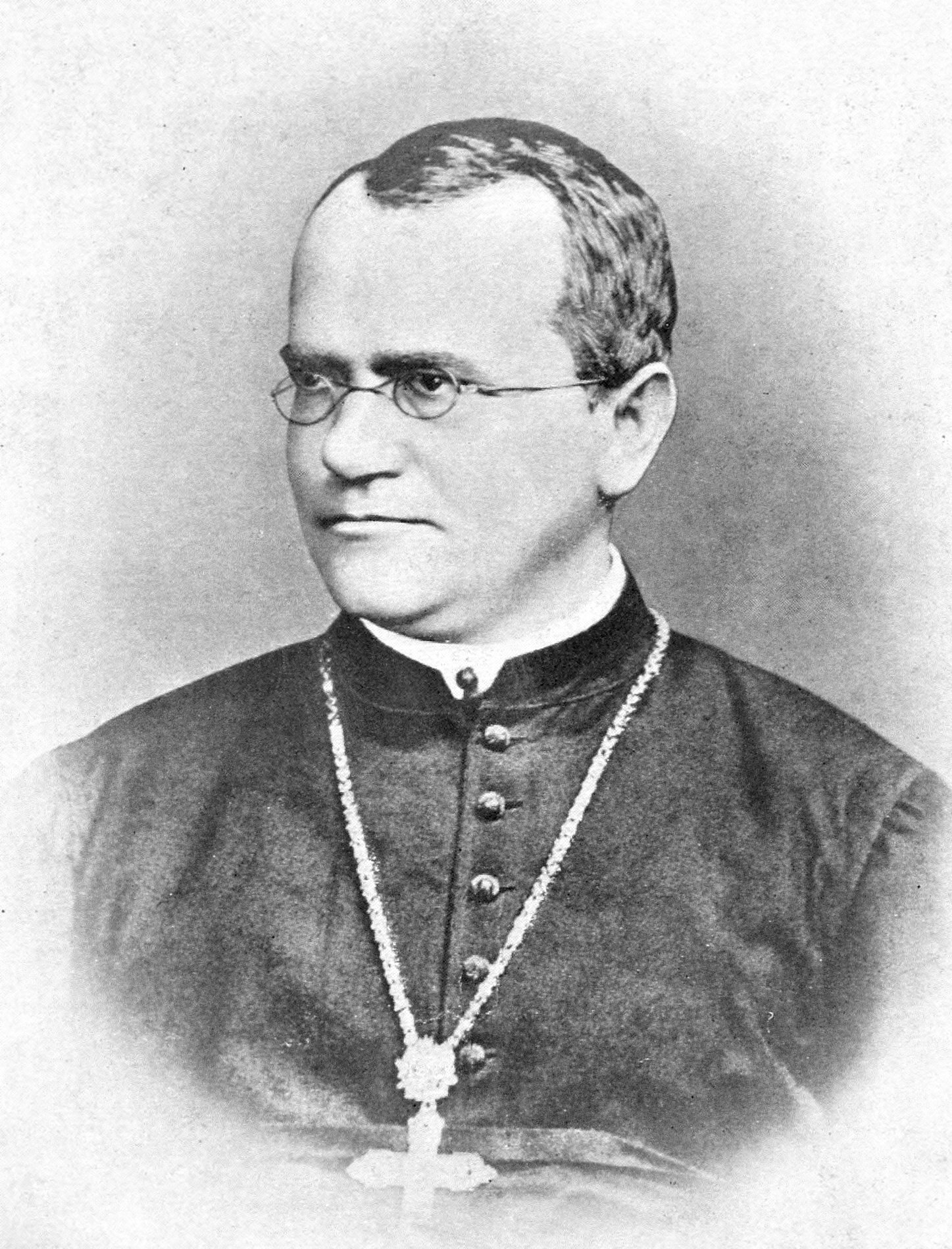
    Fr. Gregor Mendel,
    the “father of genetics”
    Drawing reasoned conclusions on the basis of witness testimony is one of the critical ways that the criminal justice system operates in this, and every, country.  It’s also what scientists do. They trust the testimony of other scientists without repeating every prior scientific test: the alternative, individually subjecting every claim to scientific testing, would be both functionally impossible and intellectually futile.

    For some reason, several of the atheists who commented persisted in demanding that religion be tested in the same way that empirical claims are tested within the natural sciences.  Or more accurately, they demanded it be proven in a way that even natural science isn’t:  “Prove your case. Prove it using testable, repeatable, independently-verifiable means. Do it in such a way that you remove all possibility of doubt.  Until you do this, your assertions have no validity, and no place in a thinking, progressive world.”  This standard is arbitrarily and unreasonably specific.  In limiting the acceptable proof to that which uses “testable, repeatable, independently-verifiable means,” the commenter is disregarding not only those truths known from theology, but also many of the truths known from history, philosophy, anthropology, archaeology, law, and so forth.

    But it’s not just the specificity of the standard that’s problematic: it’s also an arbitrarily, unreasonably, impossibly high burden of proof.  By this standard, the existence of a single atheist debunks Christianity.  This standard of proof seems to be drawn up out of thin air.  Certainly, Christianity doesn’t claim to provide evidence that no person could ever doubt. Neither, for that matter, does any field of science.  Nor could they, as even a scientific view that has survived rigorous testing could still prove to be wrong at a later day. This isn’t the standard that any facts are held to (including those in the natural sciences). It’s not even the standard we use in capital cases.  We’ve literally sent men to their deaths on less epistemological certainty than the commenter is demanding. We’ve also sent men to the moon on less certaint, since nothing within astronomy can be proven ‘beyond all possible doubt.’

    In that sense, then, this standard of proof would literally eliminate all knowledge, including scientific and mathematical knowledge.  After all, there’s at least the possibility of doubt that 3 x 3 = 9.  Perhaps you’ve done your math wrong, or your calculator is broken, or you don’t know what “3” or “9” mean, or the universal constants have suddenly shifted since you last did the formula. These possibilities are all exceedingly unlikely, but they provide at least the possibility of doubt.

    Yet this literally-impossible standard and methodology is the one that was quickly agreed upon as the appropriate burden of proof on theism, with one commenter adding: “Excellent reply Jim, no doubt you will not receive a response from the writer of this dribble because he is not able to refute that. He relies on ‘faith’ much like a child relies on Santa Claus coming every year as long as the kid is good.”  I think the clamoring for this literally-impossible standard shows both how widespread the self-refuting error of scientism is, and how destructive.  Taken seriously, this would eliminate our ability to know anything, not just the existence of God.

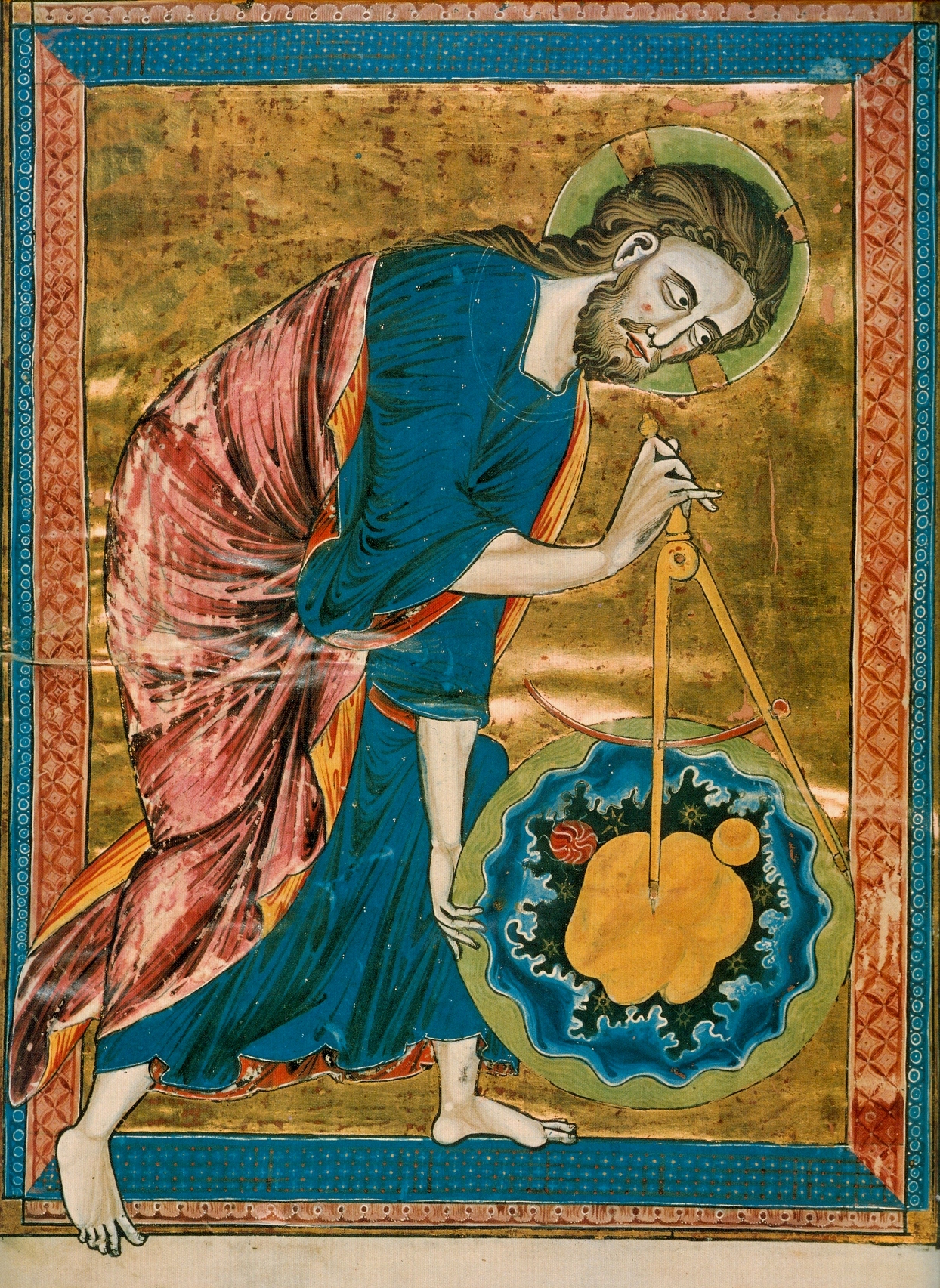
    God as Geometer, Codex Vindobonensis 2554 (1250)
    So how does all of this relate to the truth of Catholicism? Contrary to what several of the commenters suggested, we don’t just believe because we stumbled upon a Book (the Bible) and assumed it to be literally true.  Nor do we simply believe blindly, without evidence.

    On the contrary, the Resurrection is a specific historical event. As early as Pentecost, fifty days after the alleged Resurrection, St. Peter stood up in front of thousands of people in Jerusalem and asserted that the Tomb in which Jesus Christ was buried was empty: a factual claim that could have been easily debunked if His Body was, in fact, in the nearby Tomb. Peter, and several other eyewitnesses, reported seeing this risen Jesus, and were willing to be executed rather than recant this testimony. They, and Jesus of Nazareth Himself, were also reported by eyewitnesses to have performed miracles, providing a sort of external verification for their claims.

    These testimonies were believed by large groups of the Apostles’ contemporaries living everyone from Spain to Ethiopia to India, and their written records were preserved, and have been copied innumerable times and passed on. As a matter of simple historical record, they are better attested than perhaps any other documents in antiquity.

    Believing the historical record left by these eyewitnesses is not, as far as I can tell, any more irrational than believing any other eyewitness testimony, or the testimony of any other witness -- including believing the testimony of other scientists in your field, without personally repeating each of their tests.  On the contrary, it strikes me as (by far) the most rational explanation for the known historical facts.

    But it’s not just through history that we come to know the truth of theism (and of Christianity, specifically).  For example, St. Thomas Aquinas used logic and philosophy to prove his Five Ways, which established that the existence of a Creator is logically necessary.  To date, no atheist has satisfactorily rebutted these arguments.  So “faith” doesn’t mean “holding a particular view without evidence,” even if most of the forms of that evidence are different from what we have in the natural sciences.  In fact, as will be clearer in the next point, it’s unreasonable to expect the evidence of God to be like the evidence for (say) a comet, since God isn’t within the universe (and thus, not within the scope of the competency of the natural sciences).

    B. Misunderstanding God

    Back in 2006, the late Senator Ted Stevens infamously described the Internet this way:
    And again, the Internet is not something that you just dump something on. It's not a big truck. It's a series of tubes. And if you don't understand, those tubes can be filled and if they are filled, when you put your message in, it gets in line and it's going to be delayed by anyone that puts into that tube enormous amounts of material, enormous amounts of material.
    It was painfully (and admittedly, amusingly) obvious that the Senator had no idea what he was talking about. He’d gleaned facts about the way that the Internet worked, but was imagining it all wrong.

    I’m reminded of this when I hear certain atheists talk about what we Christians mean by “God.” For example, in the comments to the prior post, believers were characterized as “misinformed people who worship imaginary sky creatures,” and whose belief is akin to believing in an “invisible pink unicorn.” Another commenter described Christians as being in a God Who is an “invisible man.” But understanding the Christian notion of God as an invisible Man in the sky is like understanding the Internet as a series of tubes full of 1’s and 0’s: it’s comical, but absurdly incorrect.

    Perhaps the people making these claims know this, and are just presenting Christianity in an absurd way to try to make us look stupid. I’m not convinced. Many of the people in question seem to honestly believe that this is what we mean by “God,” which is another of the “YouTube heresies” that Fr. Barron describes. From Church and New Media, again:
    Thomas Merton, O.C.S.O.
    In his Seven Storey Mountain, Thomas Merton recalled the first time he read Etienne Gilson's The Spirit of Medieval Philosophy and encountered a philosophically sophisticated understanding of God as ipsum esse (the sheer act of being itself). He was flabbergasted because he had assumed that God was, in his words, a "noisy and dramatic" mythological being.

    Again and again, in my dialogues on YouTube, I encounter the characterization of God as a “sky fairy,” an “invisible friend,” or my favorite, “the flying spaghetti monster.” This last one comes from the militant atheist Richard Dawkins, who insinuates that there is as much evidence for God as for this fantastic imaginary creature.

    Almost no one with whom I dialogue considers the possibility that God is not one being among many, not the “biggest thing around,” not something that can be categorized or defined in relation to other things. Throughout his career, Thomas Aquinas insisted that God is best described, not as ens summum (highest being), but rather as ipsum esse (the subsistent act of being itself). As such, God is not a thing or existent among many. In fact, Aquinas specifies, God cannot be placed in any genus, even the genus of being. This distinction - upon which so much of Christian theology hinges - is lost on almost everyone with whom I speak on YouTube.

    One of the best indicators of this confusion is the repeated demand for “evidence” of God’s existence, by which my interlocutors typically mean some kind of scientifically verifiable trace of this elusive and most likely mythological being. My attempts to tell them that the Creator of the entire universe cannot be, by definition, an object within the universe are met, usually, with complete incomprehension.
    Fr. Barron alludes to the fact that this second error is tied to the first, scientism.  If you understand “God” to be a material, invisible entity living inside the universe, then it makes sense to expect that the search for God should be like the search for the “God particle.”  So you end up with people saying things like this:
    There is not clear evidence of the existence of a God in the sense that there *is* evidence of the guy next to me in the subway, or of the millions of people who live in the same city as me, by the sheer fact that I see many of them, and the artifacts they create and leave behind, every day. No one would seriously dispute their existence. People can, and do, dispute the existence of God because the artifacts that a given God would at least have left behind do not exist.
    The artifacts that a given God would have left behind? From a Christian perspective, this argument is just incoherent, since it assumes a God that is an elusive creature wandering around the universe, some sort of cross between Galactus and Carmen Sandiego.

    Let me use an example by analogy, with intelligibility.  For science to work, the universe must be intelligible. But intelligibility isn’t a material thing, and it’s not something that can be “discovered” through science. Rather, it’s a transcendental truth, and one that requires an Intelligent Creator, since the unintelligible cannot produce the intelligible. For this reason, C. S. Lewis described his faith in Christianity like this: “I believe in Christianity as I believe that the sun has risen: not only because I see it, but because by it I see everything else.”  If, in response to this, you sought to disprove the existence of universal intelligibility by showing that it doesn’t show up on a spectrometer, your argument would simply miss the mark.  You’d be (irrationally) expecting an immaterial thing to behave like a material one.

    If this is the view of God an atheist popular among atheists, it’s no wonder that we see the search for God being compared to the search for the Loch Ness Monster: both of them are about chasing for particularly elusive creatures.  I suppose it’s reasonable to reject this “God,” just as it would be reasonable to deny the existence of the Internet, if it was understood as a series of tubes of 1s and 0s. Such an Internet, and such a God, do not exist. But the problem, in both cases, is a gross misunderstanding of terms. So the solution isn’t to reject the existence of the Internet, or God. It’s to find out what those terms really mean.

    For example, contrary to several of the comments I received, Christians don’t believe that the Trinity is a creature. The word “creature” literally means “a created thing,” or “a being subservient to or dependent upon another.”  It’s as if the definition, even the etymology, of the word is screaming, “If you think God is one of these, you misunderstand Him!”  Thomas Merton’s humility, in re-learning what he “knew” about the idea of God lead him from agnosticism to Catholicism.  But that won’t happen if you refuse to take that first step, and insist on raging against an “Imaginary Sky Fairy” view of God.

    C. Miscellany

    Obviously, given the breadth of the topic and the wide range of comments, much more could be said.  Here are some of the other points that would be worth addressing in more depth, but which I omitted for brevity’s sake:
    1. There were, generally-speaking, two large blocks of negative commenters: those who claimed that it was a webcomic, and so, shouldn’t be discussed seriously (e.g., “Serious concepts deserve serious conversations. Cartoons do not”), and those who claimed that the webcomic made serious points that were true (e.g., “Maybe he exaggerated a little but the points in the comic were pretty much spot on”).  These groups can’t both be right; I’d argue that they’re both wrong. I see no reason that Inman can’t use humor and a webcomic format to raise serious points. I just think that the points he’s making are wrong.  Claiming “it was just a joke!” is a cop-out.

    2. There’s an obsession with claiming offense.  Several of the commenters viewed the rebuttal as me simply saying, “I’m offended!” For example, RationalWiki described the rebuttal this way: “The Oatmeal's 'How To Suck At Your Religion' comic is offensive to Catholics because... because... because WWWAAAAAHHHH!!!”  I mentioned that the comic was offensive once, as a warning to anyone about to click the link.  My points wasn’t remotely that the arguments in the comic were “offensive to Catholics.” It’s that the arguments were wrong.

      Having said that, there were a lot of people who cried offense, in lieu of calmly presenting an argument.  They just happened to be on the same side as “Rational” Wiki.   For example: I find it personally offensive that you are generalizing so many different types of people. People aren't meant to fit inside the imaginary boxes of society. You generalize atheists to being smug and hostile while implying that believers are SUPERIOR to all other human beings. Don't you remember what events that kind of thinking inspired? The Holocaust, Crusades, and Apartheid are just a few of them. This post reinforces the stereotypes of "the religious nut" who is hypercritical of any opinion that opposes their own. If anything, I find this post to be hostile, bigoted, and pretentious.”  Saying that you’re offended doesn’t mean that I’m wrong. It may just mean that I’m presenting the truth in a clumsy and imperfect way... or that you’re thin-skinned, or want to shut down the discussion.

      On a related note, 
       I was accused of hating atheists and (just for good measure) Muslims. The latter accusation seems to be based on a misreading of my response to panel 10.  These accusations are neither true nor relevant.

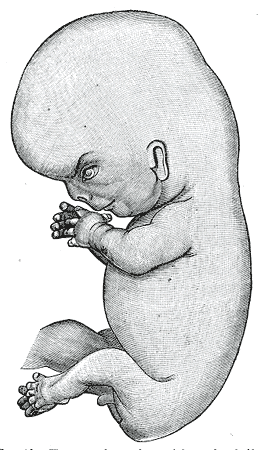
    3. Embryo (8 1/2 weeks),
      Gray's Anatomy plate
    4. The Auschwitz and Embryonic Stem Cell Connection: The webcomic attempted to paint opposition to embryonic stem-cell research as anti-science. It’s not. Instead, it’s an ethical opposition to medical research that profits off of the killing of unborn children. In this sense, it’s no different than ethical opposition to medical research that profits off of other murders, like those who opposed the experiments Josef Mengele did on murdered Jewish twins at Auschwitz.

      The reason is the same for each case. Being pro-science doesn’t mean that you’re in favor of doing literally anything that advances scientific research: a moral and ethical framework is absolutely necessary to the field (as Hippocrates recognized long ago). To denounce the presence of an ethical framework for “hinder[ing] the advancement of science, technology, or medicine” is a radical and dangerous line of thought.

      In response to this, several people played the offense card (see point # 2), saying that it “may or may not be one of the most offensive things I've read today.And: “Is anyone else horrified by a comparison of Auschwitz to stem cell research?! I find that to be offensive and disgusting.” To which someone else responded: “I am equally horrified; I stopped reading right there.” Then came the high dudgeon: “Sir, I have rarely seen rhetoric as repugnant as your attempt to exploit the torture and extermination of millions of my people to score cheap political points against an Internet cartoonist.

      The comparison I drew was about the ethical opposition to “medical research that profits off of mass killing” in both cases.  Commenters argued that an embryo was less of a human ... because it is made up of fewer cells.  By this logic, of course, short and skinny people are less human than me.  One commenter retorted: “are you going to call me a murderer for exfoliating because those are just cells too.”    True, an embryo is a collection of cells. So are you and me.  Suggesting that exfoliating is equivalent to abortion because both are the removal of a collection of cells is like suggesting that hair cuts and decapitations are the same, because both remove cells from the top of a person’s body.

      Another commenter actually invoked science in defending this very anti-scientific argument: “a collection of cells is not 'scientifically' considered life; you poop more cells down the toilet each day. When the embryo develops a nervous system you can consider it a living creature- before that is is not sentient.” A a question of pure science, this is garbage.  There’s literally no question that the embryo is a living (albeit tiny) human being. The sole question in dispute is whether he or she should be treated as a “person,” a non-scientific classification, assigning moral worth to some humans.  Remind me again who is being anti-science, here?

    5. But his comic wasn’t against all religious people! A number of commenters argued that the comic wasn’t against all religious people, but just the bad ones. But the comic groups everyone from jihadists to parents who tell their kids about the Resurrection in a single group: those who force their religion onto other people.  It does this by defining “force” to include everything from answering questions about the faith or door-to-door evangelization to suicide bombing.

      I appreciate nuance, and distinguishing good from bad religion (in fact, the New York Times’ Ross Douthat recently did this well in a very good book). But as I said before: the comic does this by putting basically everything above agnosticism in the “sucks” category.  So it does what it set out to do very badly. 

    I don’t imagine that this post is going to single-handedly end the New Atheism phenomenon, but hopefully, it’ll lead at least some readers to take Catholicism seriously enough to get an intellectual mooring as to what it is that they claim to be opposing.