One of the most surprising attacks on the papacy has come from Eamon Duffy, a professor of the history of Christianity at Cambridge University. Duffy’s argument is that not only was the Bishop of Rome not considered the pope in the early days of Christianity, but that there
was no Bishop of Rome for nearly a century after the death of the Apostles.
Of course, plenty of apologists and writers say the same thing. What makes Duffy unique is that he is a good historian, and well-respected in Catholic circles (primarily for his book
The Stripping of the Altars: Traditional Religion in England 1400-1570). What’s more, he’s a cradle Catholic, and at least from what I know of him, not obviously hostile to the Catholic Church. He takes Catholicism seriously, but claims that the papacy is a later development.
Eamon Duffy's Arguments Against the Papacy
Here are the key points of Duffy’s case against the papacy, taken from
Chapter One of his book,
Saints and Sinners: A History of the Popes. Because this is a long post covering many arguments, I’ve formatted it in such a way that you can either read it straight through, or use HTML links to jump directly from his claims to my responses:
 |
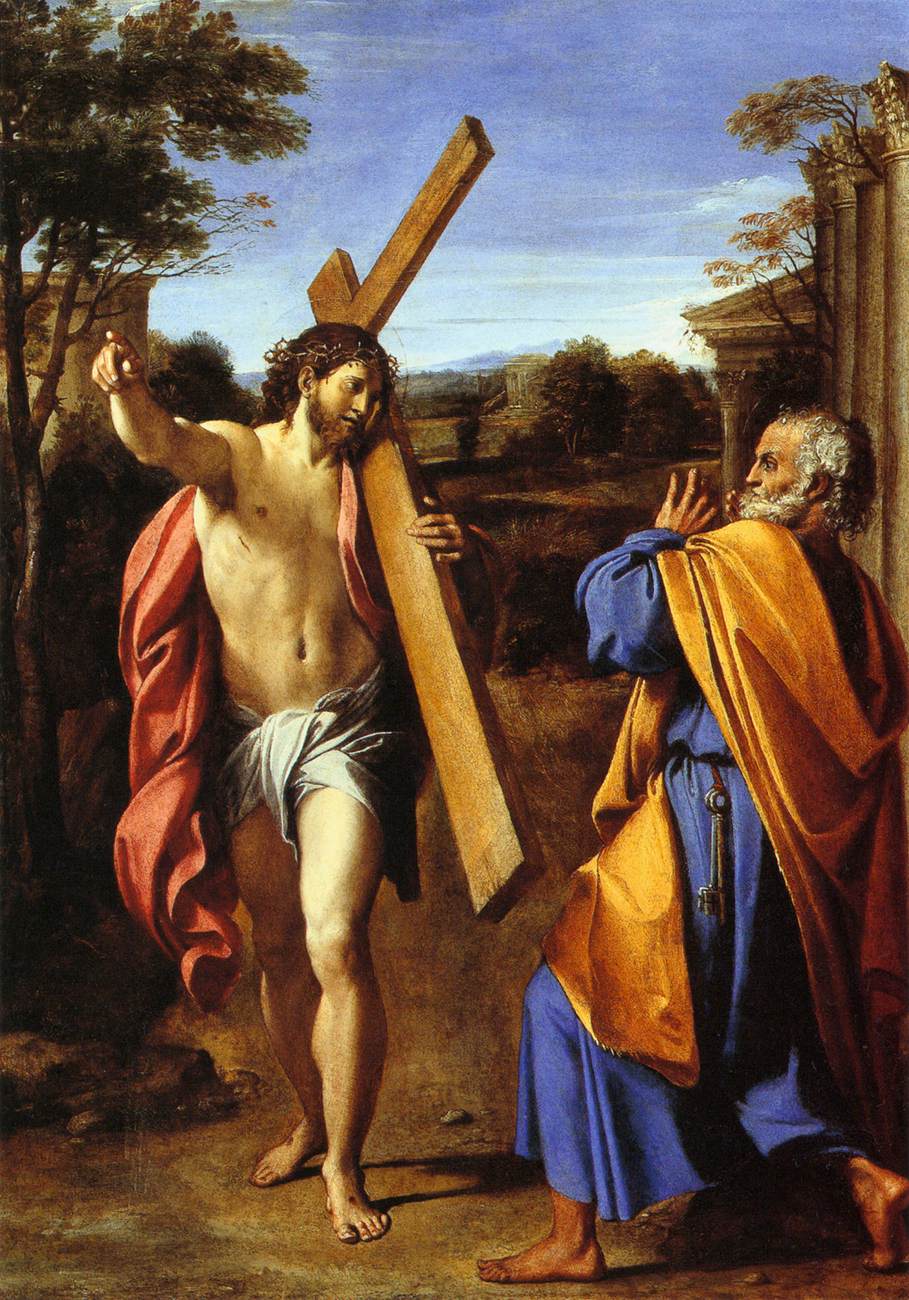
| Annibale Carracci, Domine Quo Vadis? (1602) |
The continuity between Pope and Apostle rests on traditions which stretch back almost to the very beginning of the written records of Christianity. It was already well established by the year AD 180, when the early Christian writer Irenaeus of Lyons invoked it in defence of orthodox Christianity. [....] All the essential claims of the modern papacy, it might seem, are contained in this Gospel saying about the Rock, and in Irenaeus' account of the apostolic pedigree of the early bishops of Rome. Yet matters are not so simple. The popes trace their commission from Christ through Peter, yet for Irenaeus the authority of the Church at Rome came from its foundation by two Apostles, not by one, Peter and Paul, not Peter alone.
The tradition that Peter and Paul had been put to death at the hands of Nero in Rome about the year AD 64 was universally accepted in the second century, and by the end of that century pilgrims to Rome were being shown the 'trophies' of the Apostles, their tombs or cenotaphs, Peter's on the Vatican Hill, and Paul's on the Via Ostiensis, outside the walls on the road to the coast. Yet on all of this the New Testament is silent. Later legend would fill out the details of Peter's life and death in Rome -- his struggles with the magician and father of heresy, Simon Magus, his miracles, his attempted escape from persecution in Rome, a flight from which he was turned back by a reproachful vision of Christ (the 'Quo Vadis' legend), and finally his crucifixion upside down in the Vatican Circus in the time of the Emperor Nero. These stories were to be accepted as sober history by some of the greatest minds of the early Church -- Origen, Ambrose, Augustine. But they are pious romance, not history, and the fact is that we have no reliable accounts either of Peter's later life or of the manner or place of his death. Neither Peter nor Paul founded the Church at Rome, for there were Christians in the city before either of the Apostles set foot there. Nor can we assume, as Irenaeus did, that the Apostles established there a succession of bishops to carry on their work in the city, for all the indications are that there was no single bishop at Rome for almost a century after the deaths of the Apostles.In fact, wherever we turn, the solid outlines of the Petrine succession at Rome seem to blur and dissolve. [....]
To begin with, indeed, there was no 'pope', no bishop as such, for the church in Rome was slow to develop the office of chief presbyter, or bishop. By the end of the first century the loose pattern of Christian authority of the first generation of believers was giving way in many places to the more organised rule of a single bishop for each city, supported by a college of elders. This development was at least in part a response to the wildfire spread of false teaching -- heresy. [....]
A key figure in this development was Ignatius of Antioch, a bishop from Asia Minor arrested and brought to Rome to be executed around the year 107. En route he wrote a series of letters to other churches, largely consisting of appeals to them to unite round their bishops. His letter to the Roman church, however, says nothing whatever about bishops, a strong indication that the office had not yet emerged at Rome.
Paradoxically, this impression is borne out by a document which has sometimes been thought of as the first papal encyclical. Ten years or so before Ignatius' arrival in Rome, the Roman church wrote to the church at Corinth, in an attempt to quieten disputes and disorders which had broken out there. The letter is unsigned, but has always been attributed to the Roman presbyter Clement, generally counted in the ancient lists as the third Pope after St Peter. Legends would later accumulate round his name, and he was to be venerated as a martyr, exiled to the Crimea and killed by being tied to an anchor and dropped into the sea. In fact, however, Clement made no claim to write as bishop. His letter was sent in the name of the whole Roman community, he never identifies himself or writes in his own person, and we know nothing at all about him. The letter itself makes no distinction between presbyters and bishops, about which it always speaks in the plural, suggesting that at Corinth as at Rome the church at this time was organised under a group of bishops or presbyters, rather than a single ruling bishop.
A generation later, this was still so in Rome. The visionary treatise The Shepherd of Hermas, written in Rome early in the second century, speaks always collectively of the 'rulers of the Church', or the 'elders that preside over the Church', and once again the author makes no attempt to distinguish between bishops and elders. Clement is indeed mentioned (if Hermas' Clement is the same man as the author of the letter written at least a generation before, which we cannot assume) but not as presiding bishop. Instead, we are told that he was the elder responsible for writing 'to the foreign cities' -- in effect the corresponding secretary of the Roman church.
So, how should we respond to Duffy's arguments? Let's address each of them in turn.
Peter and Paul at Rome
 |
Alonzo Rodriguez,
Farewell of Saints Peter and Paul (16th c.) |
New Testament silence? Duffy says that the New Testament is “silent” regarding the martyrdoms of St. Peter and Paul at Rome. This is mostly true. But the New Testament isn’t silent that St. Peter was in Rome (1 Peter 5:13, referring to Rome as “Babylon”), as was St. Paul (Acts 23:11; Acts 28:16). Additionally, Christ foretold that Peter would be martyred (John 21:18-19).
So we have a hint about Peter and Paul’s last days in the New Testament, and the writings of the earliest Christians fill out the details. As Duffy notes, the Tradition “that Peter and Paul had been put to death at the hands of Nero in Rome about the year AD 64 was universally accepted in the second century.” There’s no serious dispute on this point.
Legend or History? While we have second century attestation of Peter’s martyrdom in Rome, Duffy correctly notes that many of “
the details of Peter's life and death in Rome” are not written down until somewhat later. Duffy scoffs at these events as “
legends,” “
stories,” and “
pious romance.” But these accounts were “
accepted as sober history by some of the greatest minds of the early Church -- Origen, Ambrose, Augustine.” On what basis does Duffy give us any reason to favor his scoffing, over the witness of these Church Fathers?
Now, it’s not as if any claims about the papacy are rooted in stories about Peter’s “struggles with the magician and father of heresy, Simon Magus.” Catholics are free to agree with Duffy that some or all of these accounts are merely pious romance. But readers should at least be aware that they’re getting sneering dismissiveness, rather than reasoned argumentation.
Was the Church of Rome founded by Peter and Paul? Much more serious is the claim that “
neither Peter nor Paul founded the Church at Rome, for there were Christians in the city before either of the Apostles set foot there.”
Ironically, there’s no dispute about the fact that “there were Christians in the city before either of the Apostles set foot there.” Acts 2:10 tells us that there were “visitors from Rome, both Jews and proselytes,” present at Pentecost. Likely, many of these visitors were among the 3,000 converted on that day (Acts 2:41), and probably formed the seed of the first Christian community in Rome.
The dispute is over whether the presence of a handful of Christian believers constitutes the “founding” of the Church at Rome. To the early Christians, it was not enough. To them, as to Catholics today, a religious body wasn’t a “church” without a hierarchy – and a hierarchy with Apostolic succession. For this reason, authors like
Tertullian and
Irenaeus describe the methods by which churches prove their Apostolic origins: namely, that a
“bishop shall be able to show for his ordainer and predecessor some one of the apostles or of apostolic men.” Even if all 3,000 of those converted on Pentecost had been Romans who returned to Rome the next day, they wouldn’t form a church without a validly-ordained bishop.
It’s in establishing a hierarchy, by ordaining presbyters and future bishops, that Peter and Paul found the Church at Rome. The early Christians report that Paul ordained Linus (the 2nd pope), and Peter ordained Clement (the 4th pope).
Irenaeus
All the essential claims? Duffy writes that “
it might seem” that all of “
the essential claims of the modern papacy” are
contained in Matthew 16:17-19 and in “
Irenaeus' account of the apostolic pedigree of the early bishops of Rome.”
If he means that these two sources would be sufficient, even in isolation, that’s probably true. But it’s important to note that these texts don’t exist in isolation. I’ve previously written a
six-part series on the evidence for the papacy from the New Testament, and only one of those six parts focused on Matthew 16. And as you’ll see throughout the rest of this post, Irenaeus is far from alone in testifying to the Petrine succession of the papacy. So even though we
could rely on those two texts to prove all of the essential claims of the modern papacy, we need not.
Peter, or Peter and Paul? Duffy asserts that “
for Irenaeus the authority of the Church at Rome came from its foundation by two Apostles, not by one, Peter and Paul, not Peter alone.” Nowhere does Irenaeus suggest (or even hint) that the Petrine authority would be insufficient, on its own, without the added authority of St. Paul.
 |
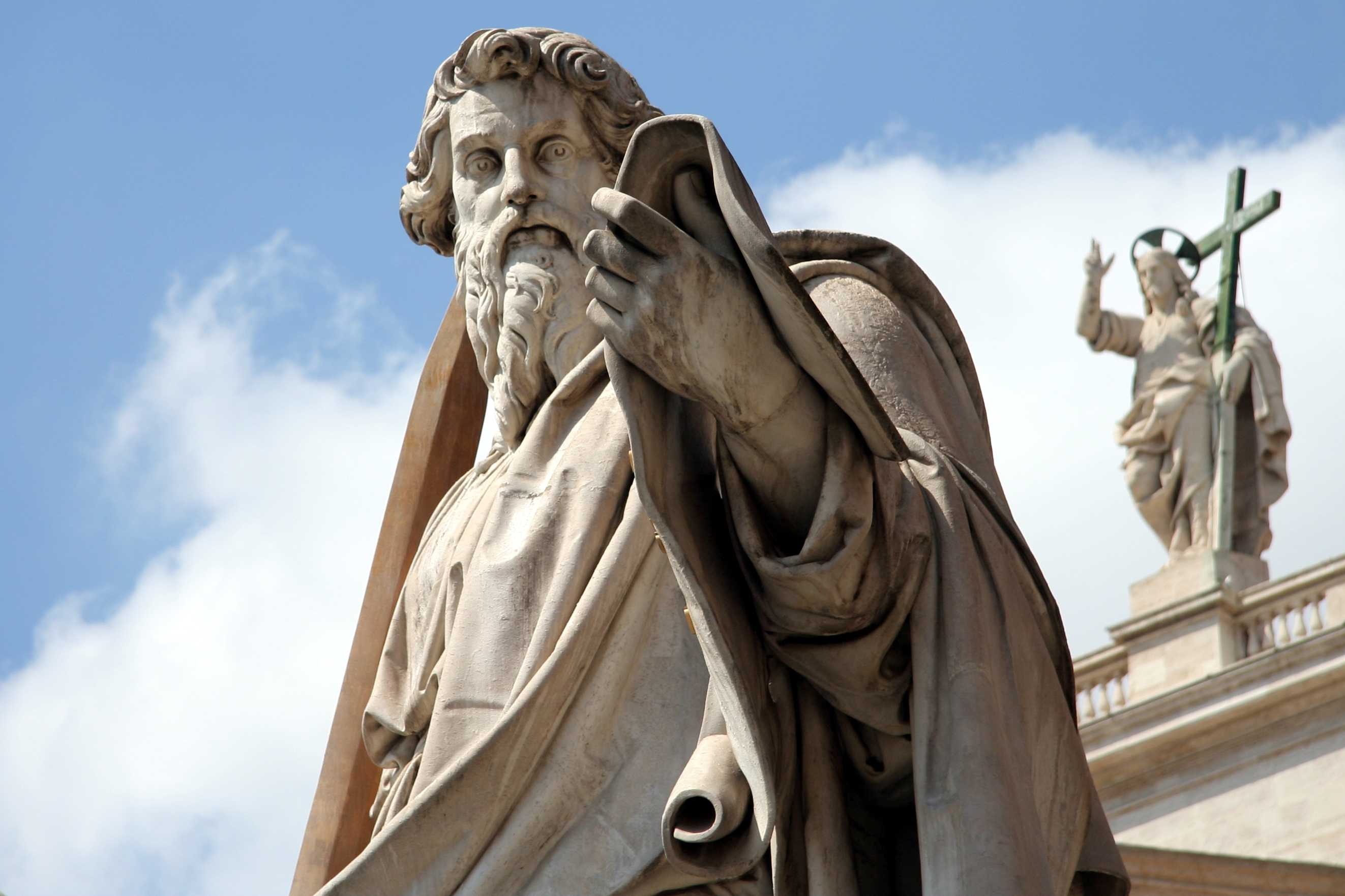
| Adamo Tadolini, St. Paul (1838) (located in St. Peter’s square, Vatican City) |
Instead, Irenaeus makes three relevant claims:
- That all other churches must agree with the Church of Rome (“it is a matter of necessity that every Church should agree with this Church, on account of its preeminent authority”);
- That this Church was founded by Peter and Paul (Irenaeus calls it “the very great, the very ancient, and universally known Church founded and organized at Rome by the two most glorious apostles, Peter and Paul”); and
- That the “blessed apostles, then, having founded and built up the Church, committed into the hands of Linus the office of the episcopate,” a lineage continuing down throughout history.
These are claims that the Catholic Church readily affirms, even proclaims. It’s for good reason that the Church celebrates the
Feast of Ss. Peter and Paul together, rather than the Feast of St. Peter alone. The Roman church (and the Roman Catholic Church) rightly glories in its Pauline as well as its Petrine foundation. It is beautiful that St. Paul, the Apostle to the Gentiles, and St. Peter, the chief Apostle to the Jews (cf. Galatians 2:8), were united eternally in their martyrdoms in Rome. But nothing said here suggests that Petrine authority would have been insufficient on its own. Duffy’s reading into the text something that just doesn’t exist.
Who’s Doing the Assuming? Duffy says that Irenaeus simply “
assumes” the existence of a Roman episcopacy dating back to the Apostles. If anyone is “assuming” anything, it is Duffy. Elsewhere, in fact, he acknowledges that Irenaeus provides a list
specifically detailing who those bishops were: “
Linus, Anacletus, Clement, Evaristus, Alexander, Sixtus, and so on down to Irenaeus' contemporary and friend Eleutherius, Bishop of Rome from AD 174 to 189.” This list of popes, Irenaeus explains, is “
most abundant proof that there is one and the same vivifying faith, which has been preserved in the Church from the apostles until now, and handed down in truth.” So Irenaeus doesn’t just “
assume” that there must have been some bishops in Rome between Peter and Eleutherius. He specifically tells us who they were, and in what order they served. And his list corresponds well with the other ancient evidence.
“All the Indications”? In a particularly gross overstatement, Duffy asserts that “
all the indications are that there was no single bishop at Rome for almost a century after the deaths of the Apostles.” This is flatly untrue. As the rest of this post shows, none of the evidence that Duffy marshalls supports his contention that “
there was no single bishop at Rome for almost a century after the deaths of the Apostles,” several second century writers say the exact opposite (that there has continually been a single bishop at Rome since the time of St. Peter), and Duffy ignores or misreads a mound of ancient evidence. Because this claim is at the heart of the thesis that he presents, I address it at greater length in
the final section below.
Blurry Lines? The claim that “
wherever we turn, the solid outlines of the Petrine succession at Rome seem to blur and dissolve” is unsupported and untrue. Petrine succession at Rome is directly attested to by numerous ancient Christian authorities. For example, it is described in detail by
St. Irenaeus,
St. Optatus of Milevis,
St. Augustine (see # 2 of chapter 1), the
Liberian Catalogue of 354,
Eusebius, and so forth. Nor is there strong evidence somewhere opposing these lists. Inasmuch as
any of the early Christians tell us about the structure of the Church in Rome, they agree with the idea of Petrine succession in that Church.
Ignatius of Antioch
Presbyters are Bishops? Duffy’s argument is based on three claims, each of which he seems to have been lifted directly from Fr. Raymond Brown and Fr. John P. Meier:
- All of the early churches were governed by “presbyters,” rather than a single bishop;
- St. Ignatius of Antioch helped change that; and
- Rome was slow to switch from presbyterial to episcopal governance.
Each of these claims is false, and badly supported by the evidence. Tim Troutman at
Called to Communion has previously
answered the first argument:
 |
| Painting of Ignatius of Antioch from the Menologion of Basil II (c. 1000 AD) |
We mentioned above that the earliest references to the clerical offices, particularly with respect to presbyter and bishop, appeared to be ambiguous. From the beginning, whenever the terms ‘bishop,’ ‘presbyter,’ and ‘deacon’ were used in any authoritative capacity, the usage was consistent with episcopal government. In monepiscopal Church government, all bishops are presbyters, but not all presbyters are bishops. That is, the office of bishop includes all functions of the presbyterate, but the presbyters cannot perform all functions of the bishops. This fact alone explains much of the apparent interchangeability of terms in the earliest texts. On the other hand, the way in which the Church immediately began to speak of these offices was incompatible with non-episcopal ecclesial governments (i.e., everything but Catholic, Orthodox, or Anglican structures). This technicalization of clerical terminology corresponds with the Church’s developing explication of the divine liturgy as sacrificial worship, which we shall discuss in the next section. Just as sacrifice had always been present in the liturgical worship, though her terminology had not always explicitly corresponded with how she now speaks of herself, likewise, the offices of presbyter and bishop had always been separate, and the terminological distinction would only later become solidified. Once it did, it continued on without ambiguity until rejected by (some of) the early Protestants.
Nor was this simply an accident of history. Rather, it was the fulfillment of what was set up within Old Testament Judaism:
The first century Jewish hierarchy, which had at its head the Sanhedrin, a council of elders, was one obvious and immediate contextual reference for the Christian clergy. Yet this collegial body was not entirely egalitarian; the elders were united and ruled under the authority of the high priest. This structure is reflected in the single bishop surrounded by presbyters in the early Church. Going back even further, Moses was commanded by God to appoint seventy elders and to go up to the Lord together with Aaron and his sons. But only Moses was to approach the Lord. This hierarchical order was deliberately replicated when Jesus, the true High Priest, selected His Apostles, and seventy other disciples. That is to say, the hierarchy of the Church was built on the existing Jewish paradigm.
I address this argument in greater detail
below.
Having said all of that, it
is true that bishops sometimes seem to be referred to in Scripture as “presbyters.” But this doesn’t suggest that there is no distinction between the ranks. As far as I know, no one denies that Apostles are a distinct order from deacons, yet St. Paul describes himself as a “deacon” (
diakonos; see 2 Cor. 3:6, 6:4, 11:23; Eph. 3:7). Likewise, St. Peter describes himself as a “fellow-elder” or “fellow-presbyter” (1 Peter 5:1), despite being an Apostle (and Pope).
There are likely three reasons for this:
- The greater includes the lesser, a fortiori: So we can describe the bishops as priests, and (as Popes Benedict XVI and Paul VI have noted), the pope, along with all bishops and priests, remains a deacon.
- Humility: Reminding bishops that they are called to be priests, reminding priests that they are called to serve as deacons, and (as St. Peter did) identifying with one’s subordinates.
- Terminology: The words “bishop,” “presbyter,” and “deacon” all carry non-technical meanings (“overseer,” “elder,” and “servant / minister”). So when St. Paul refers to himself as a “diakonsis,” he might be emphasizing his diaconal identity, or he might just be pointing out the way that he is a servant of the Gospel. Eventually, as Troutman notes, the words “bishop,” “presbyter,” and “deacon” start to be used in a more technical way, but particularly in the early days, it’s not overly surprising to hear about a presbyter helping to oversee the Church.
Does Ignatius Introduce The Mono-Episcopacy? I was surprised to see Duffy advance the idea that St. Ignatius of Antioch was “
key” in introducing the mono-episcopacy (one bishop per city / diocese). As far as I’m aware, this argument was first advanced in 1983, in Fr. Raymond Brown and Fr. John P. Meier’s book
Antioch and Rome: New Testament Cradles of Catholic Christianity, and is built almost completely upon circular arguments and arguments from silence.
Ignatius wrote seven letters on his way to being martyred in Rome: one to St. Polycarp, the bishop of Smyrnæa; five to churches in Asia Minor, instructing them to obey their bishops; and one to the church of Rome, thanking them for their support, and asking them not to try to interfere with his martyrdom.
Since Ignatius told the churches in Asia Minor to obey their bishop, Brown and Meier
seized upon this as “proof” that the mono-episcopacy must have been a novelty:
As Meier has shown (p. 77 above) to explain Ignatius' insistence on and defense of the threefold order, one must posit that the single-bishop model appeared in Antioch and Asia Minor ca. 100.
And since Ignatius
doesn’t tell the Romans to obey their bishop, Brown and Meier
cite this as proof that the mono-episcopacy must be a novelty that hadn’t yet come to Rome:
Indeed, the signal failure of Ignatius (ca. 110) to mention the single-bishop in his letter to the Romans (a very prominent theme in his other letters) and the usage of Hermas, which speaks of plural presbyters (Vis. 2.4.2) and bishops (Sim. 9.27.2), make it likely that the single-bishop structure did not come to Rome till ca. 140-150.
I was, and remain, thoroughly unimpressed by this circular, “heads I win, tails you lose” line of argumentation:
So if Ignatius mentions a three-tiered structure, this must mean that nobody believed in it, and he has to "defend" it, and if he doesn't mention a three-tiered structure, that must mean it didn't exist in that city. So no matter what he says or doesn't say, we can thus conclude there were presbyter-bishops. That's pretty terrible scholarship. After all, if Ignatius only wrote about the three-tiered structure to defend the notion of this novelty, we'd expect to see him only write about it to Rome, since apparently only Rome didn't practice it. Why would he be convincing the Christians who already agree with him, and then not bring it up to the Christians who don't?
Here’s a better way of explaining those same facts, without resorting to mental gymnastics and circular arguments:
(A) Ignatius mentions, but doesn't defend, the mono-episcopacy in his letters to the churches of Asia Minor:
Nowhere does he attempt to defend the idea that there are three tiers, he simply assumes his readers know it's true. He doesn’t say “there are three tiers of governance in the Church,” but “you need to obey your bishop.”
(B)
Ignatius mentions, but doesn't defend, the mono-episcopacy in his letters to the Church of Rome: 
Brown and Meier claim that Ignatius failed “
to mention the single-bishop in his letter to the Romans.” Duffy likewise writes that Ignatius’ “
letter to the Roman church, however, says nothing whatever about bishops.” Both of these claims are false, and demonstrably so.
likewise claims that Ignatius' “
In Chapter 2 of
Ignatius' letter to the Romans, he refers to himself as the bishop (singular) of Syria: “
Pray, then, do not seek to confer any greater favour upon me than that I be sacrificed to God while the altar is still prepared; that, being gathered together in love, you may sing praise to the Father, through Christ Jesus, that God has deemed me, the bishop of Syria, worthy to be sent for from the east unto the west.” And because he is the sole shepherd of the Church at Syria, he beseeches the Romans in Chapter 9: “
Remember in your prayers the Church in Syria, which now has God for its shepherd, instead of me.” So it just
isn’t true that Ignatius fails to mention the single-bishop in his letter to the Romans. He does, twice.
(C) There are three likely reasons that Ignatius doesn't exhort the Roman church:
- The Roman Christians are already obedient: he describes them as “those who are united, both according to the flesh and spirit, to every one of His commandments; who are filled inseparably with the grace of God, and are purified from every strange taint.” So he doesn’t need to tell them to be obedient, since they already are.
- Unlike his other letters (which are encouraging the churches of Asia Minor to obey their bishops), this letter is intended to thank them for their support, and to ask them not to interfere with his imminent martyrdom. It reads almost nothing like the other letters, because the theme and tone are totally different. Just as John’s Gospel, his Epistles, and his Revelation sound different (since they’re thematically different), we see the same thing in Ignatius’ writings.
- Finally, the very fact that this is the pope’s own diocese may have deterred Ignatius from issuing exhortations or instructions. Throughout early Christian history, we see plenty of examples of the Bishop of Rome stepping in to settle disputes in other churches; you’d be hard-pressed to find examples of that in the other direction. So if anything, Ignatius’ silence here points towards (rather than away from) the papacy.
I Clement
Pope Clement, or the Roman Church? It’s interesting to me that Duffy concedes that Clement is speaking on behalf of the entire Roman Church, but then uses this as an argument
against his being the bishop. To me, this evidence points in the other direction: if Clement can speak for the entire group, this suggests a position of authority. Likewise, when
St. Peter speaks on behalf of all Twelve Apostles in Matthew 16:15-16, this has traditionally been viewed as an exercise of his papal authority. I can’t speak give instructions as the Roman Catholic Church, because I don’t have the authority to do so. The pope, in contrast, does.
 |
| Pier Leone Ghezzi, Martyrdom of St. Clement (1726) |
Know-Nothings? It is telling that Duffy should claim that “
we know nothing at all about” Pope Clement, because it demonstrates either his ignorance or his dismissal of a wealth of ancient testimonies. Let’s review just what we
do know about Clement, from the writings of other early Christians.
First, Tertullian, writing in c. 200,
issues this challenge to heretical sects:
Let them exhibit the origins of their churches, let them unroll the list of their bishops, coming down from the beginning by succession in such a way that their first bishop had for his originator and predecessor one of the apostles or apostolic men; one, I mean, who continued with the apostles. For this is how the apostolic churches record their origins. The church of Smyrna, for example, reports that Polycarp was placed there by John, the church of Rome that Clement was ordained by Peter. In just the same way the other churches produced men who were appointed to the office of bishop by the apostles and so transmitted the apostolic seed to them.
So not only do we know that church of Rome claimed that Clement was a bishop, but that he was ordained by St. Peter, and they seem to have had some sort of written records supporting this claim. It’s a good reminder of why we should not simply dismiss the testimony of the Church Fathers. These ancient authorities often have access to evidence, like oral testimonies and now-lost records, that we
just don’t have today.
As an aside, Tertullian says that St. Peter was the “
originator and predecessor” of Pope Clement. This is true, but ambiguous. Peter apparently ordained Clement as a priest, and Clement ultimately succeeded him as Bishop of Rome (after Linus, who was ordained by St. Paul, and Cletus, also known as Anacletus). That is the order painted by Irenaeus, Eusebius, and others, and the ordering preserved in the prayers at Mass. But, perhaps as a result of Tertullian's ambiguity, Jerome would later write that “
most of the Latins think that Clement was second after the apostle” (a view Jerome did not endorse).
A bit more than a century after Tertullian, Eusebius
writes that, “
Clement also, who was appointed third bishop of the church at Rome, was, as Paul testifies, his co-laborer and fellow-soldier.” This tells us both that Clement was the third Bishop of Rome (not some Roman “foreign correspondent,” as Duffy imagines), and that this is the same Clement that St. Paul mentions in Philippians 4:3. St. Jerome agrees with this identification between the Pope Clement and the “Clement” in Philippians 4:3, and says as much in his book
De Viris Illustribus (
On Illustrious Men). He also tells us that Clement was “
bishop of the church at Rome,” was one of the men suspected of authoring the Epistle to the Hebrews, and was the one “
who, they say, arranged and adorned the ideas of Paul in his own language.” About the encyclical from Clement to the Corinthians, Jerome has this to say:
He [Clement] wrote, on the part of the church of Rome, an especially valuable Letter to the church of the Corinthians, which in some places is publicly read, and which seems to me to agree in style with the epistle to the Hebrews which passes under the name of Paul but it differs from this same epistle, not only in many of its ideas, but also in respect of the order of words, and its likeness in either respect is not very great.
This
confirms that it was in Clement’s capacity as Bishop of Rome that he was able to speak “
on the part of the church of Rome.” It’s also noteworthy that the pope’s encyclical was apparently still being used as a Reading in the Liturgy “in some places” even in c. 393, when
De Viris Illustribus was written.
So, in fact, we know quite a bit about Clement of Rome: that he was an esteemed companion of St. Paul’s, was ordained by St. Peter, became Bishop of Rome, was listed on the second-century Roman church’s roll of bishops, wrote on behalf of Rome to the Corinthians (an epistle so highly valued that it was incorporated into the Liturgy for centuries), etc.
 |
| Icon of St. Clement of Rome |
Does Clement “Always” Speak of Bishops in the Plural? It’s an overstatement to say that the letter “
always” speaks of “
bishops” in the plural, since bishops are only mentioned three times. And when they are mentioned (in 42:4-5 of
the encyclical), it involves Pope Clement claiming that both the episcopacy and diaconate are of Divine origin. It would be ironic to attempt to use this chapter
against the Catholic claim for the papacy, since as
Francis A. Sullivan, S.J., notes:
Protestant scholars reject this account as a fiction, invented to give apostolic, and ultimately divine, authority to a development that, in their view, was simply natural and historical, following the sociological laws that apply to any developing society.
In other words, Clement's ecclesiology is the opposite of what Protestant scholars (and scholars like Duffy) are advocating. Herein lies an important point mitigating against Duffy's theory that “
the church at this time was organised under a group of bishops or presbyters, rather than a single ruling bishop.”
If the early Church regarded their ecclesial structure as being of Divine origin, how likely were they to want to change it?Michael C. McGuckian, S.J. shows a related flaw with this theory, in his reply to Sullivan. In contrast with other developments (like the canon of Scripture), we simply see no evidence pointing to any development in the governance structure of the early Church:
A first problem with this scenario is its lack of historical plausibility. The process of canonization of the Scriptures is documented. Different list of books were circulating during the fourth century, and a definitive list was drawn up in the African councils at the end of that century and by Pope Innocent I in 405. This list was in peaceful possession in the Western Church until the Reformation, and it was necessary to reaffirm it at the Council of Trent (DS 1502–03) and at Vatican I (DS 3029). The fact that the Church had a decision to make in regard to the Scriptures is documented and clear. Of the corresponding process of canonization of the episcopate, there is, on other hand, no trace whatever. The notion of a church choosing its church order is unheard of in Christian tradition until the sixteenth century with the Reformation in Switzerland, and the choice between presbyteral and episcopal government is church-dividing to this day. Is it plausible to suggest that it would not have been equally divisive in the first decades of the Church’s life, and could have taken place without leaving any trace whatever?
So we’re left to believe that the early Church –- who, according to Clement’s letter, believed their church governance structure to have come directly from the Lord – simply changed their church governance structure, without anybody talking about it? And that this process happened in every local church throughout the world, without any contemporary writing to object to (or support) this change?
The Shepherd of Hermas
Bishops, Plural? The Shepherd of Hermas speaks of “bishops,” plural, but it’s in the context of a revelation of
the global Church, not the governance of a single city. At one point in the vision, Hermas says:
Those square white stones which fitted exactly into each other, are apostles, bishops, teachers, and deacons, who have lived in godly purity, and have acted as bishops and teachers and deacons chastely and reverently to the elect of God. Some of them have fallen asleep, and some still remain alive.
This
seems to suggest that a trifold distinction between “bishops, teachers, and deacons” who exist as the three ranks of clerics within the Church after the death of the Apostles. But the text is a mystical revelation, rather than a description of the practices of the Church, and it’s vague on this point.
Clement, the Foreign Correspondent? Duffy over-argues, by claiming that
we’re told that Clement was “
the elder responsible for writing 'to the foreign cities' -- in effect the corresponding secretary of the Roman church,” which
the text never says.
 |
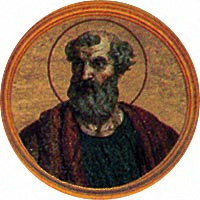
| Pope Pius I |
More importantly, as Duffy notes, “
we cannot assume”
that “Hermas' Clement is the same man as the author of the letter written at least a generation before.” In fact, we have clear evidence to the contrary. The Shepherd of Hermas was written about a half-century after Pope Clement I’s death.
The Muratorian fragment, which dates to c. 170 A.D., says:
But Hermas wrote the Shepherd very recently, in our times, in the city of Rome, while bishop Pius, his brother, was occupying the [episcopal] chair of the church of the city of Rome.
Obviously, this shows that Hermas isn’t referring to Pope Clement, who had been dead for decades by the time (c. 140-154) that
Pope St. Pius I was Bishop of Rome. More importantly, the Muratorian fragment disproves Duffy’s claim that there was no single Bishop of Rome at the time that The Shepherd of Hermas was written. The Muratorian fragment (as well as later sources, like
the Liberian Catalogue of 354) explicitly tell us that
Hermas’ own brother, Pope Pius I, occupied the Roman episcopate at that time.
That the text refers to Pope Pius was occupying “the Chair” is important. To say that a particular man sits in the “Chair” (
cathedra) is to say that he is in charge: in modern parlance, this man is in the seat of authority. The papal seat, the Chair of Peter, is prefigured by the “Chair of Moses” (Mt. 23:1-3). It's why we say that infallible papal declarations are made
ex cathedra ("from the chair), and why we call a bishop's church a “cathedral.” In other words, the Muratorian canon provides yet more support for the idea that there was a single bishop running Rome at this time.
A Conspiracy of Silence?
Duffy’s entire argument is built around the idea that the early churches were presbyterian in governance (that is, they were governed by a body of elders, rather than by a single bishop), and that “
there was no single bishop at Rome for almost a century after the deaths of the Apostles.”
So what’s his proof?
He provides no positive proof, at all. Instead, the argument rests entirely upon an argument from silence. In the very earliest Christian writings, we aren’t told what (if any) distinction exists between bishops and presbyters. On the basis of this silence, Duffy concludes that there
was no distinction, and that the titles of “bishop” and “presbyter” must be redundant. That’s it: that’s all the “proof” Duffy offers; and as far as I know, it’s all the proof any of the advocates of this view provide.
But this argument from silence has some glaring flaws. As McGuckian explained (
see above), if there
had been a transition from a presbyteral to an episcopal system of governance, we should expect to see some trace of positive evidence: someone writings something about it. But we see
absolutely nothing of the sort during this time period.
In other words, we’re left to believe that he early Church – who,
according to Clement’s letter, believed their church governance structure to have come directly from the Lord – simply changed their governance structure, without anybody talking about it? And that this process happened in every local church throughout the entire world? And throughout this whole time, nobody protested this change? Nobody argued for it? Nobody even acknowledged it?
Think specifically of the presbyters. According to Duffy’s theory, in each city, a group of men were in charge of running the local churches. And at some point, they’re stripped of this power, as one member of the presbyteral council declares himself the sole authority. And we’re to believe that they simply don’t say anything? They silently let this happen? So Duffy’s entire argument from silence requires us to assume that the Divinely-constituted system of Church governance was altered, without anyone apparently raising a peep.
So even when considering only the negative evidence – what we don’t see – Duffy’s theory is implausible. But now consider the positive evidence that we
do have.
First, there are early Church writings referring to the individual churches as being headed by a single bishop. I already mentioned Ignatius of Antioch, who wrote c. 107, on his way to martyrdom. His writings (
discussed in greater detail above) take the episcopal governance of the local churches for granted. So do several other early Christian writings: for example, the Muratorian canon, dating back to c. 170 (
also discussed above), which mentions in passing who the Bishop of Rome was several decades earlier, at a time that Duffy claims that there was no single Bishop of Rome. And these texts don’t treat the episcopal structure as novel or controversial, but as an accepted part of the structure of the Church.
The second category of writings are perhaps even more important: these are the documents specifically telling us that the single-bishop structure dates back to the Apostles.
St. Irenaeus,
St. Optatus of Milevis,
St. Augustine (see # 2 of chapter 1), the
Liberian Catalogue of 354, and
Eusebius actually go beyond that, specifically listing each and every pope from St. Peter forwards. And Irenaeus does this in c. 180 A.D., which is important, because
it shatters Duffy’s history. Just consider the timeline:
- c. 115-130: St. Irenaeus is born into a Christian family. According to Duffy, there is no episcopacy in Rome at this time. Rather, the church in Rome is headed by a presbyteral council. This remains the situation into Irenaeus’ adulthood. Somehow, Irenaeus does not know this.
- c. 150: This is when Duffy seems to think that the church of Rome moves from a presbyteral form of governance to an episcopal form of governance, although he does not provide a specific date. Apparently, none of the presbyters complain, and in fact, nobody appears to talk about the change at all, or even to acknowledge it occurred. This is all the more surprising, since Rome is already the heart of the Church. Not only is Irenaeus already an adult by this time, but so are many of the future readers of his book Against Heresies, including Christians living in Rome, and a number of the heretics he is writing against.
- c. 170: The Muratorian canon mentions in passing that The Shepherd of Hermas was written “very recently, in our times, in the city of Rome, while bishop Pius, his brother, was occupying the chair of the church of the city of Rome,” referring to the pontificate of Pope Pius I (c. 140-154). The canon speaks as if readers will know who “bishop Pius” is, and treats his pontificate as recent and undisputed history. Yet this contradicts Duffy’s theory, that there was no episcopal chair during the 140s.
- c. 180: Irenaeus writes Against Heresies, in which he explains that the Roman episcopacy is of Apostolic origin. Irenaeus provides a list of all the popes, as a “most abundant proof that there is one and the same vivifying faith, which has been preserved in the Church from the apostles until now, and handed down in truth.” Irenaeus’ list corresponds to the Muratorian canon, as it includes Pope Pius I as the ninth pope.
- c. 200: Tertullian discusses how each church has their own register of every bishop that they have ever had, and the Church at Rome traces theirs all the way back to Peter.
So, what do we make of this actual historical evidence, then? Should we just conclude that the Roman church is making up its registers of bishop, or that the author of the Muratorian canon just didn’t realize that Pope Pius wasn’t Bishop of Rome, or Irenaeus is simply “assuming” that there must have been bishops of Rome named “
Linus, Anacletus, Clement, Evaristus, Alexander, Sixtus, and so on”?
And if that is the case, how come nobody caught Irenaeus’ glaring error in “assuming” that a 30-year-old episcopacy was 180 years old? Why didn’t the Christians of Rome, who would have been old enough to remember the introduction of the papacy? Why not the heretics Irenaeus is refuting, who have ever reason to rebut his “
most abundant proof” of the Catholic Church? Did everyone in 180 A.D. suffered from some terrible bout of amnesia, that rendered them incapable of remembering even 30 years worth of Christian history? Because if not, then the timeline required for Duffy’s theory is simply incapable of supporting his argument.
 RSS Feed
 Twitter


.JPG)