Showing posts with label justification. Show all posts

A Fascinating Concession By Albert Mohler

0 comments
Albert Mohler, president of Southern Baptist Theological Seminary, is apparently startled by how much Evangelicals like Pope Francis, and is trying to scare them away from him by reminding them that we disagree whether justification is by faith, or by faith alone:
Mohler noted that Pope Benedict XVI famously affirmed the doctrine of justification by faith when writing about the apostle Paul, “but he would not add that crucial word ‘alone.’”

“Lacking the word ‘alone,’ that means justification by faith that works in synergistic mechanism with our own righteousness or attempts at righteousness and efforts to gain merit,” Mohler said.
I actually agree with Mohler here, but I think that this argument shows why Martin Luther was wrong on justification.  See, the one who added “that crucial word ‘alone’” was Martin Luther, not the Apostle Paul. And Luther even admitted as much.

Okay, let me step back to explain what we’re talking about here. The doctrine of justification by faith alone is the doctrine upon which, according to Luther, the Reformation rose or fell. And the theory was based in large part of his reading of Romans and Galatians, particularly Romans 3:28. In Luther’s German translation, it reads: “For we hold that a man is justified by faith alone apart from works of law.” But Luther added that word “alone,” and even conceded that the word for “alone” isn’t found in the original Greek, or in the Latin that he’s translating from. In his Open Letter on Translating, he wrote:
I know very well that in Romans 3 the word solum is not in the Greek or Latin text — the papists did not have to teach me that. It is fact that the letters s-o-l-a are not there. And these blockheads stare at them like cows at a new gate, while at the same time they do not recognize that it conveys the sense of the text -- if the translation is to be clear and vigorous [klar und gewaltiglich], it belongs there.
Given that “alone” isn’t found in the Greek or Latin version of Romans 3:28, how should Protestants defend Luther’s insertion of the word, particularly when it seems to change the meaning of the one of the most hotly-contested passages in Scripture? Here’s what Luther suggested would be good enough for a Catholic (or in his words, a papist donkey):
But I will return to the subject at hand. If your papist wishes to make a great fuss about the word sola (alone), say this to him: “Dr. Martin Luther will have it so, and he says that a papist and a donkey are the same thing.” Sic volo, sic iubeo, sit pro ratione voluntas [“I will it, I command it, my will is reason enough.”]. For we are not going to be students and disciples of the papists. Rather, we will become their teachers and judges. For once, we also are going to be proud and brag, with these blockheads; and just as Paul brags against his mad raving saints, I will brag against these donkeys of mine! Are they doctors? So am I. Are they scholars? So am I. Are they preachers? So am I. Are they theologians? So am I. Are they debaters? So am I. Are they philosophers? So am I. Are they logicians? So am I. Do they lecture? So do I. Do they write books? So do I. 
I will go even further with my boasting: I can expound the psalms and the prophets, and they cannot. I can translate, and they cannot. I can read the Holy Scriptures, and they cannot. I can pray, they cannot. Coming down to their level, I can use their rhetoric and philosophy better than all of them put together. Plus I know that not one of them understands his Aristotle. If any one of them can correctly understand one preface or chapter of Aristotle, I will eat my hat!
Ultimately, Luther’s position was that “justification by faith” implies “justification by faith alone.” But that’s what make Mohler’s argument fascinating, because he flatly denies this. Again, what he said was:
“Lacking the word ‘alone,’ that means justification by faith that works in synergistic mechanism with our own righteousness or attempts at righteousness and efforts to gain merit,” Mohler said.
If he is right, and I think he is, what he has (no doubt inadvertently) established is that St. Paul and Pope Benedict XVI are synergists, unlike Martin Luther.  How this helps the Protestant case on justification is beyond me.

How Should Catholics Understand Romans 9?

0 comments
In the comments on Friday's post, a Calvinist convert to Catholicism asked what to make of Romans 9:18-21, which sound like Paul's saying that God made some people for Heaven, and some people for Hell:
You will say to me then, "Why does he still find fault? For who can resist his will?" But who are you, a man, to answer back to God? Will what is molded say to its molder, "Why have you made me thus?"  Has the potter no right over the clay, to make out of the same lump one vessel for beauty and another for menial use?
I would suggest that this passage needs to be read in the context of Paul's fuller argument (which runs from Chapter 9 to Chapter 11 of the Epistle), and I'd make these points:

(1) Yes, that part of Romans 9 really does sound like St. Paul is saying that God mercifully saves some, and damns the rest.  After all, in v. 18, he says, “So then he has mercy upon whomever he wills, and he hardens the heart of whomever he wills.” He then proceeds with the three verses that the commenter cited to, in which Paul rhetorically asks and answers the question, “Why does he still find fault? For who can resist his will?

But here’s the thing. We know that, despite how it may sound, St. Paul isn’t saying that those whose hearts are hardened are eternally damned. And we know this because St. Paul explicitly denies that this is what he’s saying, when he continues this line of argumentation two chapters later.

In Romans 11:7, he says that “Israel failed to obtain what it sought. The elect obtained it, but the rest were hardened.” Then he says of those who have been hardened, “So I ask, have they stumbled so as to fall? By no means!” (Rom. 11:12).  On the contrary, Paul explains that part of his ministry to the Gentiles is “to make my fellow Jews jealous, and thus save some of them” (Rom. 11:14). And thus, “a hardening has come upon part of Israel, until the full number of the Gentiles come in, and so all Israel will be saved” (Rom. 11:25-26).

Now, this chapter in particular, with branches being cut off from Christ, or ingrafted on to Him, quite plainly repudiates any notion of “once saved, always saved.” I’d go so far as to say that this makes sense only if election is conditional – specifically, if it is conditioned on faith, as Paul explicitly says it is in Romans 9:30-31 and Rom. 11:20-21.

(2) The term “elect” simply means “chosen,” so the obvious question is: chosen to what? Are we talking about election to graces and blessings (like having five talents, instead of one), election to participation in the life of the visible Church, or election to eternal life? Protestants tend to assume that “election” is always meant in this third sense, but I’ve never seen a good explanation for this belief. In fact, verses like Romans 11:28 seem to confound that sort of reading.  And if the election Paul is speaking of is to eternal life, then the answer to his rhetorical question in Rom. 11:12 would be “yes,” since he's defined the hardened to be those who aren't elect (Rom. 11:7).

On the other hand, if Paul is speaking of election in either of the first two senses - that of blessings and curses, or particularly, of being part of the visible chosen people - Romans 9 and 11 make a lot more sense.  After all, the famous line, “Jacob I loved, but Esau I hated,” that Paul cites to in Rom. 9:13 wasn't originally about eternal salvation at all.  It was about the way that God had preserved and protected the Israelites, while allowing the country of the Edomites (the descendants of Esau) to be turned into a wasteland (Malachi 1:2-5).    There's no reference in the passage to the salvation of Jacob, Esau, the Israelites, or the Edomites... unless one presupposes that the prosperous are saved, and the desolate are damned.

(3) Finally, St. Paul explicitly denies that God shows any favoritism, as regards salvation, in Romans 2:4-11:
“Or do you presume upon the riches of his kindness and forbearance and patience? Do you not know that God's kindness is meant to lead you to repentance? But by your hard and impenitent heart you are storing up wrath for yourself on the day of wrath when God's righteous judgment will be revealed. 
For he will render to every man according to his works: to those who by patience in well-doing seek for glory and honor and immortality, he will give eternal life; but for those who are factious and do not obey the truth, but obey wickedness, there will be wrath and fury. 
There will be tribulation and distress for every human being who does evil, the Jew first and also the Greek, but glory and honor and peace for every one who does good, the Jew first and also the Greek. For God shows no partiality.
Ironically, despite Paul's warning here not to “presume upon the riches of his kindness and forbearance and patience,” Calvinists use this Epistle to justify the idea that once you're saved, you're always saved.  And despite Paul's point that “God shows no partiality” (which is literally the central argument of the Epistle, since Paul's answering the idea that God arbitrarily divided the world into two immutable groups: Jews and Gentiles), Calvinists use this Epistle to justify the idea that God shows partiality, and divided the world into two immutable groups: the elect and reprobate.

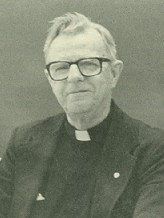
The only thing I would add to this is Fr. William Most's commentary of the massa damnata interpretation of this passage of Romans 9:
Fr. William Most
All exegetes today reject this interpretation. As Huby points out, [Cf. Joseph Huby, SJ, Saint Paul, Epitre aux Romains, Traduction et Commentaire, Verbum Salutis X, Beauchesne, Paris, 1957, p. 349.] it is altogether arbitrary to say that the "clay" in v. 21 stands for the human race, corrupted by original sin, because in the whole of chapter 9 there is not even a remote allusion to original sin. Lagrange makes a keen observation [M.J. Lagrange, OP, Saint Paul, Epitre aux Romains, Gabalda, Paris, 1931, p. 238.]: "At least the potter does not blame the vessels which he has made for ignoble uses." Hence, if God really had made certain men for ignoble roles, He should not blame and condemn these men for being such. 
Actually, St. Paul was only making a comparison, or, as Lagrange says, [Ibid.] "a simple parable." St. Paul wishes to teach that God has the right to assign men to various places in the external order of this world-which is quite different and distinct from the internal order of eternal salvation or ruin! That is, God makes some to be kings, others physicians, others laborers, etc. And similarly, He brings some into the Church in the full sense, and not others. But these assignments by no means fix the eternal lot of a man. Later in this chapter we shall examine what relation does exist between a man's eternal lot and his place in the external order of this world.
So in short, reading Paul to be talking about eternal life and eternal death in Romans 9:18-21 would not just contradict Catholic theology.  It contradicts the rest of Paul's line of argumentation in Romans itself.  It's a much stronger reading to view Paul as talking about (a) the blessing and curses of ordinary life [like giving one person five talents, and another one], and/or (b) participation in the life of the visible Church [which fits the general theme of Romans].

What Does the Book of James Say About Justification?

0 comments
Perhaps no single doctrinal issue has caused more division between Catholics and Protestants than the question of justification, or how we are made righteous before God.  Catholic believe that we are justified by faith, but must cultivate this faith through good works done in obedience to God (what St. Paul calls the “obedience of faith,” in Romans 1:5 and Rom. 16:26).  Protestants, beginning with Martin Luther, insist that justification is by faith alone: that works play absolutely no role in justification.

Lucas Cranach the Elder,
Martin Luther (1520)
Unlike many modern Protestants, Martin Luther acknowledged that Catholics (or, as he put it, “papists”), taught that faith was the foundation of salvation. That is, he recognized that we weren't actually Pelagians, and that we don't believe that you can work your way to Heaven (as is often claimed today).  But he still thought Catholics were wrong, and perverting the Gospel.  Here's how Luther contrasted the Catholic and Protestant position on justification:
They [Catholics] admit that faith is the foundation of salvation. But they add the conditional clause that faith can save only when it is furnished with good works. This is wrong. The true Gospel declares that good works are the embellishment of faith, but that faith itself is the gift and work of God in our hearts. Faith is able to justify, because it apprehends Christ, the Redeemer.
So both sides agree on justification by faith, but disagree on justification by faith alone.  That may seem like a minute squabble, but understand that Luther saw this as not only the single most important debate in the Reformation, but a battle to preserve the Gospel itself.  He described the conflict in these terms:
Since our opponents will not let it stand that only faith in Christ justifies, we will not yield to them. On the question of justification we must remain adamant, or else we shall lose the truth of the Gospel. It is a matter of life and death.
Given Luther's radical emphasis on justification by faith alone, Christians (of all stripes) are often surprised to learn that Scripture uses the phrase “faith alone” exactly once.  Here it is, from James 2:24:
You see that a man is justified by works and not by faith alone.
This explicit declaration in Scripture, that we're not justified by faith alone, would seem to end the dispute, right? Heck, even Luther saw the Book of James as fatal to his views on justification, and tried to remove it from the Bible.

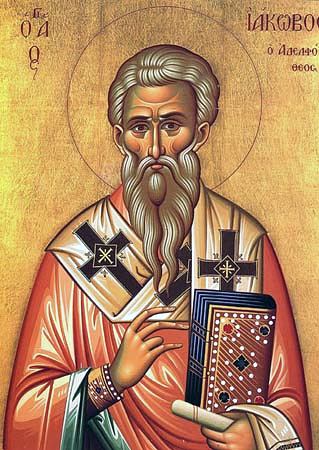
St. James
But Protestantism has survived.  Modern Protestants both proclaim justification by faith alone, and believe that the Book of James is God-breathed Scriptures.  So how do they rectify the apparent contradiction?

One way is by claiming that James is writing against a “mere profession” of faith, and that “James is combating justification by profession alone, not sola fide, in this chapter.”  In other words, where James explicitly criticizes his opponents for having faith alone (James 2:24), or faith without works (James 2:14, James 2:17, James 2:20, James 2:26), this interpretation assumes that what James really meant to say was that his opponents have the wrong kind of faith, or that they don't really have faith at all.

This is part of a broader Protestant trend to read James as distinguishing between saving faith, and whatever he's criticizing in James 2.  So, for example, Arthur Pink, in his work Studies on Saving Faith manages to devote a full chapter to the idea of “counterfeit faith,” without pointing to a single passage of Scripture actually distinguishing between saving and counterfeit faith. And as Jimmy Akin notes in an excellent article on the subject, several Protestant translations (including the NIV, RSV and CEV) have even added words to James 2:14 to make the chapter fit this view.

But there are several problems with this interpretation.  The first, and most obvious, is that James acknowledges that those he's criticizing have faith, and notes that even the demons have faith.  The second is that James compares their faith to his own, and to Abraham's, and to Rahab's.

(1) The Faith of the Demons

In James 2:19, St. James acknowledges:
You believe that God is one; you do well. Even the demons believe -- and shudder.
In saying, “You believe that God is one; you do well,” James forever dispels the notion that his opponents are merely professing to hold a faith that they privately doubt or deny.  But in comparing their faith to that of the demon's, James is showing the insufficiency of faith.

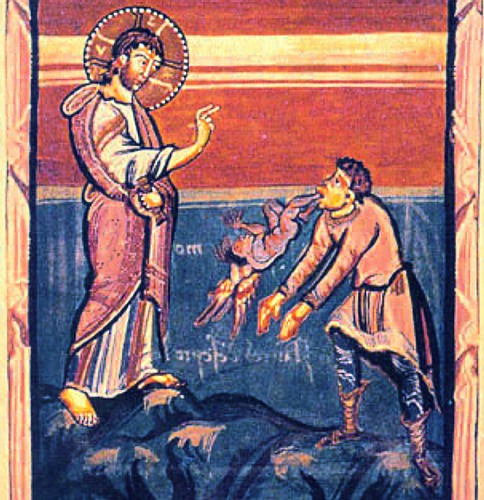
Medieval Illustration of one of the
Exorcisms Performed by Jesus
The demons know God exists, because they've encountered Him in a way that we haven't.  In fact, in Mark's Gospel, the first to identify Christ as the Holy One of God (after God the Father Himself) are the demons.  We see this in Mark 1:23-26:
And immediately there was in their synagogue a man with an unclean spirit; and he cried out, “What have you to do with us, Jesus of Nazareth? Have you come to destroy us? I know who you are, the Holy One of God.” But Jesus rebuked him, saying, “Be silent, and come out of him!” And the unclean spirit, convulsing him and crying with a loud voice, came out of him.
And again, in Mark 1:35,
And he healed many who were sick with various diseases, and cast out many demons; and he would not permit the demons to speak, because they knew him.
The demons know better than anyone on Earth who Jesus is, and they also know what that means.  Nor do they apparently doubt His claims: the demons tremble, as James says: they flinch before Him in anticipation of being destroyed, as Mark 1:24 makes clear.

Put another way, the demons understand and believe who Christ is, but despite this knowledge, they choose to work against Him, rather than work for Him, and are justly damned as a result.  This would seem to prove James' point: that works are vital to justification.  What we do, how we respond to faith, matters.  When we're tempted with something sinful, for example, do we follow the One we know is Lord, or do we oppose Him?

(2) The Faith of Abraham

In James 2:18, St. James compares his opponents' faith to his own:
Rembrandt, Sacrifice of Isaac (1635)
Show me your faith apart from your works, and I by my works will show you my faith. 
If the demons are examples of those who have faith, but for whom it does no good, James also provides Abraham (James 2:21-24) and Rahab (James 2:25-26) are examples of those who have faith and who are saved.  And what's the difference between Abraham and Rahab, on the one hand, and the demons, on the other?  It's not that the demons are just pretending to believe in God, or anything of the sort.  It's how each side reacts to this belief.  As James explains, Abraham and Rahab by the works they perform in response to faith.  To wit:

  • Was not Abraham our father justified by works, when he offered his son Isaac upon the altar?” (James 2:21)
  • And in the same way was not also Rahab the harlot justified by works when she received the messengers and sent them out another way?” (James 2:25)

James isn't saying that works, apart from faith, save.  But he is saying that faith is “completed by works” (James 2:22), and insufficient in itself.

Rectifying James and Paul

How then, should we rectify this with all of the statements that St. Paul makes against works in Romans and Galatians?  The Protestant Matthew Henry Complete Commentary on the Whole Bible explains:
When Paul says that a man is justified by faith, without the deeds of the law (Romans 3:28), he plainly speaks of another sort of work than James does, but not of another sort of faith. Paul speaks of works wrought in obedience to the law of Moses, and before men's embracing the faith of the gospel; and he had to deal with those who valued themselves so highly upon those works that they rejected the gospel (as Romans 10:1-21, at the beginning most expressly declares); but James speaks of works done in obedience to the gospel, and as the proper and necessary effects and fruits of sound believing in Christ Jesus. Both are concerned to magnify the faith of the gospel, as that which alone could save us and justify us; but Paul magnifies it by showing the insufficiency of any works of the law before faith, or in opposition to the doctrine of justification by Jesus Christ; James magnifies the same faith, by showing what are the genuine and necessary products and operations of it.
Yes, yes, and a thousand times, yes. The sort of “works” that Paul is clearly obedience to the Mosaic Law, which is why he also refers to it as “works of the Law” (Romans 3:20; Galatians 2:16), “the Law” (Rom. 3:20; Gal. 2:21) and uses circumcision as an example of the inadequacy of the Law (Gal. 5:6).  In 1 Cor. 7:19, St. Paul actually contrasts circumcision with obedience to God's commands, saying:
Circumcision is nothing and uncircumcision is nothing. Keeping God’s commands is what counts.
So obedience to the Mosaic Law is meaningless for salvation, while obedience to “the law that requires faith” (Rom. 3:27) is not.  This interpretation certainly makes sense of Paul's references, in Romans 1:5 and Romans 16:16 to the “obedience of faith.”  Faith is the foundation of salvation, but we need to respond to that faith by obeying God.   From this perspective, James and Paul clearly speak with one voice: there's no contradiction, or even a real tension between the two.

Martin Luther and the Book of James

0 comments
Martin Luther's hostility to the Book of James is well-known, and I've mentioned it in other contexts, but I wanted to consider today the implications for the Lutheran view of justification, at the heart of the Reformation and of modern Catholic-Protestant disputes.

Here's what Luther had to say about the Book of James:
In the first place it is flatly against St. Paul and all the rest of Scripture in ascribing justification to works. It says that Abraham was justified by his works when he offered his son Isaac; though in Romans 4 St. Paul teaches to the contrary that Abraham was justified apart from works, by his faith alone, before he had offered his son, and proves it by Moses in Genesis 15. Now although this epistle might be helped and an interpretation devised for this justification by works, it cannot be defended in its application to works of Moses' statement in Genesis 15. For Moses is speaking here only of Abraham's faith, and not of his works, as St. Paul demonstrates in Romans 4. This fault, therefore, proves that this epistle is not the work of any apostle.
In other words, Luther taught that the Book of James contradicted the doctrine of sola fide, or justification by faith alone.  If he's right about this, then either the Bible is wrong, or Protestants are wrong.  As far as I can tell, this leaves Protestants with three options:


Sir Joseph Noel Paton,
Dawn: Luther at Erfurt (1861)
(1) The Book of James teaches false doctrine, antithetical to the Gospel.  In other words, Luther is right.  If this is the case, you should cut that Book out of the Bible.  But of course, this raises all sorts of problems.  Because then, you're not deriving their views on justification from Scripture, but creating a Bible that agrees with the views you already hold.

(2) Luther didn't understand the Book of James, or how it related to justification.  This is a huge blow to Luther's credibility, and substantially undermines the Reformation.  This is the doctrine Luther viewed as the most important, the doctrine that justified (if you'll pardon the pun) the entire Reformation, since (in his words), “if this article [of justification] stands, the church stands; if this article collapses, the church collapses.”  This is the doctrine he referred to simply as “the Gospel.”  But if Luther doesn't understand how justification works in the writings of St. James, why should we believe that he understands the way that justification works in the writings of St. Paul?

(3) The doctrine of justification by faith alone is wrong.  In this view, the Reformation was started because Luther was proclaiming a false doctrine, which the Catholic Church recognized and rejected as false. But if this is true, the Reformation was a mistake that needs to be fixed.

In any case, if the Reformation stands or collapses on the strength of the doctrine of sola fide, it's remarkable that the father of the doctrine, Martin Luther, admitted that it was contrary to a Book we know today to be Scripture.

The Case Against Protestant Special Pleading

0 comments
If you're not familiar, “special pleading” is a type of logical fallacy; Wikipedia explains that it “involves someone attempting to cite something as an exemption to a generally accepted rule, principle, etc. without justifying the exemption.

So for example, you might argue for the general rule that “thieves should be punished, because stealing is wrong,” but then say, “it's okay when I steal, because I can really use the money.” But, of course, everyone can use the money, and stealing is wrong when anyone does it.  To apply a separate standard for yourself is special pleading, and it's a fallacious argument.  Either stealing is okay if you can use the money, or stealing is wrong and should be punished, or neither: it can't be both.

With that in mind, I think that there's a central question on which Protestants often employ special pleading, whether they know it or not.  Namely, if an individual Christian declares that all (or virtually all) Christians on Earth misunderstand core elements of the Gospel, but that he understands it correctly, could he be right?

I. The Problems with “Yes

To say yes to this would suggest that it's possible that the Gospel is so obtuse that not a single soul correctly understands it.  This contradicts the Protestant notion of the perspicuity of Scripture, which has proclaimed since the Reformation that “anyone who is literate could comprehend the gospel and the Scriptures.

It also would seem to render Jesus' promises null, when He declared that He'd be with us always (Mt. 28:20),  that His Holy Spirit would lead us into “all Truth” (John 16:13), that this same Holy Spirit, the “Spirit of Truth,” would help us and be with us forever (John 14:16-17), and that Jesus wouldn't leave us as orphans (John 14:18).

This answer also raises some very troubling notions.  The Gnostics, some of the earliest Christian heretics, claimed that there were secret Gospels, with esoteric teachings known only to themselves.  Orthodox Christianity resoundingly denounced this.  To suggest that some elements of the Gospel are known only to a chosen few, out of all of Christianity, seems to reintroduce those same Gnostic elements.

Finally, it would leave the Gospel forever unsettled.  Tomorrow, some Rob Bell or Harold Camping could come along with some new “insight” into Scripture, and we'd all have to change our religion to stay hip to the Gospel du jour. How can we say we believe in orthodox Christianity, if we declare a belief that tomorrow, we may end up believing something totally different?  That sounds like the house of faith built upon sand, which Jesus condemns, rather than the house of faith built upon Rock (Mt. 7:24-27).


II. The Problems with “No

So it would seem that the answer would have to be no. And as Catholics, of course, we'd agree.  But this answer also raises problems for Protestants: after all, isn't this exactly what Martin Luther and John Calvin did?  Each of those men declared that certain core elements of the Gospel were misunderstood by everyone on earth.  In an earlier post, I pointed to four major areas in which they declared all of Christianity wrong:

  1. On Baptism, the Protestant history Philip Schaff, in his History of the Christian Church, Volume II: Ante-Nicene Christianity. A.D. 100-325writes in the section on "The Doctrine of Baptism" that "This ordinance was regarded in the ancient church as the sacrament of the new birth or regeneration," and that its "effect consists in the forgiveness of sins and the communication of the Holy Spirit." Again, this is A.D. 100 - 325.  The situation remains the same for centuries more, until after the Reformation in the 1500s.

  2. On the Eucharist, the Protestant historian J.N.D. Kelly concedes that during the early Church period, “Eucharistic teaching, it should be understood at the outset, was in general unquestioningly realist, i.e., the consecrated bread and wine were taken to be, and were treated and designated as, the Savior’s body and blood.” (Early Christian Doctrines, 440).  Again, this didn't change for centuries afterward.

  3. On forensic justification, the Calvinist scholar Alister McGrath concedes that the “Reformation understanding of the nature of justification - as opposed to its mode - must therefore be regarded as a genuine theological novum.”  Francis Beckwith, in Return to Rome, does a good job of handling the early Church Fathers who are sometimes used to defend forensic justification - he shows quotes from each proving that their views weren't the Protestant one at all.

  4. On the canon of Scripture, I've addressed it here in greater depth. So far, no one's been able to find a single early Christian who owned or used a 66-book Protestant Bible.

If all the world's known Christians could at one time: misunderstand what Baptism does, worship the Eucharist as an idol, proclaim a different Gospel on justification (2 Corinthians 11:4), and have a Bible mixed with good and bad Books, what hope do Christians today have?

There are two posts I've read which really put this problem into perspective.  The first is from Brantly Millegan, who writes:
Prior to the Reformation, the 73 book Catholic biblical canon had been the undisputed biblical canon for over 1000 years. This new 66 book Protestant canon being defended by John Calvin had never existed before, never having been put forth by any individual or group in the 1500 years prior (even during the first three centuries of the Church during which the canon was a disputed matter). The 16th century self-appointed reformers literally removed books from the universally accepted Bible to create a brand new canon and then justified it by appealing to an “inward illumination of the Holy Spirit”.

Would evangelicals accept someone doing the same thing today?

If an influential non-denominational mega-church decided to remove, let's say, the book of Esther from the Old Testament and began printing Bibles with a 65 book canon, and started saying that all those who had more than 65 books in their Bible had added them and were therefore heretics, evangelicals would rightly be in an uproar: 'How dare the the mega-church change the Bible!'

If the mega-church responded that they had made their decision “by the testimony and inward illumination of the Holy Spirit”, would any evangelical be satisfied by that response?
Yet that, of course, is exactly how John Calvin defends his decision to reject seven Books of what was then called the Bible (and is now called the Catholic Bible).  He comes close to claiming to be individually inspired in this decision, something virtually no Calvinist would feel comfortable claiming today.

The second post is one I find even more troubling, and one I've mentioned before.  Chaplain Mike Mercer, a former Baptist minister (now a Lutheran), explains that Luther's Bible put Hebrews, James, Jude, and Revelation at the back of the New Testament, placing a warning page before them:
Up to this point we have had to do with the true and certain chief books of the New Testament. The four which follow have from ancient times had a different reputation.
Luther then proceeds to write rather scathing critiques of the four Books.  While offering some faint praise, Luther levels the following charges:
  • On Hebrews: we cannot put it on the same level with the apostolic epistles.
  • On James: I do not regard it as the writing of an apostle,” and it “is flatly against St. Paul and all the rest of Scripture in ascribing justification to works.
  • On Jude:no one can deny that it is an extract or copy of St. Peter’s second epistle,” and “it is an epistle that need not be counted among the chief books which are supposed to lay the foundations of faith.
  • On Revelation: I miss more than one thing in this book, and it makes me consider it to be neither apostolic nor prophetic.
And in critiquing the Books, Luther offers this standard:
Finally, let everyone think of it as his own spirit leads him. My spirit cannot accommodate itself to this book. For me this is reason enough not to think highly of it: Christ is neither taught nor known in it. But to teach Christ, this is the thing which an apostle is bound above all else to do; as Christ says in Acts 1, “You shall be my witnesses.” Therefore I stick to the books which present Christ to me clearly and purely.
Is that a standard Protestants today would feel comfortable using?  Just accept the Books of the Bible which feel right to you, or which you find agreeable?

As I said, I find his post troubling: Chaplain Mike seemingly points to Luther as a positive example, that perhaps Evangelicals should stop trusting in the sixty-six Books that they've got, since some of them may be more or less Scripture than others.

Conclusion

In his defense, Chaplain Mike is at least being consistent: if the whole world could have the wrong Bible in the Sixteenth Century, it's quite rational that the whole world could have the wrong Bible today, particularly when the same man who lead the charge against the Catholic Deuterocanon also wanted to tear out those four New Testament Books. On what basis can Protestants trust Luther on the Old Testament while ignoring him on the New?

As both Brantly and Chaplain Mike show, a Protestant today who acts like Luther or Calvin would be soundly rejected and branded a heretic.  Yet on what basis, other than special pleading, can this be said with a straight face, without also calling the Reformers heretics? 

More Sketchy Translations by the NIV

0 comments
In an earlier post, I talked about how the NIV (which I generally like) plays unfortunate sectarian games with its translations.  The example I gave was this one: the word paradosis means “tradition,” and the NIV translates it as “tradition” when its used in a negative sense in Scripture (when Christ condemns the Pharisees' adherence to traditions of men over the word of God in Mt. 15:1-9).  But when St. Paul talks about the Traditions we're bound to hold, in 1 Corinthians 11:2, 2 Thessalonians 2:15, and 2 Thessalonians 3:6, the NIV translates the exact same word as “teachings,”  instead.

This reinforces the Evangelical error that Christ condemns Tradition, rather than condemning specific traditions which were obstructing obedience to the Gospel.  And it fuels ignorance: St. Paul says we're called to obey Apostolic Tradition, whether passed on in Scripture (“by epistle”) or word of mouth (2 Thessalonians 2:15). Protestantism has long been uncomfortable with that passage, but the NIV's solution to simply change what it says is obviously unacceptable.  (For the record, there is a Greek word for “teachings”: it's didaktos, and it's used in Matthew 15:9).

Well, Patrick Vandapool, who has a hilarious blog, makes a quite serious point: that the NIV also does this in dealing with works, as well as Tradition.  In translating the same word, ergon (which means “works”), here's what Patrick found:.
If the word ἔργον is used in a negative sense, it is translated as “work” 10 times and as “deed” 7 times.

More revealing is…

If the word ἔργον is used in a positive sense, it is translated as “work” 0 (zero) times and and as “deed” 17 times.
I haven't researched this one myself, but given what I've seen, it's not altogether surprising.  Certainly, Bibles are translated by teams of translators who don't always translate the same word consistently.  And sometimes, there are even good reasons to translate the same word in two (or more) different ways, depending on the context.

But here, the translation seems obviously sectarian.  Evangelicals accuses Catholics of defying Scripture by (1) holding to Sacred Tradition in addition to Scripture, and (2) by allegedly practicing “works-righteousness,” or in having too high a view of the role of works, generally. What the NIV editors have done is stack the Scriptural deck, and in the process, have introduced two new teachings:
  • “Teachings” are good, but “traditions” are bad;

  • “Deeds” can be good, but “works” are bad.

Significantly, these teachings weren't taught in the Bible, until the NIV changed what the Bible said!

Debunking "Easy-Believism"

0 comments
Many Evangelicals will tell you that if you just pray the “Sinner's Prayer,” you'll be saved, of if that you have faith in Jesus Christ, He'll save you even if you don't obey Him.  In light of yesterday's Gospel  (Matthew 16:21-27), I want to address why this is flawed, and what this says about the larger debate about “faith and works.” I'm very much indebted to a powerful homily delivered by Fr. Kelly yesterday on the true cost of Discipleship.

I. What is Easy-Believism?

So what is easy-believism, and who buys into it?  The Calvinist website Monergism.org has a good description:
The term “easy-believism” is a usually derogatory label, used to characterize the faulty understanding of the nature of saving faith adhered to by much of contemporary Evangelicalism, most notably (and extremely) by such Dispensational authors as Charles Ryrie and Zane Hodges. The term was popularized in an ongoing debate between Hodges, to whose theology the label “easy-believism” was affixed, and John MacArthur, to whom the term “lordship salvation” came to be applied.

Essentially, the teaching of “easy-believism” (which proponents prefer to call “free grace,” or some similar term), asserts that the faith which saves is mere intellectual assent to the truths of the gospel, accompanied by an appeal to Christ for salvation (at the end of his life, Hodges embraced the even more extreme position that salvation requires only an appeal to Christ, even by one who does not believe the most basic truths of the gospel, such as his death, burial, and resurrection [which he clearly taught, for example, in “The Hydra's Other Head: Theological Legalism,” printed in the Grace In Focus Newsletter]). According to proponents of the “free grace” movement (i.e. “easy-believism”), it is not required of the one appealing for salvation that he be willing to submit to the Lordship of Christ. In fact, at least according to some proponents, the person appealing for salvation may at the same time be willfully refusing to obey the commands of Christ; but because he has intellectual faith, he will still be saved, in spite of his ongoing rebellion.
So understand right off that this is something your Evangelical neighbor might well believe in, but probably not your “Reformed” neighbors.

II. What's an Easy Way to Know It's False?

Last Sunday's Gospel was the famous one from Matthew 16:13-20, in which Jesus changes Simon's name to Peter, and founds His Church upon Him, after Peter confesses Christ's Lordship. I want to just remind you of one part, Matthew 16:15-16,
He [Jesus] said to them, “But who do you say that I am?” Simon Peter said in reply, “You are the Messiah, the Son of the living God.
Father Kelly pointed out that this is one of the clearest declarations of faith in the Gospels. And Jesus tells us that this declaration of faith comes from God Himself (v. 17).  It's not simply an “intellectual belief,” as if Peter deduced it, but Divine revelation.  Jesus responds to this faith by blessing Peter in the ways I've described elsewhere. But look what happens next (Matthew 16:21-23):
From that time on, Jesus began to show his disciples that He must go to Jerusalem and suffer greatly from the elders, the chief priests, and the scribes, and be killed and on the third day be raised.

Then Peter took him aside and began to rebuke him, “God forbid, Lord! No such thing shall ever happen to you.” He turned and said to Peter, “Get behind me, Satan! You are an obstacle to me. You are thinking not as God does, but as human beings do.”
Peter's confession of faith, while inspired by God, doesn't prevent him from becoming an adversary to God -- in fact, it happens almost immediately.  Did Peter stop believing that Christ was the Messiah? Absolutely not: even in rebuking Jesus, he calls Him “Lord.”  Frankly, Peter's intentions don't even seem obviously wicked: he's not pursuing wealth, or fame, or women: he's just wanting the Gospel to be easy.  

Peter is suffering from a “disordered love,” where he wants what's easiest, rather than what's best.  We see this in parents who spoil their children, and (as Father Kelly emphasized in his homily), we're each guilty of it, every time we avoid proclaiming the Gospel to those we love.  We don't want to hurt their feelings, or we ourselves don't want to suffer, so we avoid saying and doing what we need to.  We become obstacles to God, stumbling stones on the way to the Gospel.

Jesus doesn't let us miss that this is the point of His rebuke (Mt. 16:24-27):
Then Jesus said to His disciples, “Whoever wishes to come after me must deny himself, take up his cross, and follow me. For whoever wishes to save his life will lose it, but whoever loses his life for my sake will find it.

What profit would there be for one to gain the whole world and forfeit his life? Or what can one give in exchange for his life? For the Son of Man will come with his angels in his Father’s glory, and then He will repay everyone according to his conduct.

Christ makes it clear that total self-denial and obedience is required for Discipleship, and required for salvation.  If you try and cling to your old life, if you want to believe that Jesus is the Messiah but not respond, you will lose your life.  On the other hand, if you respond to the Gospel, He promises to reward your conduct at the end of time.


So Peter's believing that Christ was the Messiah, the Son of the living God,” was great, but not enough. Next, he had to learn to act upon that belief, by denying himself, taking up his cross, and following.  He does this, and  Jesus hints at his manner of martyrdom in John 21:18-19.  Peter will ultimately be crucified upside-down, after he declares himself unworthy to die in the same manner as Jesus.


III. What Does This Mean for the Debate About Faith and Works?

We know from the life of St. Peter that mere belief, even a belief revealed to us by God the Father Himself, isn't enough to save us.  If we want eternal life, we need conduct, not just belief.  When Catholics speak of the need for faith and works, that's what we mean: belief in Christ's Messiahship (faith), coupled with the conduct Jesus calls us to (works).

But here's the deal.  Proper conduct is tied to belief: it's all part of walking by faith.  We see this also from the life of St. Peter, after Peter sees Jesus walking on the water (Mt. 14:28-31):
“Lord, if it’s You,” Peter replied, “tell me to come to You on the water.”


“Come,” He said.


Then Peter got down out of the boat, walked on the water and came toward Jesus. But when he saw the wind, he was afraid and, beginning to sink, cried out, “Lord, save me!”


Immediately Jesus reached out His Hand and caught him. “You of little faith,” He said, “why did you doubt?”
Peter's conduct (walking on water) was only possible through faith. We know this, because once he doubted, he could no longer perform the conduct.  That captures the essence perfectly: the sort of works which Catholics talk about aren't something arising apart from faith, but are a part of faith.

The same is true in Matthew 16.  We only have the ability to deny ourselves when we cling to Him.  Only in believing in Him can we have the courage (or the graces) to take up our Cross and follow.  No one in history has ever lived a life of discipleship without having faith.  It's just not possible.

All of this makes me think that the classical Reformed (old-school Lutherans, Presbyterians, and the like), are much closer to Catholics than they are to Evangelicals on the question of how we're saved. Specifically, go back to that definition from Monergism.  They come close to grasping this when they denounce easy-believism like this:
According to proponents of the “free grace” movement (i.e. “easy-believism”), it is not required of the one appealing for salvation that he be willing to submit to the Lordship of Christ. In fact, at least according to some proponents, the person appealing for salvation may at the same time be willfully refusing to obey the commands of Christ; but because he has intellectual faith, he will still be saved, in spite of his ongoing rebellion.
Although they're Calvinist, they clearly believe that in order to be saved, you need to:

  1. Believe;

  2. Stop intentionally disobeying;

  3. Obey.


Those are the three things which the “Lordship salvation” adherents, like John MacArthur, teach. For Jesus to be Savior, He must also be Lord. Catholics agree completely.  We just describe it differently sometimes.

In a nutshell, mere belief won't save you, and most Protestants (outside of the so-called “free grace” movement, which proclaims “easy-believism”) seem to agree.

Why Did the Law of Moses Exist?

0 comments
I've been listening to a very good talk on Galatians 2-5 given by Christendom College's Professor Eric Jenislawski called  “Saint Paul's Galatians: Are You Saved?”  That talk, and countless others, are available free on the Institute of Catholic Culture's website.

In it, he poses the question: Given how emphatically St. Paul denies that the Law of Moses can save us, why did God bother with the Mosaic Law at all?  Prof. Jenislawski does a great job of explaining the three answers Paul gives in Galatians 3.  Here are the three in a nutshell, taken from the handout (which is worth reading, by the way):
1. To prevent sin
Gal 3:19: “lt was added because of transgressions...
The most obvious rationale: God forbids certain behaviors in order to check evil.
2. To put to death self-righteousness
Gal 3:22: “But the scripture consigned all things to sin, that what was promised to faith in Jesus Christ might be given to those who believe.
Only when one knows just how sick one is, does one desire the physician.
Understanding the radical nature ofsin is an essential prerequisite to understanding the redemption that is offered in Jesus Christ. 
3. To chaperone Israel during its youth
Gal 3:24: “the law was our custodian (paidagōgos = disciplinarian) until Christ came.
That's a great summary, and the rest of the handout serves as a good overview of Galatians 2-5 in general.  Following those three major points, here's what Jenislawski said in his talk:
The next question is, “Why then the Law?” That’s Galatians 3:19. Because I imagine the Jews, the Jewish Christians, a little bit like the elder brother of the Prodigal Son, saying, “We’ve served you all these years, and now you’re telling us that to be justified before God you don’t have to keep the Law of Moses? What gives? What was its purpose? Just for nothing? Is God some kind of weird tyrant who says, ‘Today, if you want to be saved, stand on your left leg, and wear a funny hat. Tomorrow, three turtledoves’ It’s clearly not capricious or arbitrary, so what’s the purpose of the Law, if the Law doesn’t save?”

Do you see how that could be a natural question for Paul’s audience, who had previously been so Law-observant? So Paul gives three arguments for the Law. All of them show a sort of positive relationship between the Law, and the New Covenant of Jesus Christ. But all of them do this in a way that makes perfectly clear that it’s not like the Law begins to justify, and Christ finishes the job, or that the Law is sort of half of justification, or that justification is about the Law and Christ is a “plus One” on top of that, like cherry on the cake. There’s a certain relationship, but the Law does not justify. It only prepares for justification.

Paul steps through this in three steps. First argument for “why, then, the Law?” [is Galatians 3:19.] It was added because of transgressions. Why did God make so much Law? The same reason almost anybody makes law: people are doing stuff they shouldn’t be doing. That’s sort of a simple argument: since we’re pressed on time, I probably don’t have to further elaborate. If people weren’t sinning so much, God wouldn’t have to say “now, don’t do that, and don’t do that and don’t do that…” and there’s a lot of that in the Law of Moses. You can see that condemnation of people for doing bad things is important for getting them to ultimately do good things, but it’s not the same. Is that good?

Second, [Galatians 3:21], “is the Law against the promises of God? Certainly not.” So they’re not opposed. This is [Galatians 3:21-22]. “For if a law had been given which could make alive, then righteousness would indeed be by the Law. But the Scripture consigned all things to sin, that what was promised to faith in Jesus Christ might be given to those who believe.”

Now that’s a pretty radical statement. The Scripture consigned all things to sin, and by Scripture, he means the written Law of Moses, that’s what he’s talking about here, because this is an answer to “why, then, the Law?” So that’s pretty radical. What’s the purpose of the Law? To consign – RSV says “all things,” you could even read it “all” to sin. The second purpose of the Law is to say to Israel: SINNER! No, take it to heart, hear it one more time: SINNER! Sinner here, sinner there, that’s sin, that’s sin, that’s sin.

To be mean? No. Because only when Israel learns the radical nature of sinfulness can it appreciate what is offered in God’s grace. How often does Jesus in the Gospels attack self-righteousness? Not righteousness, but self-righteousness. “Because he wished to justify himself, he asked, ‘who is my neighbor?’” because that man wanted to come off squeaky clean, even though he hated Samaritans. Part of what Jesus does, constantly in the Gospel, is to teach people about the radical nature of sin. We can make the make the mess, and we can owe the debt, but we can’t pay it off by our own power. Only God’s grace can do that. God’s been trying to teach the human race that since Adam. And so an essential component leading up to understanding what is offered to you in the Cross of Christ, which is remission of your sins, and Redemption, justification, is understanding that it comes through grace and faith, and not by one’s own power.

Because a fallen man can do nothing to get himself out of the hole. And to do that, Israel had to be made constantly aware of its sinfulness. Because how often are the Jews, even with the sacrificial system, and the Ten Commandments, cheating on the Law and falling into this payoff mentality? “Ehhh, today not so good, extorted a bunch of poor people. Three oxen… done!” Kind of like you might do with MasterCard. $400 in debt, but okay, the bill comes, I cover it, I’m back to zero. That is not the relationship between a man’s sin and his power to get out of sin. It’s like stroking a check for $10 million on MasterCard, and the bill comes, and it’s like “Oh my gosh.” That’s why the Lord loves parables of crushing debtors. Remember the parable about the man who owes $10,000, and then he’s forgiven, and he throttles the guy who owes him a hundred? Or why Jesus who loves people who are in positions of medical infirmity who cannot be cured. Or prostitutes: once you’ve given yourself over to that kind of scarlet life, you can’t just do a series of actions, and get back to purity. Once you have leprosy, nothing under the sun can cure you (at least at that time). You have to have a certain kind of understanding that only God can make you whole. Or Augustine puts it this way: “Only once you know how sick you are do you ardently desire the physician.”

It’s a common mentality. Some people don’t like to go to the doctor: “ehhh, what’s he going to tell me? I don’t want to hear it.” And when the doctor tells you, “I’m sorry, you have cancer,” oh boy, do you sit up and take notice and love that physician. Because if you don’t, you’re dead. So the Scripture consigns all things to sin, lets people know the radical nature of sin, so that what was promised to faith in Christ may be given to those who believe.

So do you see how there’s kind of a dialectical relationship between the Law and Christ? The Law condemns precisely so Christ might bring justification. It’s not like one starts the process in a positive way, and the Other does the other 25%. The first one’s entirely negative: condemnation, so that once one’s on one’s knees, one can receive salvation from Christ.

Third argument gets us into what it means to be a good son or daughter of God, and the value of our human works. Paul says [Galatians 3:23-24], “before faith came, we were confined under the law, kept under restraint until faith should be revealed. So that the law was our ‘custodian,
” (says RSV, literally paidagōgostrainer of children, chaperone, you could say), “until Christ came, that we might be justified by faith.”

Third argument is that the Law was fitted for Israel in its infant and adolescent stage of covenant history. Now “pedagogy” means “the art of teaching,” that’s not what it means in ancient Greece. It’s literally “disciplinarian.” Somebody who’s Johnny’s chaperone. Didn’t teach him, but brought him to school each day, carried his books, made sure he didn’t play hookie, didn’t hang out with the other Greeks who were drinking too much wine, gave him a slap when he stepped out of line. Kept him on the right path so that in adolescence, he might grow to maturity one day, internalize virtue, and not need the chaperone anymore. So too was ancient Israel under the Law. All kinds of rules and regulations, and Israel chafed under it sometimes, as a teenager does his father’s rules and regulations. But the purpose of that is that someday, you wouldn’t say, “Dad, please come tell me it’s ten o’clock and time to go to bed.” The purpose is that someday you’d be without that chaperone and disciplinarian because the Law is written in your heart. You don’t need the artificial enforcements about what’s right and wrong. You do what’s right, and avoid what’s wrong. So the third argument is covenant-historical.
For whatever it's worth, the last of this arguments, the idea that the Law was our paidagōgos, is something I've talked about before.

Purgatory and Ghosts

0 comments
Randal Rauser, an associate professor of historical theology at Taylor Seminary in Canada, wrote a column on Tuesday for the Christian Post, called "Should Christians believe in ghosts?"  He began by showing that the  ancient Israelites believed in ghosts (Rauser points to the conjuring of Solomon in 1 Samuel 18), and that the Apostles believed in ghosts, quoting Mark 6:48-50,
He was about to pass by them, but when they saw him walking on the lake, they thought he was a ghost. They cried out, because they all saw him and were terrified.
And Luke 24:36-37,
While they were still talking about this, Jesus himself stood among them and said to them, "Peace be with you." They were startled and frightened, thinking they saw a ghost.
Rauser then shows, by telling his readers that "Gregory the Great" (that is, Pope Gregory the Great) discussed a number of alleged ghostly apparitions in 585 A.D.

But the question, not of ghosts per se, but of ghosts roaming the world, is a bit troubling theologically.  Shouldn't they be in Heaven or in Hell?  Professor Rauser's response to this problem was fascinating to me:
Many Christians have understood ghosts, or at least some of them, as enduring a purgatorial existence. But this does not exclude other possibilities such as some "lost" ghosts who are engaged in malevolent mischief (e.g. poltergeist activity) or ghosts who are regenrated but engaged in particular missions on earth. Moreover, even the purgatory option is open to Protestants, so long as it is qualified appropriately (i.e. some views of purgatory are inconsistent with Protestantism but others are not).
I found two things fascinating here:
  1. That Rauser was willing to acknowledge the possibility of the existence of some form of Purgatory.  He leaves the question at this, without explaining which forms of Purgatory are compatible and which are not.

  2. Conversely, the notion that some views of Purgatory are "inconsistent with Protestantism" is something of an odd claim, these days. Is there anything under the sun that isn't consistent with some form of Protestantism?  And who's in charge of Protestantism, to decide which things are authentic manifestations or reforms of the Protestant tradition, and which things are deviations?
Fortunately, I wasn't the only person with raised eyebrows at this admission. One of the commenters wrote, “Dr. Rauser, could you explain the purgatorial possibilities open to Protestants? I’ve never heard of this. It would certainly be fascinating in its interpretive potential as it applies to the paranormal.”  And yesterday, he responded.  In relevant part, he explained:
Purgatory, boiled down to essentials, is constituted by the following claim:

(1) the process of sanctification in the regenerate continues posthumously.

That’s it. All you need for purgatory is (1). You can always add additional claims like “this posthumous process of sanctification expiates the guilt of sin” but a claim like that is not essential to the doctrine of purgatory.

There is no inconsistency between the core claims of Protestantism and (1). Therefore, it follows that Protestants can accept a doctrine of purgatory.

Just to hammer this point home, let’s assume that a Protestant has absolutely impeccable credentials because she holds to the following very traditional, mainstream Protestant claims:

(2) Penal substitution: Christ suffered in the place of the elect, taking the punishment that was owing to them.

(3) Double imputation: at the moment of regeneration/conversion the guilt of the elect person is imputed to Christ and his righteousness is imputed to the elect.

(4) Justification: at the moment of double imputation the elect person is justified.

There is simply no conflict, or even discernable tension, between (2)-(4) and (1). Thus, a Protestant who has reason to believe that the process of sanctification continues posthumously should have no problem accepting (1) whilst retaining.
Given that Catholics don't think that Purgatory is something apart from the work of Christ, I'm at a bit of a loss for how "some views of purgatory are inconsistent" at all. The real difference appears to be, not with Purgatory, but with how Protestants and Catholics understand justification and sanctification.

Within Catholicism, God doesn't simply declare us righteous, He makes us righteous, though the Holy Spirit.  Anything less would be akin to God lying.  In contrast, Lutheranism claimed that God merely declares us righteous, while we remained depraved sinners - Luther compared it to snow covering a dunghill.  Another analogy would be a white shirt stained red with sin.  Luther's view of justification would just have God putting a white shirt over the stained shirt,* and pretending the stained shirt didn't exist; Catholicism views God as actually washing away all the filth.

This renders sanctification nearly meaningless in Lutheran theology. It's simply not necessary for salvation at all.  Instead, sanctification is simply the result of being saved, just as within Calvinism, both justification and sanctification are results of being saved.  So sanctification is helpful for convincing yourself you're saved, but it doesn't do anything.  If that's all sanctification is, there's no reason for Purgatory.

The reason that Purgatory doesn't fit well within a Protestant schema isn't that it adds something to the work of Christ. It's that if God cares enough about our sanctification to continue to work on us until we're actually cleansed, then it must be more important than mere evidence of our justification, and it seems to be necessary to enter Heaven (Rev. 21:27).  If all that's true, forensic-only justification, the most important doctrine of the Reformation, is almost certainly wrong.

Having said all of this, I'm actually not saying that Rauser is necessarily right about ghosts, or about ghosts being in Purgatory (my own inclinations match Jimmy Akin's), but only that if he is, then it seems to me that he's showing why the Lutheran understandings of justification and sanctification are wrong, or at least incomplete.  If Rauser gives serious examination to the problem of Purgatory, it seems almost certain that he'll find himself confronting the Catholic question soon enough.  I'm pleased to see him going down that road, and pleasantly surprised that the Christian Post is permitting him to do so.

*While I disagree with Luther on justification, this was more or less my approach to my wardrobe for many years.

Can Classical Protestantism Affirm the Lord's Prayer?

0 comments
Called to Communion had a great discussion on this topic in regards to Calvinism, but I wanted to look at the same thing in regards to traditional Lutheranism. Pastor Hemmer of Hope Lutheran Church contrasts the Lutheran position with Catholicism quite neatly:
Can you be forgiven of sins you have not yet committed? 
The answer to this question exposes a huge difference between Lutherans and Roman Catholics in their understanding of forgiveness. Case in point: Baptism. For a Roman Catholic, in Baptism, God only forgives past sins. For a Lutheran, when God baptizes you, He places you into His forgiveness. That forgiveness covers past sins, current sins, and future sins. As Luther explained it, we live in our Baptism every day. 
So, to the person who is worried that Jesus might return before he has the chance to confess sins and receive forgiveness for those sins, the answer is, “Yes, as long as you remain in the forgiveness delivered to you at Baptism, you are already forgiven of those future sins.” There’s no partial forgiveness. Either all of your sins are answered for by Jesus or none of them is.
Contrast this with the Lord's Prayer (Mt. 6:9-13), in which we pray, "Give us this day our Supersubstantial [or Daily] Bread, and forgive us our debts, as we also forgive our debtors" (Mt. 6:11-12).  There are two things to note about this prayer:
  1. We're asking God for forgiveness whenever we pray this, not thanking Him for forgiveness He's already delivered;
  2. The forgiveness is conditional: conditioned upon us also forgiving.
It was this second point which Christ knew would be controversial. Out of the entire Lord's prayer, Jesus saw fit to comment only on this part. So immediately after teaching the Disciples the prayer, He said (Mt. 6:14-15):
For if you forgive other people when they sin against you, your heavenly Father will also forgive you. But if you do not forgive others their sins, your Father will not forgive your sins.
So whether your sins are or are not forgive is premised off of whether or not you forgive others their sins. That's a tough message, but it's one that Christ could scarcely make clearer. Strangely, Martin Luther, in his Larger Catechism explicitly denies that this condition exist, even while quoting to the passage, and making clear that the forgiveness is available only to those who forgive:
If, therefore, you do not forgive, then do not think that God forgives you; but if you forgive, you have this consolation and assurance, that you are forgiven in heaven, not on account of your forgiving, for God forgives freely and without condition, out of pure grace, because He has so promised, as the Gospel teaches, but in order that He may set this up for our confirmation and assurance for a sign alongside of the promise which accords with this prayer, Luke 6:37: Forgive, and ye shall be forgiven. Therefore Christ also repeats it soon after the Lord's Prayer, and says, Matt. 6:14: For if ye forgive men their trespasses, your heavenly Father will also forgive you, etc.
The problem appears to be that Luther couldn't understand how God's forgiveness could be pure grace, a free gift, and yet still conditional. But the problem is easily solved: a gift can still be conditional without us earning it.  For example, if I say, "if you swing by my house later today, I'll give you the keys to a brand new car," you don't somehow merit the gift by coming over. But if you refuse to show up to the house, you reject and deny the free gift. So it is with the forgiveness of God: we're given this free gift conditioned (again, rather explicitly) upon our forgiveness of others.

That's not just an idle hypothetical. In Matthew 18:23-35, a King freely forgives a servant a large debt (Mt. 18:27).  The servant then refuses to forgive a fellow servant a small debt (Mt. 18:28-30). So the King retracts the forgiveness, and turns him over to be tortured until the debt is paid (Mt. 18:34). Christ concludes: “This is how my heavenly Father will treat each of you unless you forgive your brother from your heart” (Mt. 18:35).  That's really straightforward: even if we've already been forgiven by Christ, that forgiveness can be taken away if we refuse to forgive others.  The servant wouldn't have merited being forgiven 10,000 talents (the equivalent of millions of dollars) by forgiving his brother servant the hundred denarii (the equivalent of a few dollars) he was owed.  The forgiveness is both a grace and conditional. So Luther's extreme opposition to any meritorious action on the part of the individual (for fear that this would lead to us "working our way to Heaven") meant that he couldn't understand Mt. 6:14-15, or Mt. 18:23-35, or any of the other passages which speak about the condition of forgiveness As a result, his explanation of the passage is something of a mess.

Calvin's is no better, in which he simultaneously declares Mt. 6:12 to be a condition, stating that "This condition is added, that no one may presume to approach God and ask forgiveness, who is not pure and free from all resentment," and yet proceeds to argue that "the forgiveness, which we ask that God would give us, does not depend on the forgiveness which we grant to others."  Now, it either is or isn't a condition. Calvin's attempt to have it both ways results in this embarrassing conclusion: "Christ did not intend to point out the cause, but only to remind us of the feelings which we ought to cherish towards brethren, when we desire to be reconciled to God." So rather than a condition of God's forgiveness, like Christ explicitly says, Calvin's position is that Christ decided to throw into the Lord's Prayer a short reminder about our feelings. But every Christian knows that there are times when we don't feel like forgiving our neighbor.  So Calvin's interpretation renders the condition of Matthew 6:12 and 6:14-15 to be simply advisory.  We ought to forgive others, but it's not necessary to be forgiven. Contrast that with Jesus Christ: "if you do not forgive others their sins, your Father will not forgive your sins" (Mt. 6:15). It's a condition of forgiveness, not a feel-good admonition about feelings, period.

Conclusion

A Lutheran or a Calvinist could affirm something like:
  1. We forgive others because Christ has forgiven us first; and
  2. Only through the grace of God are we able to truly forgive.
So a prayer like, "Thank you, Lord, for having forgiven me of my sins; out of gratitude, I shall try to forgive others" would be completely compatible with their faiths.  But that's not what the Lord's Prayer says. It says,  "forgive us our debts, as we also forgive our debtors",  and Christ tells us that means that "if you forgive other people when they sin against you, your heavenly Father will also forgive you. But if you do not forgive others their sins, your Father will not forgive your sins." Like I said before we're asking God for (1) present-tense and (2) conditional forgiveness.

From a Lutheran and Calvinist perspective, we already have total and unconditional forgiveness from the past, so we'd be asking God for less than we currently possess as justified Christians.  In other words, we'd be asking Him to take away some of our forgiveness, and to add a new condition in to what was previously unconditional.  From that perspective, the Lord's Prayer would be a spiritual evil.  But of course, it's not: so the problem must like with the Lutheran and Calvinist understanding of how God's forgiveness operates, rather than with the prayer given us by Jesus. In short, it seems to me that the Protestant notion of forensic justification, in which past, present and future sins are forgiven, cannot be right, given what Christ teaches us about forgiveness, and given the Prayer He leaves us with.

The Catholic Argument from History

0 comments
There are a lot of ways of establishing that the Catholic Church is correct.  One way is to show that the New Testament Scriptures describe a single, visible, authoritative Church capable of settling disputes.  When we find that governance in the Church was headed by the Apostles, with one Apostle (Peter) guiding the other Eleven, that's good evidence that the Catholic Church was the Church Christ founded (Mt. 16:17-19) and intends us to be part of (John 17:20-23).

For some people, that'll do the trick.  They'll read John 6 on the Eucharist, or notice Apostolic Succession in Acts 1, or Petrine primacy in Matthew 16 and Acts 2 and Luke 22 and so on, and they'll have a Eureka! moment - asking themselves, 'how have I read these Scriptures so many times, and never noticed that?'  It's an "Emmaus" moment, when you suddenly discover a Truth you'd never seen before in Scriptures you may well have memorized.  But there are other Christians who look at passages of Scripture which I think spell out core Catholic doctrines, and they just don't read them that way.  For those folks, let's look at a different way of establishing the Catholic Church.

Step One: At One Point, The Global Church Held Catholic Beliefs

To see what I mean above, take four common Protestant doctrines:
  1. Baptism is just symbolic (that is, it's not regenerative, and the Holy Spirit doesn't actually cleanse us through it);
  2. The Eucharist is just symbolic (it's not actually the Body and Blood of Christ); 
  3. Justification is just forensic (we're declared righteous by God, but we're not actually made righteous through the Holy Spirit); and 
  4. The Bible is composed of the 66-Book Protestant canon.
To my knowledge, every Protestant denomination holds to at least one of these four doctrines, and many denominations hold to all four.  Now contrast these views with history.

Forget whatever you happen to think about Baptism, the Eucharist, justification, and the canon of Scripture.  At this point, we're just determining what the whole of Christianity used to teach, rather than whether these teachings were right or wrong (we'll turn to that, next). To my knowledge, even Protestants will concede that the visible Church was Catholic during a long period prior to the Reformation.  And although it's true that there were eventually Coptics and Orthodox as well, on all four of the above doctrines, none of them take the Protestant view, either.

So at a bare minimum, we can say that the historic visible Church universally denied all four of the Protestant doctrines above.  In fact, the evidence suggests much more than that -- it suggests that there are centuries of Christianity in which a Protestant would be hard-pressed to find to find a single orthodox Christian who held to any or all four of the above doctrines.  Let's look at each, very briefly: 
  1. On Baptism, the Protestant history Philip Schaff, in his History of the Christian Church, Volume II: Ante-Nicene Christianity. A.D. 100-325, writes in the section on "The Doctrine of Baptism" that "This ordinance was regarded in the ancient church as the sacrament of the new birth or regeneration," and that its "effect consists in the forgiveness of sins and the communication of the Holy Spirit." Again, this is A.D. 100 - 325.  The situation remains the same for centuries more, until after the Reformation in the 1500s.
  2. On the Eucharist, the Protestant historian J.N.D. Kelly concedes that during the early Church period, “Eucharistic teaching, it should be understood at the outset, was in general unquestioningly realist, i.e., the consecrated bread and wine were taken to be, and were treated and designated as, the Savior’s body and blood.” (Early Christian Doctrines, 440).  Again, this didn't change for centuries afterward.
  3. On forensic justification, the Calvinist scholar Alister McGrath concedes that the "Reformation understanding of the nature of justification - as opposed to its mode - must therefore be regarded as a genuine theological novum."  Francis Beckwith, in Return to Rome, does a good job of handling the early Church Fathers who are sometimes used to defend forensic justification - he shows quotes from each proving that their views weren't the Protestant one at all.
  4. On the canon of Scripture, I've addressed it here in greater depth. So far, no one's been able to find a single early Christian who owned or used a 66-book Protestant Bible.
You'll be hard-pressed to find any early orthodox Christian who doubted or denied that (1) Baptism actually regenerated you and made you a Christian, (2) the Eucharist was truly the Body and Blood of Christ, and (3) in justification, God declares us "holy" by actually making us holy, just as you'll be hard-pressed to find an early Christian who (4) ever owned or used a 66-book Bible.

Step Two: This Leaves Only Four Possibilities

Given the above, what should we make of it?  Well, it's theoretically possible:
  1. That the issues of Baptism, the Eucharist, justification, and the canon of Scripture aren't "essential" doctrines;
  2. That the above are essential doctrines, so for long periods of time, no Christian got any of these issues right;
  3. That the above are essential doctrines, so the only true Christians were the dissenters;
  4. That the Catholic Church was, and is, right on these four issues.
The first three of these are very problematic:
  1. The issues of Baptism and justification go to the very heart of how we're saved, and how we become Christians. For Protestants, the canon of Scripture determines where all other doctrines come from, so it's the single most important doctrine.  And on the Eucharist, it's either truly God or an idol Catholics worship.  These seem to be some of the most central questions of Christianity. If these aren't "essentials," it's hard to see what is.  So this produces a theological relativism.  Furthermore, if these aren't essentials, the Reformation was over non-essential issues, and is a wound that should be healed by a return to the Church.
  2. If all of Christianity could get these core doctrines wrong, we're faced with two problems.  First, Christ appears to promise in Scripture that He and the Holy Spirit will perpetually guide and guard the Church (see the lists of Scripture references here and here).  It's hard to rectify the notion that the Holy Spirit will guard the Church, and the notion that the Holy Spirit would allow the entire Church to fall into apostasy. But the second problem is just as ominous: if a Protestant claims that the entire global Church fell into heresy without knowing it, how can we say that's not the case today?  So this produces theological agnosticism, where no one can even say if the Christianity Christ founded exists on Earth.
  3. This is essentially the argument that the only good Catholic is a bad Catholic. There are a number of problems.  Of those who denied the claims of Catholic Christianity but stayed in the Church, we're dealing with people who lived a lie. That's not just being a bad Catholic, but a bad Christian. As Christ says in Matthew 5:37, let your "yes" be a "yes," and your "no" be a "no."  Those who declare "yes," while believing "no" are lying.  Of those who denied the claims of Catholic Christianity and left the Church, we know who these people were, historically speaking. Most importantly, they didn't affirm the four doctrines above. (The third approach, that there was an unknown group of true Christians living in the mountains somewhere, is handled here).  So this produces theological self-refutation, because you would have to claim that the only true Christians were either those people Protestants denounce as heretics or those people who lived their lives denying their religion.
The remaining choice is that the Catholic Church is right.  

Conclusion

To state it positively:
  • Christ promised that He and the Holy Spirit would preserve the Church;
  • Historically, the Church has been incredibly clear (1) that Baptism is regenerative, (2) that the Eucharist is the true Body and Blood of Christ, (3) that the Holy Spirit makes us truly justified, and (4) that there are more than 66 Books of the Bible;
  • Even if we don't understand how these things are true from Scripture, we can know that they're true, because the Church said so, and God protects the Church, and we believe in God.
Any contrary reasoning seems to run into some quite severe problems.