Showing posts with label predestination. Show all posts

Luther and Calvin v. Augustine and Justin Martyr on Free Will

0 comments
One of the core tenets of Calvinism is the belief that there's no such thing as free will, particularly in regards to matters of salvation.  What strikes me about this doctrine is that I'm not sure anyone really believes it.  I realize that sounds odd, but consider: even those, like Luther and Calvin, who claim that the will is in total bondage contradict themselves throughout their writings, while St. Augustine (who Luther and Calvin considered the father of the doctrine) expressly denies it.  Let's consider each man in turn:

Luther on Free Will

Martin Luther's 1525 book On the Bondage of the Will argues that free will is an illusion, and that men are either the slaves to God, or the slaves to Satan:
Title Page, Martin Luther's
On the Bondage of the Will
But this false idea of "free-will" is a real threat to salvation, and a delusion fraught with the most perilous consequences. If we do not want to drop this term ["free-will"] altogether - which would really be the safest and most Christian thing to do - we may still in good faith teach people to use it to credit man with "free-will" in respect, not of what is above him, but of what is below him. That is to say, man should realize that in regard to his money and possessions he has a right to use them, to do or to leave undone, according to his own "free-will" - though that very "free-will" is overruled by the free-will of God alone, according to His own pleasure. However, with regard to God, and in all that bears on salvation or damnation, he has no "free-will", but is a captive, prisoner and bondslave, either to the will of God, or to the will of Satan.
Read that passage carefully, and consider the numerous ways in which Luther disproves his own point:
  1. If man has no free will, how can he choose to drop the term free-will altogether, as Luther suggests?  For that matter, if man has no free will, how can he even want to drop the term free-will altogether?  Desire, after all, is tied to the will.

  2. When Luther speaks of dropping the term free-will as being the safest and most Christian thing to do,” how can he speak of actions on a spectrum of goodness?  That is, how could one Christian option be any more safe or more Christian than another, if each is the direct result of the will of God?  How could one of God's actions be any safer or more Christian than any of His other actions?

  3. If man has no free will, how can Luther speak of us as teaching anything “in good faith”?  Likewise, if man has no free will, how can Luther encourage men to “credit” themselves with free-will in respect to what is below them?

  4. Finally, and most centrally, Luther argues that “in all that bears on salvation or damnation, [man] has no "free-will",” yet still claims that a particular doctrine (the doctrine of free will) “is a real threat to salvation.”  If every man is a mere captive to the will of God (the saved) or the will of Satan (the damned) on matters of salvation, how could any doctrine pose a threat to salvation?

    If the saved are completely slaves to God, unable of doing anything contrary to His Will, how would the existence of a false doctrine overcome the will of God?  [The Calvinists ultimately recognized this absurdity, and created the doctrine of  “Perseverance of the Saints” (and the related doctrine of being “Once Saved, Always Saved”) in response.]
I mention this not to pick on Luther, but because Luther is the first of a long string of Protestant theologians to make these sort of internally-incoherent arguments. The very writers who profess to disbelieve in free will write things that only make sense if a thing such as free will exists

For example, a given theologian will deny free will, then talk about the importance and the necessity of having a saving faith in Christ, and ensuring that this faith is an authentic one.  But faith is inherently an act of the will, as St. Thomas has explained. We don’t speak of how doors or rocks have faith in God, because that’s meaningless. Without wills, they cannot have faith.  Or the same writer might say that instead of worrying about good works, we need to trust in God.  But to trust is also to make an act of the will.  It's for precisely this reason that no one can externally force you to have faith, or to trust in God, or any of the rest, because it's an operation of the will

Ironically, this is the very problem that Luther is complaining about in the section that I quoted above: that even Protestants can't seem to avoid speaking as if free will exists.  There's good reason for that.

Calvin on Free Will
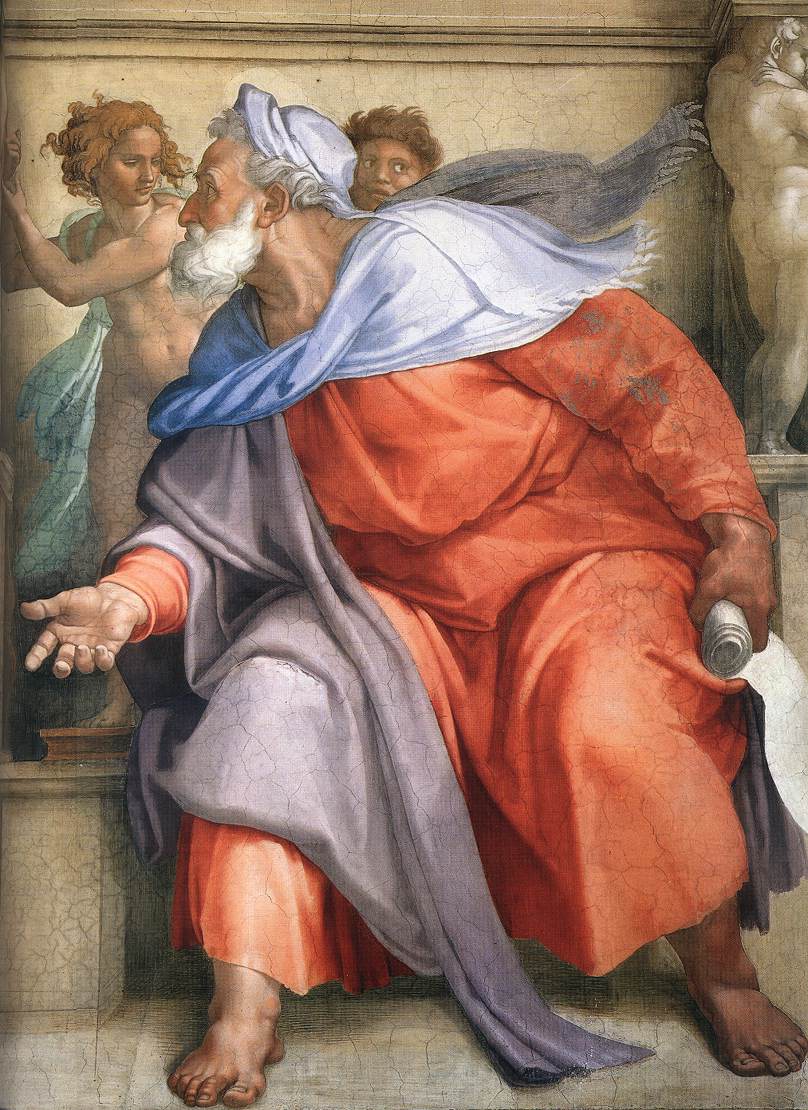
Michelangelo, Ezekiel
(Sistine Chapel detail) (1510)
Another Protestant Reformer who talks himself in circles on free will is John Calvin, who carries Luther's doctrines against free will to their logical end-point.  Calvin, like Luther, denies the existence of man's free will in regards to issues of salvation.  But that poses a real problem for anyone who reads the numerous portions of the Bible that call us to convert.  For example, Ezekiel 14:6 says, “Therefore say unto the house of Israel, Thus says the Lord GOD; Repent, and turn yourselves from your idols; and turn away your faces from all your abominations.”  Now, that's pretty plain Scripture, showing the clear existence of an authentic free will related to salvation: that the Israelites are capable of repenting, of turning away from idols, and turning away from abominations.

You might think that since Calvin denied such a will existed, he'd find some way of shirking the plain meaning of the passage.  Nope, on the contrary, Calvin's exegesis of the passage only reinforces these realities:
Now God shows why he had threatened the false prophets and the whole people so severely, namely, that they should repent; for the object of God’s rigor is, that, when terrified by his judgments, we should return into the way. Now, therefore, he exhorts them to repentance. Hence we gather the useful lesson, that whenever God inspires us with fear, he has no other intention than to humble us, and thus to provide for our salvation, when he reproves and threatens us so strongly by his prophets, and in truth is verbally angry with us, that he may really spare us.
Consider something that actually lacks a free will, like a robot programmed to perform certain tasks.  Does it make any sense to threaten, to terrify, to exhort, to inspire, to humble, or to reprove that robot?  Of course not.  If we yell at our computers, it's because we're acting in irrational anger. Yet this is exactly how Calvin describes God.

More than that, Calvin says that God does all of these things to and for us, so that we should repent, so that He may spare us.  If one believes in the existence of free will related to salvation, Calvin's exegesis makes perfect sense, and is quite good here.  But if you deny the reality of such a free will, as Calvin himself did, then this exegesis makes no sense.

St. Augustine on Free Will

Both Luther and Calvin are big fans of St. Augustine, and derive their views on predestination and free will in part from some of Augustine's writings (particularly one of his speculative works, his Letter to Simplician).  But taking a fuller view of Augustine's own writings, it's clear he was neither a Lutheran nor a Calvinist on the issue of free will related to salvation.

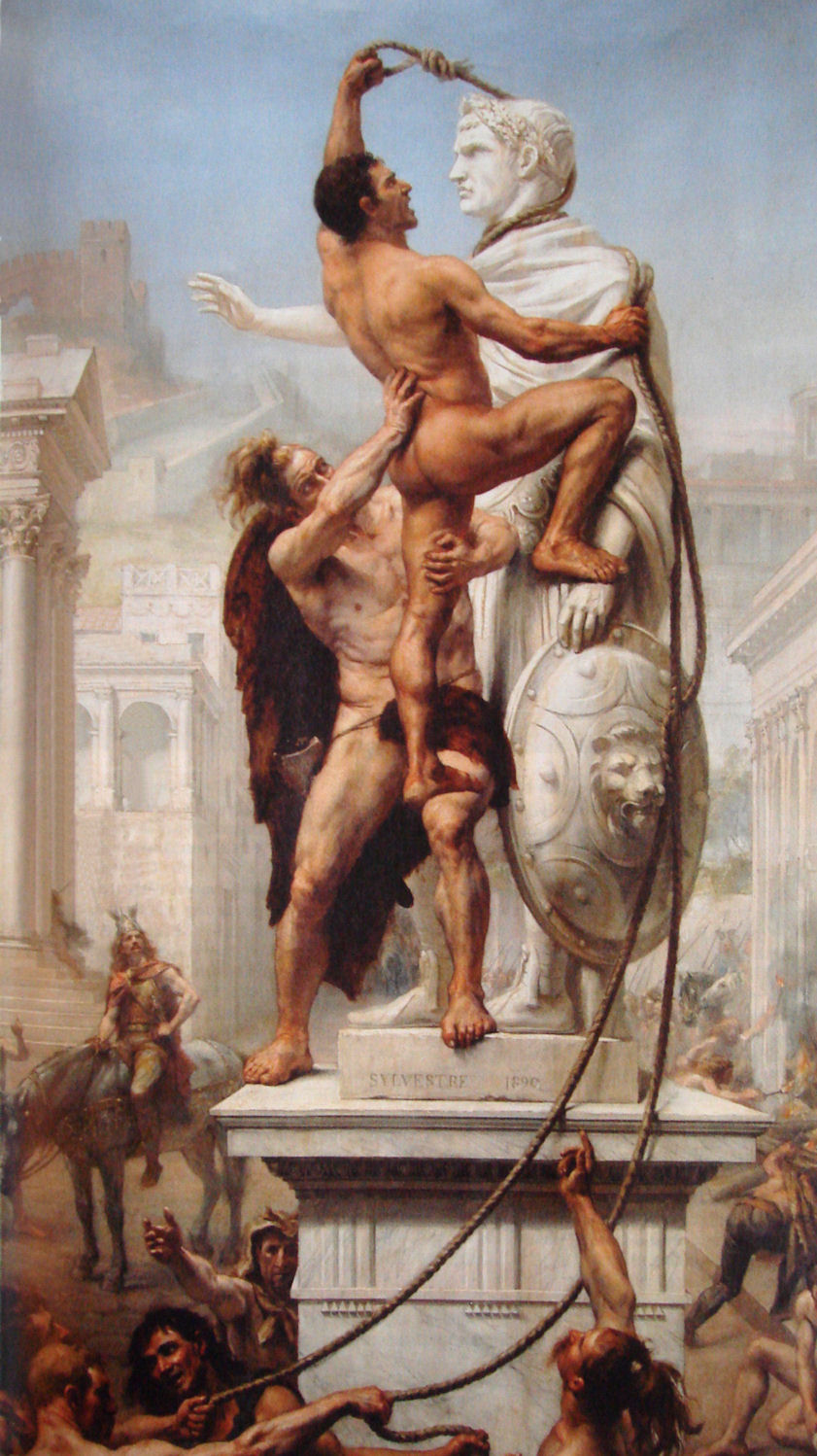
Joseph-Noël Sylvestre,
The Sack of Rome by the Barbarians in 410 (1890).
For example, in his famous City of God, he writes of how when the Visigoths pillaged Rome, they raped “not only wives and unmarried maidens, but even consecrated virgins.” Augustine is aware that these women are guilt-ridden, feeling “shame, lest that act which could not be suffered without some sensual pleasure, should be believed to have been committed also with some assent of the will.

In response, he assures them that they needn't be ashamed, and indeed, that they haven't violated their vow of virginity, since “the purity both of the body and the soul rests on the steadfastness of the will strengthened by God's grace, and cannot be forcibly taken from an unwilling person.”  He explains this conclusion from the following principle:
Let this, therefore, in the first place, be laid down as an unassailable position, that the virtue which makes the life good has its throne in the soul, and thence rules the members of the body, which becomes holy in virtue of the holiness of the will; and that while the will remains firm and unshaken, nothing that another person does with the body, or upon the body, is any fault of the person who suffers it, so long as he cannot escape it without sin.
Now, this is pretty basic Christianity.  Fornication is a mortal sin, but a person isn't guilty of fornication (or any sin) by being raped.  These women were victims, not sinners, and Augustine goes to great lengths to make that unambiguously clear.  Yet to take Luther and Calvin's arguments seriously, the difference between fornication and rape would disappear, since no free will exists in either case.

Augustine's argument echoes those Fathers who came long before even his own time.  For example, St. Justin Martyr wrote, back in 151 A.D., denouncing the pagan view of immutable Fate:
“We have learned from the prophets and we hold it as true that punishments and chastisements and good rewards are distributed according to the merit of each man’s actions. Were this not the case, and were all things to happen according to the decree of fate, there would be nothing at all in our power. If fate decrees that this man is to be good and that one wicked, then neither is the former to be praised nor the latter to be blamed.”
Put another way, if the Lutheran-Calvinist view of the bondage of the will were true, every bad action we commit would be as far beyond our control as the rape of the Roman virgins was to them.  And just as they could not be justly condemned for actions that they could not resist, neither can we be condemned for the actions we cannot resist.


Conclusion

Admittedly, free will is a bit of a mystery.  We don't fully grasp what it is, or how it works.  It puzzles theists and atheists alike.  But we can be sure that it exists, in part because it is necessary for God's Justice, and in part because we cannot coherently speak of it not existing (any more than we can coherently speak of a self-caused universe arising without God).

As St. Justin Martyr notes, free will has to exist for God's rewards and punishments to be Just.  St. Augustine reaffirms this, and applies this principle, explaining that those actions done to us that we do not will, cannot be imputed to us as sins.  What matters is not what happens to us, but what we will.  Thus, it is wrong to condemn the virgins of Rome as fornicators when they were raped. It would be infinitely more wrong to send them to Hell for being raped.

All of this, in addition to being logically necessary, is self-evident.  That is, each of us experiences free will, even if we choose to deny it.  It's for this reason that even those, like Luther or Calvin, who set out to deny free will (at least as pertains to issues tied to salvation) cannot help but speak as if it exists.  Because it does.  And we can observe it does.
“Did God Die For You?” (St. Paul and Unconditional Election)

0 comments
That's the title of a tract I was handed on the street earlier this month. It's in the form of a series of questions and answers. One of the questions is, “How do I know if God has chosen me to be saved?” The answer begins (my emphasis added):
A. You may be one of God's chosen (elect) people or you may not -- only God knows those He intends to save; therefore we have to leave the question of “election” completely to the sovereign will of God.
And since Calvinists claim that, “Jesus died only for the elect,” the answer to the tract's title question seems to be, “We don't know.”  Christ may have died for you, He may not have -- there's no way to know for sure, and nothing you can do about it, anyways. That's the Good News?

But it gets worse. Arminians teach that God predestined those He knew would accept salvation. But Calvinists deny this. Instead, Article 9 of the first Chapter of the Canons of Dordt teaches:
This election was not founded upon foreseen faith, and the obedience of faith, holiness, or any other good quality of disposition in man, as the pre-requisite, cause or condition on which it depended; but men are chosen to faith and to the obedience of faith, holiness, etc., therefore election is the fountain of every saving good; from which proceed faith, holiness, and the other gifts of salvation, and finally eternal life itself, as its fruits and effects, according to that of the apostle: "He hath chosen us (not because we were) but that we should be holy, and without blame, before him in love," Ephesians 1:4.
(Note that the only support Dordt supplies for this doctrine is by adding some words to Ephesians 1:4.)  This is what Calvinists mean by unconditional election.  If God chose the good over the bad, that would be a condition.  If He chose the faithful over the faithless, that would be a condition.  If He chose some and not others for coherent reasons known only to Himself, that would still be a condition (just one we don't know).  Calvinists deny that He had any reason.  Instead, He looks across all of Creation, and arbitrarily chooses some to go to Heaven, and some to go to Hell.   He could just as easily have sent everyone to Heaven, but decided not to.

I'm not exaggerating.  GotQuestions?, in defending unconditional election, says as much:
God could have chosen to save all men (He certainly has the power and authority to do so), and He could have chosen to save no one (He is under no obligation to save anyone). He instead chose to save some and leave others to the consequences of their sin (Exodus 33:19; Deuteronomy 7:6-7; Romans 9:10-24; Acts 13:48; 1 Peter 2:8).
There are a lot of things wrong with this vision of salvation.  For starters, it renders both faith and works irrelevant. That is, they have no place to play in our salvation at all. We're saved because of God's election, not because of our faith. We then have faith because we're already saved.

But what's most ironic about it is that, in defending this scheme of salvation, Calvinists rely heavily upon the ninth chapter of St. Paul's epistle to the Romans. I say “ironic,” because in this letter, St. Paul is opposing those who believe that God arbitrarily divided the world into two groups: the Jews and the Gentiles (“Greeks”), only one of whom He'd save. Paul writes in response to this, in Romans 2:6-11,
For He will render to every man according to his works: to those who by patience in well-doing seek for glory and honor and immortality, He will give eternal life; but for those who are factious and do not obey the truth, but obey wickedness, there will be wrath and fury.

There will be tribulation and distress for every human being who does evil, the Jew first and also the Greek, but glory and honor and peace for every one who does good, the Jew first and also the Greek. For God shows no partiality.
My reaction is simple: if St. Paul was a Calvinist, would he have written these words?  Could he have?  It would be more accurate, were he a Calvinist, to say that God does show partiality, and does divide the world into two arbitrary and unchanging groups for purposes of salvation, but that the two groups are elect/reprobate, rather than Jew/Greek.

What then, to make of Romans 9, where Paul does seem to say that God divides the world between the saved and damned before the dawn of time?  If he changing course?  Of course not.  Paul is quick to note that membership in these groups changes, as those who weren't God's children can become His children (see Romans 9:25-26).  And Paul summarizes his argument from Romans 9 this way (Romans 9:30-33):
What shall we say, then? That Gentiles who did not pursue righteousness have attained it, that is, righteousness through faith; but that Israel who pursued the righteousness which is based on law did not succeed in fulfilling that law. 
Why? Because they did not pursue it through faith, but as if it were based on works. They have stumbled over the stumbling stone, as it is written, “Behold, I am laying in Zion a stone that will make men stumble, a rock that will make them fall; and he who believes in him will not be put to shame.”
Note his rhetorical question: why?  He doesn't say, “God arbitrarily decided it.”  He doesn't say “They lost the cosmic lottery before the dawn of time.”  He says,  instead, that they rejected Christ (the “Stumbling Stone”), and rejected faith, treating salvation as something that they could merit or earn through works of the Law.

So even here, St. Paul is quick to bring the question of salvation back to this: what do we believe, and how do we respond to that belief?  But if Paul believed in unconditional election, that question is irrelevant.  So St. Paul certainly doesn't appear to be a Calvinist.

Tough Questions About Predestination, Free Will, Evil and Hell

0 comments
A recent convert to Catholicism, in response to last Friday's post on the problems of free will, evil, and Hell, asks some really hard questions.  There are actually a lot of good comments on that post, so if it's a subject that interests you, you should check it out.  Let me start out with two hypotheticals, before moving on to readers' questions.

I. The Mystery of Free Will: Does God Will Us to Sin?

Here's what the reader, Toenail of the Body, asked:
Question 1: If we claim God is omniscient and omnipotent, then He didn't just create the damned and "knew" they would fall- He created them to fall. This is a distinction that I have really wrestled with and I'm hoping you can maybe spread some light on it. I realize that the Church says there is free will and I believe that; you might call my faith blind faith though. So, if you have any thoughts I'd appreciate them.
The first sentence (the one in red) is untrue.  The Church explicitly denies it in CCC 1037: “God predestines no one to go to hell; for this, a willful turning away from God (a mortal sin) is necessary, and persistence in it until the end.

This is the mistake Calvinists often make.  But if it were true, it would mean that God is the Author of confusion and the Creator of evil.  But 1 Corinthians 14:33 that “God is not the author of confusion.”  And He can't be the Creator of evil, because it's contrary to His nature. 1 John 1:5 says that “God is light, and in Him there is no darkness at all.”  If He has no potentiality for evil, it's impossible for Him to create it.


Even though God creates man, and even though He creates each individual knowing how they'll use their free will, free will is still a Divine spark.  He doesn't simply design us as robots, but creates as thinking beings capable of doing good or evil.  This is what I meant in the earlier post, when I said that Genesis 1:26, in which God decides to make us in His Image “isn’t a physical description, but a spiritual one.”

Let's take the four major categories:

  • With the forces of nature, we can speak of mere causality - you lower water to below freezing, and it begins to turn into ice.  It has no say in the matter, no self-awareness, and simply isn't alive.  It's inorganic matter.  So it is a force acted upon by external influences, and has no will at all.

  • Plants are living, but appear to be exclusively a product of their environment.  They cannot be trained, and they have no will.

  • Animals appear to have some degree of a will, but are still governed by instinct.  They're essentially a product of their biology and environment.

  • Finally, God, however, isn't a mere force of nature, and external forces cannot act on Him in a way that causes Him to change.  In fact, God never changes.  As James 1:17 tells us, “Every good and perfect gift is from above, coming down from the Father of the heavenly lights, Who does not change like shifting shadows.”  He simply has no room for improvement, so there's never a need to change.  So God has pure Will, without being controlled in even the slightest by things like “nature” or “nurture.”


As humans, we are both fleshly and spiritual being.  As such, we can behave like animals, acting on mere impulses or hormones, or allowing their lives to be defined by their biology or environment.  But unique amongst Creation, we possess the desire and (to an extent) the capability for self-improvement.  That is, we can look at our lives, decide that we don't like the decisions we've been making, or the way we've been living, and begin to live a different way.  In doing so, we're acting upon a spiritual impulse, whether we realize it or not. We're recognizing that our will exists, and using it to overcome our nature and our nurture.

That, I should point out, can be good or bad.  For example, the Nazis (influenced by thinkers like Nietzsche) idolized man's will, and used it to act in a way so disturbingly demonic that it goes beyond the worst of what we see in the animal kingdom.  You'll see some pretty barbaric violence amongst animals. But what you don't see are animals putting one another in concentration camps.  That's an evil that requires human intelligence and will.

So we can say that (a) the will exists, and (b) we are capable of willing good or evil.  This means that when God creates us with a free will, He's not simply programming us to act good or evil.  If that were the case, the will would be no different than nature or nurture, and we'd be no different than animals (or even plants).  Rather, He's creating us with a will, similar to His own Will.  We can either use it in conformity with His, or in rebellion from His. 

Now, when God creates us, He already knows how we're going to use that free will, certainly.  But that's different than willing it.  When you have a baby, you know that baby will need to have her diaper changed, and will puke on your nice things, wake you up, and do all sorts of impolite things at inappropriate times.  But no sane person has a baby in order to get someone to puke on their nice things, and wake them up at odd hours of the night.  That may be a reason to join a fraternity, but not to have a child.  Rather, you ideally want to have a child out of love, and are willing to put up with those “unpleasantries.”

Likewise, God creates even the damned out of love. Because He's in the eternal present, He foresees that things will end up badly for them, but He still loves them, and wishes that they'd turn away from their evil. 

II. A Keen Insight into the Transition from Puritanism to Unitarianism

The reader's next question is incredible insightful:
Question 2: The above viewpoint propagates some additional questions about the "fairness" of Hell. If some were created just to be thrown into hell, then is that not a little "unfair" of God? 
Yes. It's fortunate that this viewpoint is wrong (as discussed in the answer to Question 1).  Because if some people are predestined to Hell, and can never do anything to avoid it, then yes, that would seem to be quite unjust of God.  To eternally punish someone for the authentically unavoidable violates even a basic sense of justice (and God's Justice is higher, not lower, than our own).  It also violates everything we hear from Scripture.  That's simply not a description of the God of the Bible.

The Calvinist answer is that we sin, and therefore merit Hell.  Fair, but only if sin is our fault.  If we have no control over our actions, we shouldn't be punished for them.  Take the famous 19th century case in which a woman named Esther Griggs dreamed that her house was on fire, picked up her baby, while yelling, “Save my baby!” and threw the baby out the window to the street below, killing the baby.


This post mentions John Calvin and Tiger Sharks.
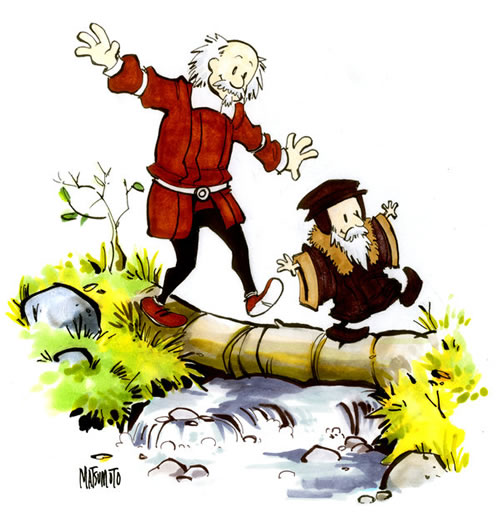
I can't avoid a Calvin and Hobbes reference.
If Ms. Griggs were awake, and aware that no fire existed, her actions would constitute murder.  But since she was asleep, and did not will to murder her child (she was trying to save the child from an imagined fire), and could not will to murder her child (since she was asleep), she was innocent of any crime.  So even secular law distinguishes between willful acts and omissions, and things which happened which we don't will.

Similarly, if a woman dies in labor, we don't accuse her child of murder.  He wanted nothing more than to be born, and could do nothing other than what he did.  Accusing him of a crime he has no control over would be barbaric.  To sentence a man to even a short stint in prison for the crime of being born would be absurd.  All the more so to sentence a man to an eternity in Hell.

I mentioned in my last post that God doesn't send tiger sharks to Hell.  It wouldn't make any sense: they're acting on blind instinct, and have no knowledge of good and evil.  The Catholic answer to Calvinism is to look to Scripture: Genesis 2:16-17 and Gen. 3:6-7 make it clear that knowledge of good and evil is a prerequisite for damnation.  And knowledge of good and evil is only a sensible prerequisite for damnation if that knowledge somehow gives you the power to choose or avoid sin.  Otherwise, countless Scriptural passages are drained of any sense.

The reader concludes:
I believe some retort to this unfairness by asking who we are to question God. While that is a very nice platitude, I believe it avoids the question. Others have challenged this by redefining hell to mean a complete abolition of mankind. Not only is the body not resurrected, but the soul is utterly destroyed. Thus, there is not a punishment that has an infinite duration, but rather a punishment that cannot be undone. Thoughts?  
This is exactly the reason that I believe that the Puritans became Unitarians.  They started out as Calvinists, realized that their doctrine of double predestination appeared to make God quite evil, and sought to soften it by imagining that since God controls everyone's eternal fate (and free will is illusory), then He'd just steer everyone to Heaven.  I find it fascinating that this reader started with the same false premise (that God wills some to go to Hell) and ended up rationalizing it in the same way (maybe an eternal Hell doesn't exist).  It certainly reinforces the Puritan to Unitarian argument, I'd say.

Family Radio: The Newest Layer of Crazy

0 comments
As most of you likely remember, the Rapture-obsessed group Family Radio, headed by Harold Camping, claimed that the Bible "guaranteed" that the Rapture and Judgment Day would occur on May 21, 2011.  I live-blogged the coming and going of May 21 at the time.  Needless to say, their predictions (even promises) of what the Bible guaranteed were false.


For most people, this would be a red flag.  Obviously, Camping is a crackpot.  And it should have been a call to repentance.  This was a group which had no problem claiming that anyone who didn't accept the interpretation of Scripture which they developed on their own was going to Hell.  When that interpretation of Scripture was shown to all the world, in a public and humiliating way to be false, they should have rent their garments and found an authentic shepherd who knew what the heck he was talking about.

Instead, Camping just re-invented what May 21 was all about.  This is a sure mark of pride.  Rather than admit that they were wrong, they're simply moving the goal posts and acting like they weren't publicly exposed as ignorant of the plans of God.  What I hadn't realized was how bad it had gotten. Now, Family Radio made two predictions which were easily proven false:
  1. That there would be global earthquakes;
  2. That all the "true" Christians (those who bought into Camping's nonsense, and rejected the Church) would be bodily assumed into Heaven in the "Rapture."
Both of these were obviously false prophesies.  You don't need to be a member of their group to know whether or not there were a bunch of earthquakes on May 21 (nope), or whether 3% of the world's population disappeared on that day (nope).  But here's what Family Radio is teaching these days:
Thus we have learned that except for a somewhat different understanding of the words “earthquake” and “rapture” or “catching up” no other past teachings of Judgment Day or the end of the world have been changed. The time line, the certainty of it, the proofs, and the signs are all precisely the same. No other past teachings have been changed or modified. Indeed, on May 21 Christ did come spiritually to put all of the unsaved throughout the world into judgment.
That's right: they were still right, it's just that and “earthquake” and “rapture” don't mean what you think they mean. By "earthquake," it turns out that they really meant that "All of mankind was shaken with fear. Indeed the earth (or mankind) did quake in a way it had never before been shaken."  This is an "earthquake," since man is formed from the earth (no, really, their teaching is that bad).  Even if you buy into the idea that "earthquake" means "manquake," mankind wasn't shaken with fear - at most, they were shaking with uncontrollable laughter, as Camping and Co. made Christianity look idiotic. So even under their modified "prophesy," they're still wrong.  That's astonishing, really -- they're making "prophesies" after the event in question, and still can't make them true.

Much more troubling, where we jump from "stupid" to "evil," is their claim that because of the invisible Rapture,  no one else can be saved, ever again:
The second word, “rapture,” identifies with the idea of the completion of God’s salvation program. The catching up of all the elect meant that there was to be no more salvation activity to be done anywhere in the world by God. Each and every true believer had become eternally safe with God in Heaven. No more was there any aspect of God’s salvation program that remained to be done. But the same thing became true this past May 21, even though no one was raptured. No one who had not become saved by that date can ever become saved. 
Here's an obvious question: why bother running the radio show at all, then?  It's literally doing no good, even if Family Radio is right. We've now reached the end-point in the absurdity of double-predestination.  Nothing anyone does from now until the end of time will have an iota of an effect.  The elect are already saved in such a way that even their rejection of Christ won't matter; and Christ will do nothing to save the damned now. As for the end of the world, here's their new and improved end-times vision:
Thus we can be sure that the whole world, with the exception of those who are presently saved (the elect), are under the judgment of God, and will be annihilated together with the whole physical world on October 21, 2011, on the last day of the present five months period. On that day the true believers (the elect) will be raptured. We must remember that only God knows who His elect are that He saved prior to May 21.
So you're either going to Heaven or Hell, there's nothing, not a single thing, you can do about it, and you've got no way of knowing which way you're going.

In a single movement, Camping manages to combine the worst elements of Protestantism:

  • the "you're going to Hell, and Jesus won't ever save you, no matter what you do" of hyper-Calvinism,
  • the "of course Christ wants to come back in my lifetime" eschatological narcissism of Rapture Evangelicalism, and 
  • the refusal to admit error in the face of false prophesies of Seventh Day Adventism, Jehovah's Witnesses, and sinful man generally.

The fortunate thing, of course, is that October 21, 2011, isn't very long from now.  I look forward to the day, very soon, when Family Radio is brought to humiliation once again.  But I look forward to it precisely because these are well-meaning Christians being lead astray by Camping's insane teachings.  Once Family Radio can no longer cling to its pride, can no longer simply reinterpret the prophesies it's constantly sure of, perhaps then we can draw Camping's followers to a firmer foundation of their faith. Their fervor, such as it is, is admirable.  But they've put their trust in princes (Psalm 146:3), rather than taking refuge in the LORD (Psalm 118:9).