Are the Infancy Narratives Historically Reliable?

0 comments
Nick, the atheist whose original arguments I addressed here, returned with better ones. Specifically, he points to seeming contradictions in the Infancy Narratives:
Marten de Vos, Nativity of Jesus (1577)
I'm sure you're aware that the [G]ospels were written long after the death of Jesus and also after the epistles of Paul, which mention none of the alleged facts of Jesus' life. They were also copied and recopied by scribes that could have had their own religious agendas. 
The question is about Jesus' birth followed by Herod's massacre. Now through my research Ive found that when the [G]ospels were written, many years after Jesus' death, nobody knew when he was born. Jews expected the Messiah to come from Bethlehem (Micah 5:2) but John's [G]ospel specifically remarks that he was born in Galilee and not Bethlehem. 
To fix this detail Matthew and Luke handle the problem differently and have him getting there by different routes. Matthew has Mary and Joseph in Bethlehem all along, moving to Nazareth long after the birth of Jesus. Luke, by contrast, acknowledges that Mary and Joseph lived in Nazareth before Jesus was born. 
Luke says that Caesar Augustus decreed a census and everyone had to go 'to his own city'. Joseph was of the house of David and therefore had to go to Bethlehem. This seems odd because why would the Romans require Joseph to go to the city where David lived a millennium earlier? Moreover, the census decreed by Caesar Augustus wasn't made until AD 6, long after Herod's death. Why the glaring contradictions? 
Shouldn't that throw up a red flag that Matthew traces Joseph's decent from King David via 28 intermediate generations, while Luke has 41 generations? Could it not be possible that these two different views were a desperate attempt to fulfill the prophecy of Micah, while tactlessly mentioning events that historians are capable of independently checking?
We should realize at the outset that this whole line of argument presupposes that Jesus historically existed. That is, it presupposes that there was a Jesus of Nazareth, creating the historical problem of how to also present Him as Jesus of Bethlehem. If Jesus were a myth, they could have just set the story in Bethlehem to begin with.  So I don't think atheists can grant the historicity of Jesus of Nazareth for purposes of these types of questions, and then retracts that historicity when it suits them.  In other words, the nails are in the coffin on Nick's first arguments (that Jesus was a repackaged Egyptian or Greek or Roman myth).

Having said that, Nick really raises nine separate issues worth addressing:
1. I'm sure you're aware that the gospels were written long after the death of Jesus and also after the epistles of Paul, which mention none of the alleged facts of Jesus' life.
The Gospels were probably written a few decades after the Death and Resurrection of Christ, but still within the span of time in which plenty of eyewitnesses were alive.  And it's true that St. Paul’s letters almost certainly come first.

It's a gross exaggeration to say he mentions “none of the alleged facts of Jesus’ life,” but it’s true that he doesn’t dwell on many of the details prior to His death and Resurrection.  That makes sense, though. Paul is writing in response to specific controversies facing the early Church.  He's not writing to pagans who need to learn about who Jesus is.  He's writing to existing Christians. So he skips a lot of the background, because they already know it.

In other words, he's writing apologetics, not a biography.  The Gospels are the biographies of Christ.  You don't see a lot of biography in Paul's letters, or a lot of apologetics in the Synoptic Gospels, but that's because they're different genres of Books.
2. They were also copied and recopied by scribes that could have had their own religious agendas.
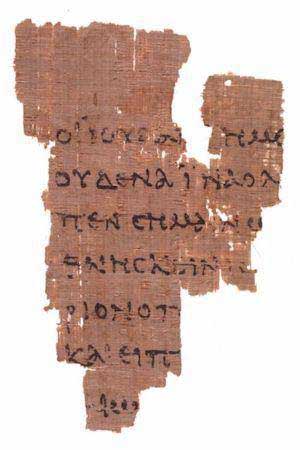
Early-Second Century Parchment
Containing Part of John 18
There were, quite quickly, numerous copies of the various New Testament writings spread throughout the entire known world. So even if an unscrupulous scribe had attempted to add or alter some details, it’d be obvious, since the rest of the manuscripts would remain the same.  And we have really ancient manuscripts of certain parts of the New Testament, and don't see evidence of tomfoolery when compared to the modern copies.
3. The question is about Jesus' birth followed by Herod's massacre. Now through my research I've found that when the [G]ospels were written, many years after Jesus' death, nobody knew when he was born.
I don't know that it's true that “nobody knew when He was born,” and I don't know what sort of research could ever hope to prove that.  It is, in any case, largely irrelevant.  We’re dealing with where Jesus was born, not when.

The Gospels never tell us the exact day (or even year) when He was born, but they do tell us where. And that’s a very knowable detail. In particular, the Gospel of Luke seems to be based off of Mary’s own account: there are a number of details only she witnessed, and not found elsewhere.  I'm sure Mary would recall what city she birthed the Savior in.
4. Jews expected the Messiah to come from Bethlehem (Micah 5:2) but John's [G]ospel specifically remarks that he was born in Galilee and not Bethlehem.
No. John’s Gospel specifically remarks that some people in the crowd didn’t believe Jesus was the Messiah, because they didn’t think He was from Bethlehem (John 7:42). Neither Jesus nor John endorses this error.

In fact, in context, it doesn’t even make sense to say that John thinks the crowd is right here. Are we to understand that John, whose Gospel is written last, and was written that we might believe in Christ (John 20:30-31) just mentioned in passing, “Oh, by the way, this isn’t the Messiah promised in Scripture”?
5. To fix this detail Matthew and Luke handle the problem differently and have him getting there by different routes. Matthew has Mary and Joseph in Bethlehem all along, moving to Nazareth long after the birth of Jesus. Luke, by contrast, acknowledges that Mary and Joseph lived in Nazareth before Jesus was born.
It doesn’t work to say that Matthew and Mark are trying to fix a problem in John’s Gospel, since his Gospel wasn’t written yet. And it’s not true that Matthew “has Mary and Joseph in Bethlehem all along.” All we know is that at the time Jesus was conceived, Mary and Joseph did not yet live together, but that Joseph took her into his home thereafter (Matthew 1:24). No details on whether that was in Nazareth or Bethlehem. The first time the two are mentioned in Bethlehem is Matthew 2:1, at the time of Jesus’ birth.
6. Luke says that Caesar Augustus decreed a census and everyone had to go 'to his own city'. Joseph was of the house of David and therefore had to go to Bethlehem. This seems odd because why would the Romans require Joseph to go to the city where David lived a millennium earlier?
When it says he’s of the “house of David,” it’s explaining who his family is. Namely, they’re the direct descendants of David, who was from Bethlehem.  Many of these descendants probably still lived near their ancestral home.  The world was somewhat less transient then, and being the descendant of an important person can tie you to the area a bit more.  For example, you can still find some descendants of the Pilgrims living in Boston.  So St. Joseph was almost certainly from Bethlehem, which explains why they're going back there.
7. Moreover, the census decreed by Caesar Augustus wasn't made until AD 6, long after Herod's death. Why the glaring contradictions?
I don’t know where Nick got that information, but it’s mistaken.
8. Shouldn't that throw up a red flag that Matthew traces Joseph's decent from King David via 28 intermediate generations, while Luke has 41 generations?
No. Abraham is also referred to as the “father” of various people in the New Testament. It’s a common Semitism: “brother” could mean cousin or nephew, “father” could mean great-great-great grandfather, etc. Matthew highlights some of the big names, choosing fourteen (seven twice) for each epoch of Jewish history. He even says as much: “fourteen generations in all from Abraham to David, fourteen from David to the exile to Babylon, and fourteen from the exile to the Messiah” (Matthew 1:17). Luke goes into more depth.
9. Could it not be possible that these two different views were a desperate attempt to fulfill the prophecy of Micah, while tactlessly mentioning events that historians are capable of independently checking?
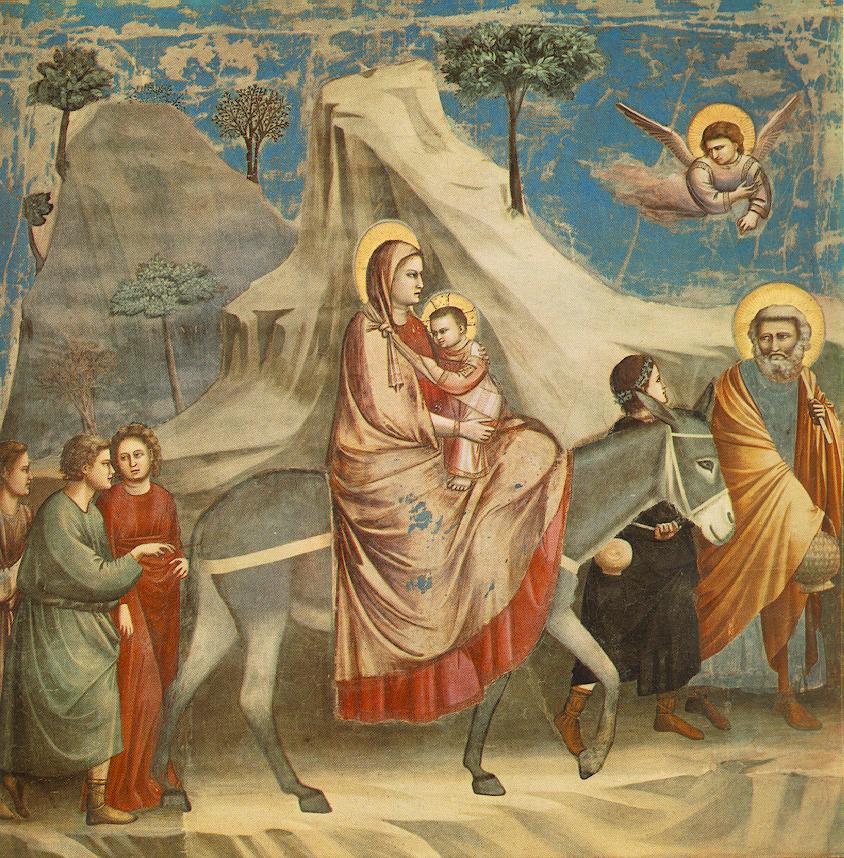
Flight to Egypt, Giotto (14th c.)
Is it possible? Sure, if one denies Scriptural inspiration. Is it likely? No.  After all, if Jesus were simply a myth, why not just make Him from Bethlehem?  And why would John purposely undermine the Infancy Narratives of Matthew and Luke, if he's writing to encourage faith in Christ?  This explanation of the facts presented in the Gospel is incredibly convoluted.

Taking the account at face value, on the other hand, works seamlessly.   Mary and Joseph lived in Nazareth, but moved back to Joseph's hometown of Bethlehem during the census enrollment.  They fled Israel during Herod's persecution, but returned after his death, settled in Nazareth.  I imagine that plenty of people reading this can relate: growing up in one city, moving to the other as an adult, perhaps moving back and forth a couple times throughout adulthood, particularly when it comes time to start a family.  I'd say that this version -- that is, that the Gospel writers aren't lying -- rings truer on a number of levels than the accounts that seek to write this off as a conspiracy.

Any Interest in a Shameless Popery Book or e-Book?

0 comments
A few of you have approached me in the past about this topic, but I wanted to open this up to general discussion.  If I put together a book and/or an eBook, would any of you be interested in buying it?  Most likely, I'd take material I've already written for the blog, lay it out in a more straightforward format, and combine it with some additional original content.

Here's what I'm looking to find out from you:

  1. How interested or uninterested are you in this?  (Please, be honest!  If interest levels are low, that could save a lot of unnecessary hassle).
  2. What topic or topics would you most like to see addressed?
  3. What's your preference on the format?  Do you prefer traditional books over e-books?
  4. How long should the book be?  
I can't promise I'll take every suggestion, but it'd certainly be helpful for me!

Signs the Recession is Finally Hitting the D.C. Area

0 comments
This has nothing to do with Catholicism, but I found it funny.  I took this picture in the Metro station at Pentagon City.  See if you can figure out what's going on (I explain below):


So a company advertising their temporary-placement services planned for a three-panel add boasting of their intelligence.  But either they couldn't afford all three ads, or the person in charge of putting them up screwed up, but they got two-third of the way through the word, before getting rudely interrupted by Demi Moore on behalf of Ann Taylor.  Either way, the company comes off looking pretty unintellige

Jesus and Mithras, Debunked

0 comments
On his Facebook page, my friend Cary laid out C.S. Lewis' trilemma: that given everything we know about Him, Jesus must be Lord, liar, or lunatic.  You can't just write Him off as a “good teacher.” One of his atheist friends, Nick, responded:
How about thief? Similiar [J]esus like stories, ones that predate the life of [J]esus, exist in pagan and egyption culture. Look it up if feel so inclined to test your faith. Just remember religion is believed by common people to be true, by the wise to be false, and by the rulers to be...useful. What is your choice?
That possible (that Christ is just another in a series of myths) is considered in Msgr. Ronald Knox's expanded version of the trilemma, laid out in Belief of Catholics: he also addresses the notion that Christ was just a “guru” head-on.  I asked Nick for specific examples supporting his claim, and he gave me this:
Let's start with a list of things that come from paganism or other cultrures that predate [C]hristianity; the timing of the two biggest pagan holidays with the birth and death of [J]esus, the concept of [H]eaven, hell, prophecies, sacrifice, baptism, communion with [G]od through a holy meal, immortality of the soul and virgin births. Gods that are similar to [J]esus include mithrus, dionysus, attis, osirus and orpheus. Any mediterranean religion has its own similarities. [...] Ohh and I almost forgot, [C]hristmas trees and [E]aster eggs are also pagan traditions
I've run into this argument numerous times, and it's all smoke, no fire. I answered a Protestant variation of it before (in which John MacArthur claimed everything distinctively Catholic comes from Babylonian paganism).  But because I think it's easily debunked, and because it's a surprisingly popular argument by atheists, it seems fitting to address it directly.

I. Just How Similar Are These Stories?

The first thing to recognize is that, almost without exception, neither the atheist nor the Christian in the conversation know anything about Mithras, Dionysus, Attis, Osiris, Orpheus, or any of the other names the atheist will drop.  Without picking on Nick too much, he couldn't even spell two of the names.  That's not unusual.  People who know what they're talking about in this area don't raise this argument against Christianity.

Here's why.  From the Wikipedia summary of the myth of Attis:
In the late fourth century a cult of Attis became a feature of the Greek world. The story of his origins at Agdistis, recorded by the traveler Pausanias, have some distinctly non-Greek elements: Pausanias was told that the daemon Agdistis initially bore both male and female attributes. But the Olympian gods, fearing Agdistis, cut off the male organ and cast it away. There grew up from it an almond-tree, and when its fruit was ripe, Nana who was a daughter of the river-god Sangarius picked an almond and laid it in her bosom. The almond disappeared, and she became pregnant. Nana abandoned the baby (Attis). The infant was tended by a he-goat. As Attis grew, his long-haired beauty was godlike, and Agdistis as Cybele, then fell in love with him. But the foster parents of Attis sent him to Pessinos, where he was to wed the king's daughter. According to some versions the King of Pessinos was Midas. Just as the marriage-song was being sung, Agdistis/Cybele appeared in her transcendent power, and Attis went mad and cut off his genitals. Attis' father-in-law-to-be, the king who was giving his daughter in marriage, followed suit, prefiguring the self-castrating corybantes who devoted themselves to Cybele. But Agdistis repented and saw to it that the body of Attis should neither rot at all nor decay.
That has.... nothing to do with Christianity?  Seriously, where are the parallels between that and the Life, Death, and Resurrection of Christ, as reported in the Gospels?

You could do the same thing for Osiris, Orpheus, etc.  The cult of Mithras did have similarities with Christianity, but it was a pagan imitation of Christianity, created after the time of Christ.  So in a nutshell,  the pre-Christian accounts are all unmistakably different, and quite radically so, while the post-Christian account is an initiation of Christianity, rather than the reverse.


II. Just How Bad is This Methodology?

To show why I think this is a bad argument against the historicity of Christ, let's use it to “debunk” the existence of someone we know to be real: Mohandas Gandhi.

Step 1: To start with, find a lot of remarkably-similar sounding events between the lives of two historical figures.  This is what conspiracy theorists have already done (quite impressively) for the Kennedy and Lincoln assassinations.  For our purposes, just look a the surface similarities between Gandhi and Jesus:
Never existed, apparently.
  • Born in Asia, left, and returned through Africa.  Gandhi was born in India, left, and returned by way of Africa (South Africa).  Jesus was born in Israel, left, and returned by way of Africa (Egypt).
  • Born in countries oppressed by European imperialists.  India at the time of Gandhi's birth was under British rule.  Israel at the time of Christ's birth was under Roman rule.
  • Both were charismatic leaders viewed as a threat by the imperial powers-that-be.  The British and Romans weren't exactly keen on Gandhi or Jesus, respectively.
  • Both preached a radical message of non-violence.
  • Both were viewed as spiritual-political figures.  The followers of both Jesus and Gandhi treated them as both religious or political leaders, simultaneously.
  • Both alienated many of their followers in the same two ways.  Specifically, many Hindus were upset about Gandhi's message of radical non-violence, even against the British imperialists, and upset that Gandhi seemed too friendly with a hated religious minority (the Muslims).  Many Jews were upset about Christ's message of  radical non-violence, even against the Roman imperialists, and upset that Jesus seemed too friendly with a hated religious minority (the Samaritans).
  • Both were betrayed, to their deaths, by those they were saving.  Judas and Nathuram Godse.
These were just the basic ones that I could come up with. If you dive in deeper, I'm quite sure that you can find some pretty remarkable-seeming similarities.

For example, after receiving a donation from a poor old woman, Gandhi said, “This copper coin is worth much more than those thousands. If a man has several lakhs and he gives away a thousand or two, it doesn’t mean much. But this coin was perhaps all that the poor woman possessed. She gave me all she had. That was very generous of her. What a great sacrifice she made. That is why I value this copper coin more than a crore of rupees.”

A strikingly similar event happens in the life of Christ, as recounted in Luke 21:1-4:
As He looked up, Jesus saw the rich putting their gifts into the temple treasury. He also saw a poor widow put in two very small copper coins. “I tell you the truth,” he said, “this poor widow has put in more than all the others. All these people gave their gifts out of their wealth; but she out of her poverty put in all she had to live on.”
Other than a tiny detail (one copper coin or two?), it appears to be the same story. All said, these similarities are much closer than the similarities between Jesus Christ and Attis, for example.

Step 2: According to the atheist argument, a real-life person can't share a lot of biographical details that are similar to an earlier myth or history.  So we have to conclude from all of these similarities that either (a) the New Testament is plagiarized from the life of Gandhi, or the life story of Gandhi is just a re-telling of the Christ story.  

Step 3: Since the New Testament is a couple thousands of years older, we've now  “debunked” Gandhi's existence.  After all, if the existence of a couple of (incredibly generic) similarities between the Gospels and the Attis mythos disproves Christ, then the far more extensive similarities between the Gospels and the life of Gandhi disproves Gandhi.  

Bonus: We could do this for a lot of other figures as well.  For example, Napoleon was the non-Frenchman (a Corsican) who rose to command a ruthless French Empire.  Hitler was the non-German (an Austrian) who rose to command a ruthless German Empire.  Stalin was the non-Russian (a Georgian) who rose to command a ruthless Russian Empire.  All of them are obviously just re-tellings of the story of Alexander the Great, right?

III. Fun with Calendars


Virtually every ancient culture had its own calendar.  Anyone who tells you that a Jewish or Christian holiday falls on “the same day” as some other culture's holiday is almost certainly wrong, for no other reason.  In almost every case, you'll discover that it was just a holiday that occurred sometime in the spring, or  sometime in the winter.

For example, this year, Channukah falls on December 21, while it falls on November 28th in 2013.  In other words, you can wax conspiratorial about Channukah-Christmas connections this year, and Channukah-Thanksgiving connections in two years.

Finally, consider the number of ancient cultures in the world, and the sheer number of deities worshiped in some time or place.  Now consider the number of days in a year.  Find me a day of the year -- any day -- that isn't the anniversary of some pagan holiday or another.  This is particularly true in the spring and fall, since they're naturally connected with life and death in an agrarian society (not, mind you, because they stole that from some older myth, but because that's what crops do in the spring and fall).

Having said that, let's look at Easter and Christmas, the two holidays that Nick claims coincide, timing-wise with the two biggest holidays in paganism (apparently, all pagans now use the same calendar, and share the two biggest holidays).

Easter is tied quite explicitly with the Jewish Passover in the New Testament.  Jesus' Death and Resurrection are linked to the Passover chronologically (John 19:14, etc.), and both John the Baptist (John 1:29) and St. Paul (1 Corinthians 5:7) explicitly tie Jesus' Atonement with the sacrifice of the Passover lamb.  And the Passover had been tied for thousands of years to the Jewish calendar (Leviticus 23:5), not to anything from Egyptian or Greek paganism.

The date for Christmas isn't found in Scripture, but was customarily celebrated about nine months after Easter, out of an old Jewish custom.  The date of December 25 is also significant, since it makes January 1 the day that Jesus formally became a Jew (Luke 2:21).  It's a new beginning.  In other words, all of these dates make sense for a religious group that originated in Judaism, but used a Roman calendar.  Which is exactly what happened with the Christians.

IV. Plundering the Egyptians

So none of the events from the life of Christ are borrowed from paganism.  Whether some later Christian customs are is an interesting subject to debate, I guess, but doesn't really matter.  Or put another way: even if the Christians did take the idea for beautiful Christmas trees from Germanic pagans, what does that prove one way or another about Jesus?

In Spain, many of the churches used to be mosques, from the time of the Moorish invasion.  Much of the art is Islamic, with tessellations to represent the infiniteness of God (since tessellations are patterns continuing on in every direction, forever).  After expelling the Moors, the Christians kept the art. Why?  Because it was beautiful.  Did that mean that they suddenly treated the Qu'ran as equal to the Bible?  Obviously not.

Here, I'll point again to Reformation Day.  As I've noted, some Protestants celebrate Reformation Day on October 31, in order to celebrate something (that they find) wholesome, instead of celebrating something (that they find) evil.   The term for this is “plundering the Egyptians” (a sly allusion to Exodus 12:35-36). It's when you take the best of what others have to offer, even if they're you're enemies.

Even if we discover that the Christians plundered the Egyptians, taking some of the best of what pagan cultures had to offer, without falling into paganism themselves, that's not a mark against Christianity, much less against Christ Himself. Just shows that Christians are a much more open-minded lot than atheists give us credit for.

V. Conclusion

If you're talking to an atheist who raises this, odds are good that he got his misinformation from an Internet movie called Zeitgeist that's been repeatedly debunked by Christians.  If not, he probably got it from someone blindly regurgitating the information.  It's a funny irony.  He's willing to swallow hook, line, and sinker the most absurd of historical claims, yet claims the title of “skeptic,” and derides Christians for our alleged gullibility.

What's important here is that this an argument from scholarship.  That is, the atheist side claiming that historical scholarship proves that a-historical nature of Jesus Christ.  Yet, as William Lane Craig has noted in numerous debates with atheists, this theory isn't even widely accepted among most liberal Biblical scholars today.  As we've seen, it relies upon (a) terrible methodology, (b) a number of outright falsehoods about history, and (c) a misrepresentation of what a number of ancient myths actually taught. This just isn't a serious argument against Christianity, and it's long past time that atheists who insist upon debating religion learned something about the subject.

Reflecting on the Parable of the Talents: You Are Not St. Francis

0 comments
Yesterday's Gospel, the parable of the talents (Mt 25:14-30), has some interesting elements: the Master gives one servant 5 talents, another servant 2 talents, and the third servant 1 talent.  .  Talents, if you're not familiar, are a unit of currency (which we'll get to below).  The first two servants invest these talents, doubling their investments, while the third, out of fear of his Master, buries the talent in the ground.  The Master rewards the first two, while punishing the third harshly for not investing his talent.

Fr. Robert J Carr had some great reflections on this Gospel.  First, he explained first that, roughly speaking, “a talent was 15 years worth of salary” (it's 80 pounds of silver, or 6,000 denarii, and a day's wage was one denarius).  In today's money, assuming a year's salary at about $40,000, a single talent is worth $600,000, then.  Reconsider the parable in that light.  In other words, when the Master gives 5, 2, and 1 talents, he's giving about $3,000,000, $1,200,000, and $600,000, respectively.  It's easy to pity the guy with only one talent, until you realize just how many gifts he's been given.  

Jesus uses these extravagant amounts of wealth to symbolize just how blessed each of us has been in our own lives.  This wasn't lost on the early Christians.  Just look at the English words talented and gifted.  Each of them is a recognition that the skills that we have are a blessing from God, and that this is the sort of blessing that the parable of the talents is really about.  And remember this, too.  Even if we're the least skilled Christian on Earth, we possess something infinitely more valuable than silver in our Baptism.  In the words of one of the best hymns of the twentieth century, “we can only wonder at every gift You send, at blessings without number and mercies without end.”

And the success these servants have with their talents is extravagant, too.  The two who actually invest the money get returns of 100%. There's a lesson here, as well.  When we put our God-given talents to His use, He'll aid us, and we'll get returns on them beyond what we'd ever imagine.

This probably never happened to you.
So the question then becomes, how do we respond to these extravagant blessings?  Do we use them for the glory of God?  Or do we complain that we only got $600,000, rather than the $3,000,000 our neighbor got? Do we use our mere one talent as an excuse not to invest?  In the words of Fr. Carr, “You are not St. Francis, but that does not give you the excuse to be any less a servant of God. If we turn around and say that the Lord did not invest us with a heroic amount of holiness as we see in the saints, that does not give us a reason to live not holiness to the fullness of our ability in His grace, regardless of circumstances.”

Instead, each of us is called to holiness in a unique and personal way.  While He's given some more talents than others, in His Justice, those to whom much has been given, much will be expected (Luke 12:48).  So the servant who was given two talents returned with four, and was richly blessed for this.  That wouldn't have worked for the servant given five talents: he would have actually reported a loss (and just look how the Master responded to the servant who broke even!).  There's an important lesson here, too.  It's easy to get discouraged that we don't have the sanctity of the greatest Saints in history.  But God isn't expecting that of us.  From the servant He gave one talent, He's just asking him to return with two.

So given how richly every one of us has been blessed, and given the way that God will assist us in even the smallest task done for His Glory, we need to seriously examine whether we're using the talents we've been given.  I'll leave it for Fr. Carr to lay out the tough talk:
If you are not praying and seeking to grow in prayer, you are burying for gift of holiness. 
If you are not living the liturgical life of the Church, you are burying your gift of holiness. 
If you are not seeking to go beyond the minimum, you are burying your gift of holiness. 
If you are not evaluating your life and seeking to improve on your witness to Christ, you are burying your gift of holiness. 
If you are not participating in the sacraments, which include reconciliation and when applicable marriage you are burying your gift of holiness. 
If you are living less than what the teachings of the Church call us to, you are burying your gift of holiness. 
Each of these are difficult in one sense, but remember Jesus calls us to remember that He is like a difficult master who reaps what he does not sow, and harvests what he does not plant. 
However, when we participate in His gift, we are rewarded with sharing in His joy. His joy is found not only in us, but in others who also join God’s kingdom because of us. 
Now, in this last Sunday we celebrate in green for this year, may look at ourselves in preparation for Advent in two weeks and ask, where do we need to grow in the grace of God? Where do we need to be stronger in holiness? Where do we need to bear more fruit? And bring the answer to our reflection to Christ in search for His grace to change our lives. 
Let us seek the reward that is waiting us by asking the Lord to grace us with the wisdom to give Him a return on his investment in us. That we too may share our master’s joy.

New Media and the 2011 Fall General Assembly

0 comments
The U.S. Conference of Catholic Bishops are holding their fall General Assembly today and tomorrow, the first since Abp. Dolan was elected USCCB president. The agenda looks interesting:
The meeting will include the presidential address of Archbishop Timothy Dolan of New York, the election of the USCCB secretary-elect and the chairmen-elect of several committees, a vote on whether to add the memorial of Blessed John Paul II and Blessed Marianne Cope, a presentation on the Project Rachel post-abortion healing ministry and other items.
I've been impressed with the bishops' use of New Media (no big surprise, given how strong a believer Abp. Dolan is in using every available means of proclaiming the Gospel). The General Assembly is being broadcast by satellite, so you might see if you can catch it on TV. It's also being live streamed here.

Or if you'd just prefer to catch the highlights, check out USCCB Live on Twitter, or the Twitter accounts of some of the bishops there, like Bishop Steib of Memphis, and Auxiliary Bishop Coyne of Indianapolis. If you know of any others actively tweeting, let me know in the comments.  Also, Michael Myers of SEO Tech Bench is following coverage closely, so feel free to check him out, too.

The General Assembly can be important, a place for the bishops of the country to pray and talk with one another about some of the major issues facing them.  I'm thankful that they're giving us a peek inside that world, and I'm hopeful that it won't harm their ability to speak candidly about tough issues. This is a good time to pause and pray for our bishops, and that the Holy Spirit can draw many positives out of this General Assembly.   Lead, Kindly Light!

The Orthodox Question: Why Catholic and Not Eastern Orthodox?

0 comments
At some point, many people considering the Catholic Church face this question: “Why become Catholic, and not Eastern Orthodox?”

After all, Orthodoxy can look mighty appealing. You get a lot of the things that are desirable in Catholicism -- Apostolic Succession, visible authority, ecclesial unity, Tradition, beautiful Liturgy -- without having to accept the pope or some of the Marian dogmas.  Sure, the Orthodox aren't quite in full communion with the Catholic Church, but they're close enough that, in the past, we've celebrated in the same churches.

From a Catholic perspective, converting from Protestantism to Orthodoxy is a move deeper into full Catholic union, in a way that converting from one Protestant denomination to another is not.  For that reason, I've been a bit hesitant to answer the “why not Orthodox?” question, for fear of making the perfect the enemy of the good.  As far as I can tell, we affirm everything that they affirm.  We just affirm more, and often in different language. So let's look at a few of the things that the Orthodox affirm, and what the means for the question of being Catholic.

I. What the Orthodox Affirm

These are points that I've seen broadly conceded.  Because Orthodoxy is significantly less cohesive than Catholicism, I can't guarantee that a given Orthodox believer will affirm these.  But here goes:

(1) Rome was Founded by St. Peter and St. Paul

Constantinople claims Apostolic Succession through the Apostle Andrew.  Rome has Apostolic Succession through both the Apostles Peter and Paul.  Both the Eastern Orthodox and the Catholic Church acknowledge each other's Apostolic origins, and express this in a particularly beautiful tradition.  As Cardinal Seán O’Malley explains:
Duccio's Calling of the Apostles Peter and Andrew (c. 1310)
The patriarch [Ecumenical Patriarch Bartholomew of Constantinople, the highest ranking member of the Eastern Orthodox Church] is very, very supportive of the cause of Christian unity. Each year he sends representatives to Rome for the feast of Sts. Peter and Paul. In addition, he receives the pope’s representatives on the Feast of St. Andrew. The brothers Sts. Peter and Andrew represent the Catholic and Orthodox Churches.
This symbolic act already symbolizes an acknowledgement that Saints Peter and Paul founded the See of Rome (as countless early Christian sources attest).  And Ecumenical Patriarch Bartholomew has not been shy on this point.  In 2007, when the pope's delegation arrived to celebrate the Feast of St. Andrew, he said:
Today's celebration is an invitation extended to both our Churches to the unity of the Cross. Just as our Lord Jesus Christ stretched out his arms upon the cross, uniting all that was formerly divided, so also his apostle, in imitation of his Master, stretched out his arms, gathering us all today and calling us to stretch out our arms upon the cross spiritually in order to achieve the unity that we desire.

Elder Rome has the foremost St. Peter as its apostle and patron. New Rome, Constantinople, has the brother of St. Peter, the first-called of the apostles, Andrew. Both invite us to the fraternal unity that they shared with each other and that can only be acquired when the cross becomes our point of reference and experience of approach. 
Let us, therefore, beseech these two brothers and greatest of apostles that they may grant peace to the world and lead everyone to unity, in accordance with the particularly timely troparion (hymn) today of St. Symeon Metaphrastes, Archbishop of Thessalonika: 
"You, Andrew, were first-called of the apostles;
Peter was supremely honored among the apostles.
"Both of you endured the cross of Christ,
Proving imitators of your Lord and Master,
And one in mind and soul. Therefore, with him,
As brothers, grant peace to us. 
Amen.
The Ecumenical Patriarch's recognition of his own See, Constantinople, as New Rome, leads to my second point.

(2) Historically, Constantinople was Second to Rome

The four original Patriarchal Sees were all Petrine.  Jerusalem is where Peter first preached on Pentecost (Acts 2).  He then established the Church at Antioch.  He then established the Church at Rome, along with St. Paul.  His disciple, the Evangelist Mark, founded the Church at Alexandria.  Constantinople was added as a fifth Patriarchate, a controversial move initially opposed by the pope (but eventually accepted).  From Canon 3 of the First Council of Constantinople in 381:
Let the Bishop of Constantinople, however, have the priorities of honor after the Bishop of Rome, because of its being New Rome.
But in the controversy over adding a fifth Patriarchate (and above Jerusalem, Antioch, and Alexandria at that), one thing was clear. Rome was number one.  Canon 3 only reaffirms this.  Constantinople leap-frogs over Jerusalem, Antioch, and Alexandria, but it is explicitly second to Rome.  And its claim to fame for being one of the Patriarchates at all is because of its connection to Rome.  As the Protestant scholar Phillip Schaff noted:
It should be remembered that the change effected by this canon did not affect Rome directly in any way, but did seriously affect Alexandria and Antioch, which till then had ranked next after the see of Rome. When the pope refused to acknowledge the authority of this canon, he was in reality defending the principle laid down in the canon of Nice, that in such matters the ancient customs should continue. Even the last clause, it would seem, could give no offence to the most sensitive on the papal claims, for it implies a wonderful power in the rank of Old Rome, if a see is to rank next to it because it happens to be “New Rome.” Of course these remarks only refer to the wording of the canon which is carefully guarded; the intention doubtless was to exalt the see of Constantinople, the chief see of the East, to a position of as near equality as possible with the chief see of the West.
So the entire controversy over Constantinople's place can't obscure a central fact: the Roman See was number one in the world.

So the Orthodox acknowledge that in the ancient Church, Peter was the first of the Apostles, and the Roman See was the first of the Church.  Some sort of primacy existed.  Any Orthodox denying this is denying what the Ecumenical Patriarch concedes, or what the First Council of Constantinople concedes.

II. How to Resolve the Orthodox Question

Both Catholics and Orthodox understand the laity as the sheep to be led by God's shepherds. The job of the laity isn't to settle all the world's theological disputes, but to have faith in what the Church teaches.  But which shepherd do the sheep follow if they start going in different directions?  I see three possible ways of determining an answer:
  1. Option 1: Follow your local bishop
  2. Option 2: Resolve each dispute on your own
  3. Option 3: Follow the See of Rome

Options 1 and 2 are very problematic.  And all three of these point towards the Catholic Church.

(1) Follow your local bishop

With Option 1, if the Orthodox bishops of Australia and New Zealand broke off communion, accusing each other of schism or heresy, the Orthodox believers of those countries would divide along nationalist lines.

This is problematic for two reasons.  First, regardless of which side was right, this approach would require laity on one of the two sides to embrace schism or heresy.  Second, Pope Benedict is Patriarch of the West.  So if you want to follow Option A, and you live in the West, go with the pope.

(2) Resolve each dispute on your own

Option 2 is the knee-jerk response by both Protestants, and Westerners generally: asking, “What do I think?” 

There are two problems.  First, it's fundamentally inconsistent with the ecclesiology proclaimed by either the Orthodox or Catholic Church.  In neither Church is the laity left as the final authority on theological disputes.  This creates an immediate problem. If you should only follow the episcopacy if they're right, and it's up to you to determine they're right, who's leading who?  If the laity are going to be left to figure theology out on their own, much of the purpose of the visible Church is thwarted.  

Second, this points to Catholicism anyways.  Given everything that the Orthodox admit about Rome being founded by Peter, and about it historically holding a global primacy, the only remaining question is this: Was Peter merely primus inter pares (“first among equals”), or was he tasked with a ministry overseeing the other Apostles?  An Orthodox priest, Fr. John Maxwell, put the argument this way:

If the Roman view is to be believed, it is interesting to note that when the disciples disputed among themselves as to who would be the greatest, (Lk. 22:24-27), they seemed unaware that Christ had already picked Peter.

But look at the part Fr. Maxwell cites, in the broader context of Lk. 22:24-32:
A dispute also arose among them, which of them was to be regarded as the greatest. And he said to them, "The kings of the Gentiles exercise lordship over them; and those in authority over them are called benefactors. But not so with you; rather let the greatest among you become as the youngest, and the leader as one who serves. For which is the greater, one who sits at table, or one who serves? Is it not the one who sits at table? But I am among you as one who serves. 
"You are those who have continued with me in my trials; and I assign to you, as my Father assigned to me, a kingdom, that you may eat and drink at my table in my kingdom, and sit on thrones judging the twelve tribes of Israel. 
"Simon, Simon, behold, Satan demanded to have you [plural], that he might sift you like wheat, but I have prayed for you [singular] that your faith may not fail; and when you have turned again, strengthen your brethren."
This looks very much like Peter was given a ministry to the other Apostles.  In fact, Jesus essentially says as much, using the language of commission.  So Peter had a special place that wasn't merely honorary, but an additional commission. That's the Catholic argument.

Additionally, Peter has the ability to speak on behalf of the Twelve, as he did in Acts 2, and Matthew 16:15-16, and so forth.  In fact, I did a five part series on Peter's role in the early Church (starting here, with the passage I just quoted).  So I think Catholics can makes a very compelling case for Peter's eclessial headship.  In other words, I think option 2 points towards the Catholic Church, too.

(3) Follow the See of Rome

If the Orthodox are right that Peter is the first of the Apostles (in some sense), that Peter founded and was the patron saint of the Church of Rome, and right that Rome was the first of the Churches (again, in some sense), then it would seem logical that if there was a dispute, believers should follow Rome.

This is also the only option that doesn't guarantee Schism. Let me be more clear on that:
Benjamin West,
St. Peter Preaching at Pentecost
  • Under Option 1, any time a bishop or group of bishops goes into schism, the laity are dragged along.  The Body of Christ is torn apart, along juridical lines, into large chunks (which, of course, is exactly what happened with the Nestorian Schism and the East-West Schism).
  • Under Option 2, the whims of each Christian justify schism, so the Body of Christ is torn apart, along individual lines, into really tiny chunks (which, of course, is  exactly what happened in the aftermath of the Reformation)
  • Under Option 3, the whole Church stays together, holding to the faith of Rome.
So if Christ's prayer for Church unity (John 17:20-23) is to be fulfilled, Option 3 appears to be necessary.  

I anticipate at least one objection: but what if the Roman See goes into schism?  The answer is easy.  If God can preserve the Church collective in the faith, preventing an Apostasy, He can certainly preserve the local Roman church in the faith.  In fact, for His promises to be meaningful, the Truth must not just be out there somewhere, but must be capable of being found by Christian believers.